fetching data ... 
Background: In the last decades, Systemic Lupus Erythematosus (SLE) pregnancies outcome has greatly improved thanks to pregnancy planning, preconception counselling, multidisciplinary follow-up and increasing number of compatible drugs. However, patients are burdened by an increased risk of disease flares and adverse maternal-fetal events.
Objectives: The aim of this study was to assess how SLE pregnancies management has changed over time and how this has affected the maternal-fetal outcome.
Methods: We conducted a retrospective observational study comparing SLE (ACR 1997 and/or SLICC 2012 criteria) pregnancies prospectively followed in our pregnancy clinic in two different time periods: Group 1 (1988-2012) versus Group 2 (2013-2022). Twin pregnancies were excluded. Data were collected from preconception throughout the three trimesters. Statistical analysis was performed using Mann-Whitney, Fisher or chi-square test when appropriate. p<0.05 was considered significant.
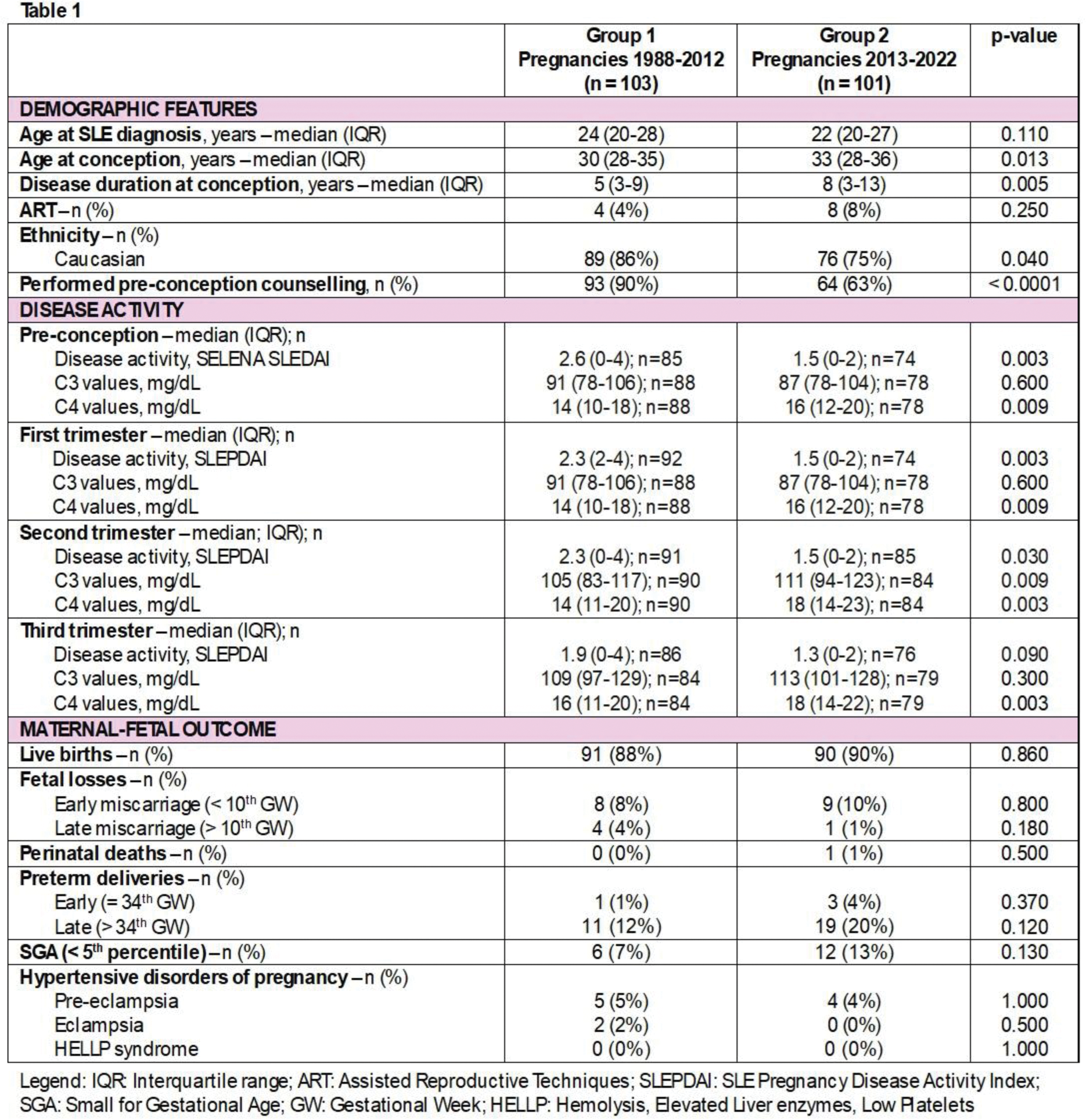
Results: 204 pregnancies in 141 SLE patients were included. Compared to Group 1 (n=103), Group 2 (n=101) showed higher age at conception (30 vs 33 years; p=0.013), lower frequency of Caucasian patients and lower rate of performed preconception counselling (90% vs 63%, p<0.0001) (Table 1). Moreover, pregnancies in Group 2 showed:
lower median disease activity (SLEPDAI score) and higher median C4 levels in each trimester (Table 1);
higher rate of hydroxychloroquine usage (66% vs 92%; p<0.0001);
lower rate of glucocorticoids usage (84% vs 67%; p=0.011) with lower median weekly dose (50mg vs 25mg; p<0.00001).
No statistically significant differences were observed in terms of disease history, pattern of organ involvement, immunosuppressive treatment and maternal-fetal outcome between the two groups (Table 1).
Conclusion: Our data show how the approach to SLE pregnancies management has changed over time thanks to increasing knowledge and awareness in this field, as highlighted by recent recommendations. Despite the decreased usage of glucocorticoids, the increased usage of hydroxychloroquine and the general lower disease activity observed in more recent pregnancies, the maternal-fetal outcome was not found to be improved. This can be related to a lower rate of preconception counselling (probably due to the increasing number of patients referred to our pregnancy clinic when already pregnant) but also to the higher age and longer disease duration at time of conception as well as to the higher number of non-Caucasian patients, that are known to have a more difficult-to-treat disease because of ethnicity and social status. Notably the percentage of live births was high in both groups and the number of complications was low.
REFERENCES: NIL.
Acknowledgements: NIL.
Disclosure of Interests: None declared.
© The Authors 2025. This abstract is an open access article published in Annals of Rheumatic Diseases under the CC BY-NC-ND license (