fetching data ... 
Background: Radioisotopic synoviorthesis is a minimally invasive treatment used for the management of refractory synovitis in patients with inflammatory and degenerative arthritis. This intra-articular procedure, which uses radioisotopes to induce synovial fibrosis and reduce inflammation, has emerged as an effective option in cases where conventional therapy has failed¹. However, evidence based on clinical practice is limited.
Objectives: To assess efficacy and safety of radioisotopic synoviorthesis in patients with synovitis refractory to conventional treatments. To evaluate its impact on symptom control and recurrences after the procedure.
Methods: A retrospective longitudinal study from a cohort of 57 patients treated with radioisotopic synoviorthesis for arthritis refractory to conventional treatments. Sociodemographic data, clinical and radiological characteristics, diagnoses, treatments and complications were collected. Clinical response evaluation included parameters such as pain reduction, inflammation and recurrence. Data on cases requiring subsequent surgery and the years to intervention were also collected. The correlation between recurrence and non-recurrence with different diseases was analysed using the chi-square test.
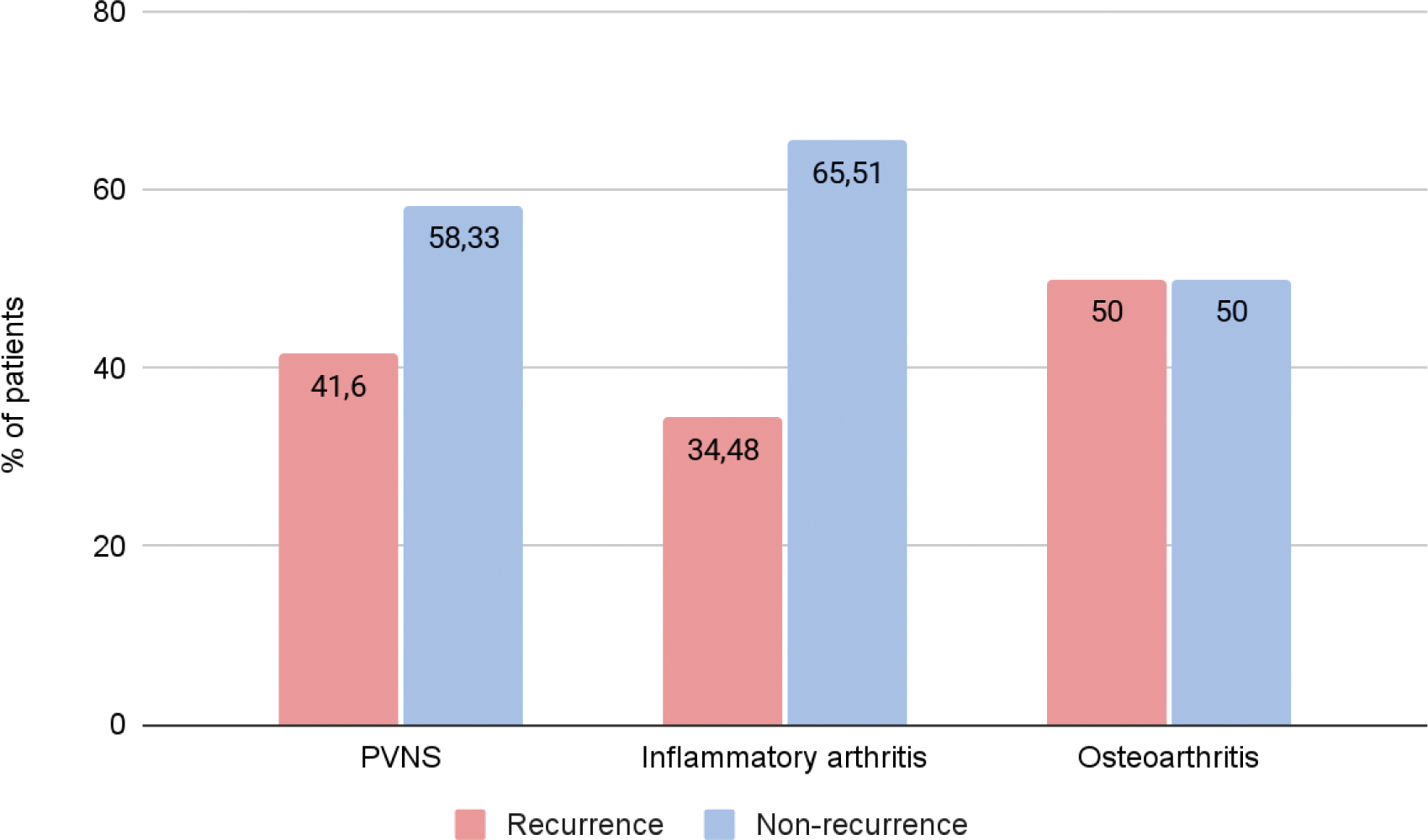
Results: A total of 69 radioisotopic synoviorthesis were performed on 57 patients (28 women/29 men). Demographic, clinical and treatment characteristics are summarised in Table 1. The diagnosis of pigmented villonodular synovitis (PVNS) was 42.10%, rheumatoid arthritis (RA) 12.28%, spondyloarthritis (SpA) 10.50%, systemic lupus erythematosus (SLE) 3.50%, gout 1.75%, osteoarthritis 7.01% and unspecified arthritis 22.80%. Diagnosis was made by magnetic resonance imaging (MRI) in 92.98%, the most frequent finding being synovial hypertrophy (58.92%), followed by cystic bone lesions (39.28%) and erosions (30.35%). The joint with the highest number of synoviorthesis performed was the knee (89.47%). The most commonly used radioisotope was Ytrium-90 (89.47%). At six months, 66.66% showed improvement compared to 29.82% who showed no clinical changes. None of them experienced complications related to the procedure. The relationship between synovitis recurrence and different diseases was analysed, separating PVNS from inflammatory arthritis (RA, SpA, SLE, gout, unspecified arthritis). However, non-statistically significant association was found (p=0.801).
General features of 57 patients treated with radioisotopic synoviorthesis.
| Overall (n=57) | |
|---|---|
| Main general features | |
| Age (years), mean±SD | 53.14 ± 15.34 |
| Sex (women/men), n (% of women) | 28/29 (49.12) |
| Disease duration since diagnosis, years, mean±SD | 10.07 ± 7 |
| Delayed axSpA diagnosis, years, median (IQR) | 0.72 ± 0.14 |
| Diagnosis n(% ) | |
| Pigmented villonodular synovitis | 24 (42.10) |
| Rheumatoid arthritis | 7 (12.28) |
| Spondyloarthritis | 6 (10.52) |
| SLE | 2 (3.50) |
| Gout | 1 (1.75) |
| Osteoarthritis | 4 (7.01) |
| Unspecified arthritis | 13 (22.80) |
| Clinical presentation, n% | |
| Tender joint | 57 (100) |
| Swollen joint | 51 (89.47) |
| Hemarthros | 4 (7.01) |
| Radiological features, n% | |
| MRI diagnosis | 53 (92.98) |
| Erosions | 17 (30.35) |
| Synovial hypertrophy | 33 (58.92) |
| Cystic bone lesions | 22 (39.28) |
| Joint localization, n% | |
| Knee | 51 (89.47) |
| Ankle | 3 (5.26) |
| Shoulder | 1 (1.75) |
| MCP | 2 (3.50) |
| Drugs from the disease diagnosis | |
| NSAIDs, n(%) | 55 (96.49) |
| Corticoesteroids, n(%) | 29 (50.87) |
| Corticoesteroid injection, n(%) | 34 (59.65) |
| Number of corticoesteroid injections, mean±SD | 1.44 ± 1.44 |
| cDMARDs | 18 (31.57) |
| Patients on bDMARDs | 15 (26.31) |
| JAKi | 2 (3.50) |
| Isotopic Synoviorthesis | |
| Type of isotope, n(%) | |
| Yttrium-90 | 51 (89.47) |
| Rhenium-186 | 5 (8.77) |
| Erbium-169 | 1 (1.75) |
| Immediate complication, n(%) | 0 (0) |
| Evolution at 6 months (improvement/no changes), n(% of improvement) | 38/17 (66.66) |
| Recurrence, (n%) | 22 (38.59) |
| Number of synoviorthesis, mean±SD | 1.21 ± 0.41 |
| Surgical treatment, n(%) | 12 (21.05) |
| Years until surgery, mean±SD | 3 ± 2.26 |
Number of recurrences and non-recurrences of the different diseases.
Conclusion: Radioisotopic synoviorthesis is an effective and safe tool for the management of refractory synovitis, especially in patients with inflammatory arthritis who do not respond to conventional treatments. This study reinforces its usefulness in clinical practice, although further studies are needed to validate these findings and determine predictors of response.
REFERENCES: [1] Castro Corredor D, Martínez Bravo WR, Ramírez Huaranga MA, Mateos Rodriguez JJ. La sinoviortesis radioisotópica en el control de la sinovitis refractaria enCastillaLa-Mancha. Una experiencia de 10años. Rev Reumatologia Clinica; 2019; 6(6):485-489.
Acknowledgements: NIL.
Disclosure of Interests: None declared.
© The Authors 2025. This abstract is an open access article published in Annals of Rheumatic Diseases under the CC BY-NC-ND license (