fetching data ... 
Background: Psoriatic arthritis (PsA) is a chronic immune-mediated disease with a highly heterogeneous clinical presentation, from peripheral inflammatory arthritis, spondylitis, enthesitis, dactylitis and nail disease to cutaneous psoriasis. Its burden on quality of life is significant, not only due to physical dysfunction but also its psychosocial impact and frequently associated comorbidities. To optimize the clinical and therapeutic approach to this disease, as with many other rheumatic conditions, there has been growing interest in developing composite, multidimensional instruments that are all-encompassing in quantifying disease-related dysfunction. The protean nature of PsA naturally makes it even more challenging to detect all disease manifestations in a single scoring system. Patient-reported outcomes (PROs), unlike physician-based outcome measures, capture the patient’s perspective and are an essential component of efficacy endpoints in clinical trials and clinical practice. PsA Impact of Disease (PsAID) is a PRO developed by EULAR, whose 12-question version (PsAID-12) comprises 12 weighted domains examining various disease perspectives. Its utilization in Portuguese PsA patients remains limited and its efficacy in identifying meaningful differences among patients remains to be fully elucidated in diverse clinical settings.
Objectives: To evaluate, in a real-life setting, the efficacy of the PsAID-12 questionnaire in capturing disease impact in Portuguese psoriatic arthritis patients by comparing its association with other widely used patient-reported outcomes.
Methods: This was a retrospective observational study including all adult patients with PsA followed at our centre and registered in the Portuguese Rheumatic Diseases Registry (Reuma.pt). Data were retrospectively extracted from all available entries up to December 2024, covering sociodemographic information and clinical parameters at the time of PsAID-12 score registration, as well as details on current and prior biologic treatments. Patients without at least one PsAID-12 score recorded were excluded. In cases where multiple appointments with PsAID-12 assessments were available, the most recent entry was used for analysis. For efficacy evaluation, patients were categorized into two groups based on their PsAID-12 scores: low impact (≤4) and high impact (>4). The two groups were then compared with respect to PROs scores collected in the same appointment. Categorical variables were reported as frequencies and percentages, and continuous variables as means and standard deviations (SD) or medians and interquartile ranges (IQR) for variables with skewed distributions. Comparisons between groups were carried out using the chi-squared test for categorical variables, and the Student’s t-test or Mann-Whitney U test for continuous variables, as appropriate. In a separate analysis, PsAID’s validity was also evaluated by testing its absolute value’s correlation with other PROs using Spearman correlation. Statistical significance was set at p<0.05.
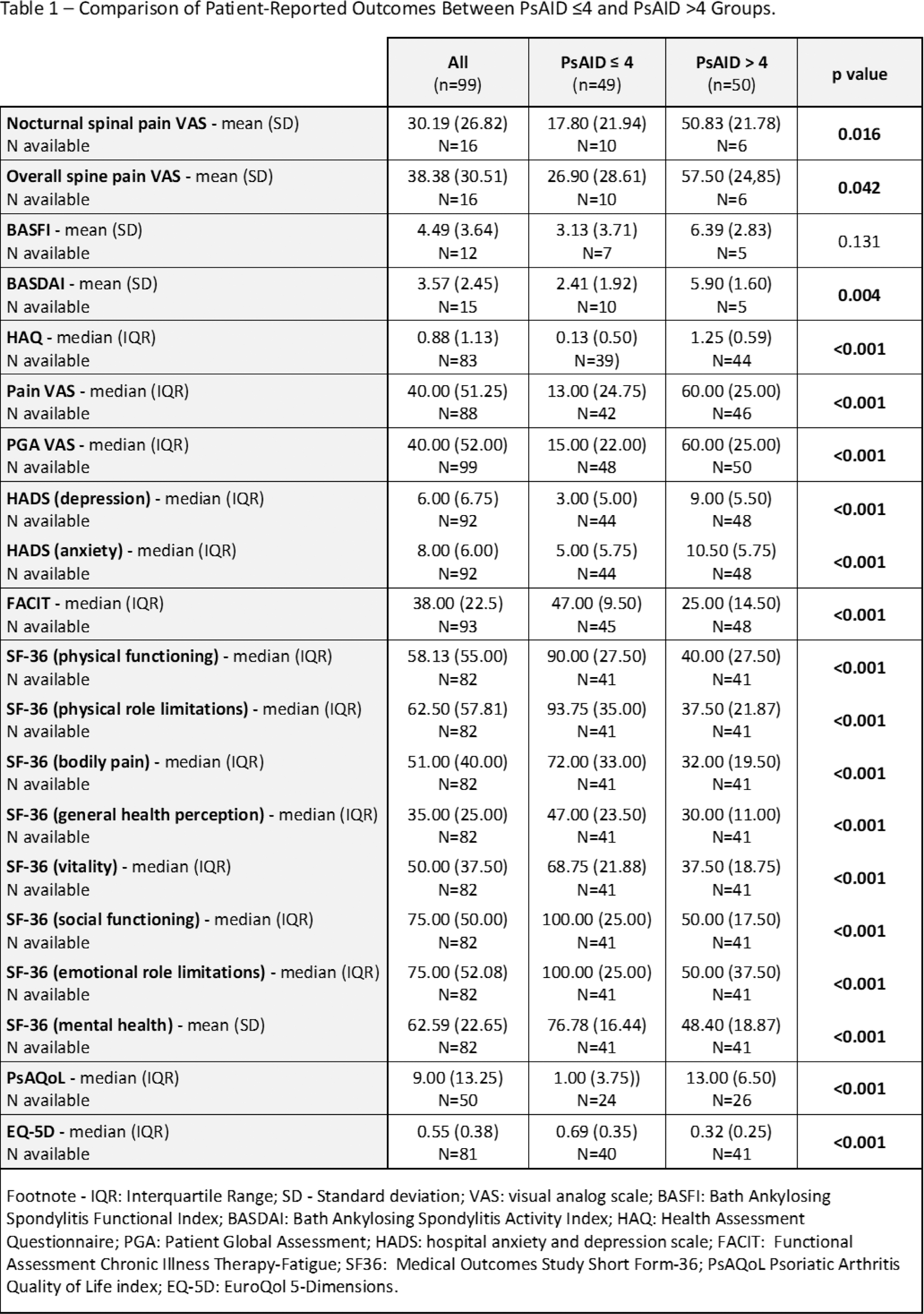
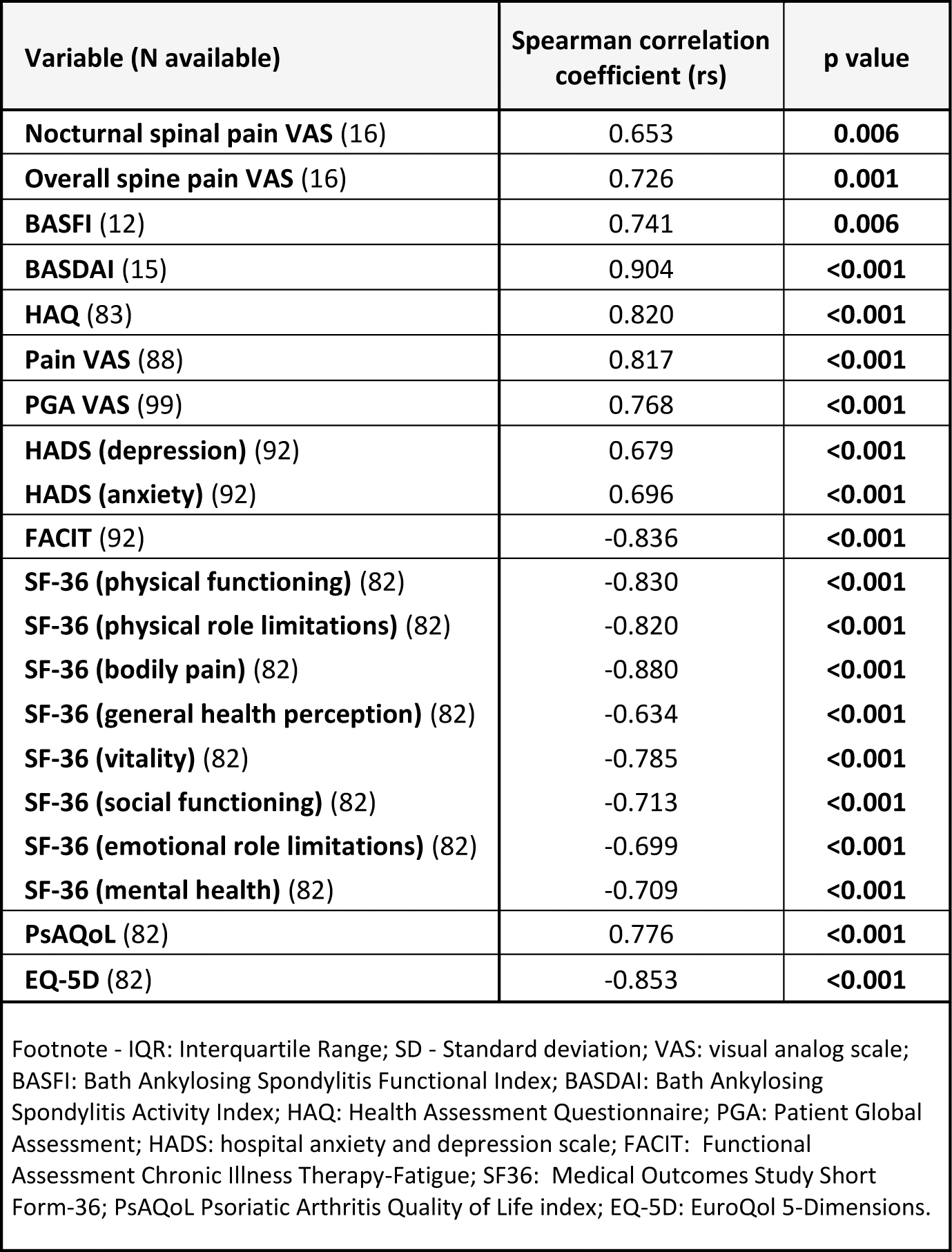
Results: A total of 99 patients were included, of whom 51 (51.5%) were female, with a mean cohort age of 50.73 ± 10.30 years and a median disease duration of 14.45 years (IQR 11.90). Regarding joint involvement patterns, 16 patients (16.2%) presented with predominant axial involvement, 52 (52.5%) had RA-like symmetric polyarthritis, and 31 (31.3%) had asymmetric oligoarthritis; of the total, 41 (41.4%) patients presented significant enthesopathy. All patients were under biological therapy, with the majority (n=71, 75.5%) receiving TNF-alpha inhibitors, adalimumab being the most frequently used drug (n=38, 40.4%). Median PsAID-12 score was 4.1 (IQR 4.05). The group with PsAID≤4 comprised 49 patients (49.5%; mean age 49.30 ± 10.72 years; 38.8% female; median disease duration of 14.45 years [IQR 11.73]), while the group with PsAID>4 included 50 patients (50.5%; mean age 52.14 ± 9.77 years; median disease duration of 14.23 years [IQR 12.31]). When comparing PROs between the PsAID ≤4 and PsAID >4 groups, significant differences were observed across multiple measures. Regarding axial disease-specific PROs, the PsAID>4 group reported significantly higher values in nocturnal spinal pain VAS (p=0.016), overall spine pain VAS (p=0.042), and BASDAI (p=0.004); similarly, in peripheral disease-oriented PROs (RA-like disease and peripheral oligoarthritis), HAQ values were significantly higher in this group (p<0.001). For the remaining PROs, applicable to all patients and including assessments of function, mental health, and daily life impact, the groups also showed significant differences: patients with PsAID>4 presented significantly higher scores in patient global assessment VAS, pain VAS, HADS (both anxiety and depression subscales) (p<0.001 for all) and PsAQoL, and significantly lower values in FACIT, EQ-5D, and SF36 (across all domains) compared to their PsAID≤4 counterparts (p<0.001 for all). PsAID also showed a statistically significant correlation with all the other PROs analysed, with the strongest correlations being those with BASDAI (r = 904; p<0.001), FACIT (r = -0.836; p<0.001), SF36-bodily pain (r = -0.880; p<0.001), and EQ5D (r = -0.853; p<0.001).
Conclusion: The PsAID-12 questionnaire demonstrated robust efficacy in capturing disease impact among Portuguese PsA patients, correlating strongly with other widely used PROs. These findings underscore its potential utility as a comprehensive tool for assessing multiple domains of disease impact in real-world clinical settings, paving the way for its broader implementation in clinical practice and research.
REFERENCES: NIL.
Acknowledgements: NIL.
Disclosure of Interests: Miguel Correia Natal: None declared, Bárbara Fernandes Esteves: None declared, Carlos Marques-Gomes: None declared, Mariana Diz Lopes: None declared, Mariana Sebastião: None declared, Inês Almeida: None declared, Lucia Costa: None declared, Georgina Terroso: None declared, Miguel Bernardes Abbvie, Janssen, AstraZeneca and Pfizer, Abbvie, Janssen, AstraZeneca, Pfizer and GSK.
© The Authors 2025. This abstract is an open access article published in Annals of Rheumatic Diseases under the CC BY-NC-ND license (