fetching data ... 
Background: In recent years, two IL-23 inhibitors (IL23i)- Goselkumab and Risankizumab, have emerged as promising therapeutic options for psoriatic arthritis patients (PsA). Clinical trials have demonstrated their efficacy in both treatment-naïve patients and those with an inadequate response to TNF inhibitors. However, real-world data on their effectiveness and long-term drug survival remain limited.
Objectives: The primary objective was to evaluate the efficacy and drug survival of two IL-23i Guselkumab and Risankizumab, in a cohort of difficult to treat psoriatic arthritis (PsA) patients, reflecting real-world clinical practice. The secondary objective was to assess the reasons for treatment discontinuation.
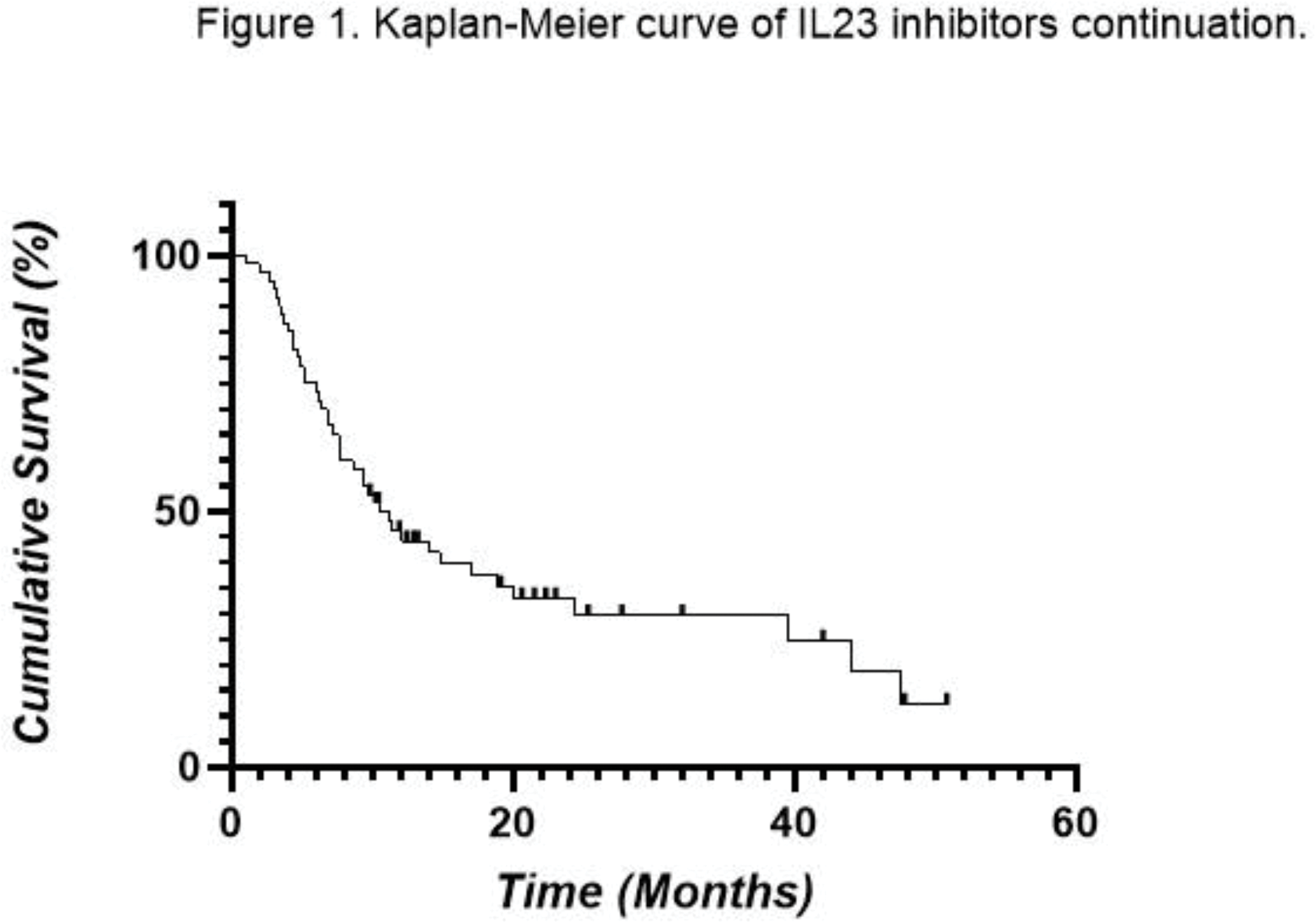
Methods: We conducted a retrospective observational study in psoriatic arthritis (PsA) patients who were under the follow-up care of the rheumatology clinic at Tel- Aviv Sourasky Medical Center. Patients initiating biologic therapy with either Guselkumab or Risankizumab between 2019 and July 2024 were included. Data were extracted from patient records and included baseline characteristics (age, sex, comorbidities, disease duration and history of prior biologic treatment (as well as details related to IL-23i therapy (treatment duration and concomitant use of cDMARDs). Disease activity scores (DAPSA and PASI) were recorded at two time points: the initiation of IL-23i treatment and the last day of follow up. The effectiveness of IL-23i was evaluated based on absolute changes in DAPSA and shifts in categorized DAPSA, ranging from complete remission (DAPSA < 4) to low, moderate, and high disease activity. For patients who discontinued therapy, the reasons for discontinuation were documented. Drug survival was analyzed using Kaplan-Meier plots.
Results: Sixty PsA patients were included, with 60% treated with Guselkumab (n=36) and 40% with Risankizumab (n=24). The median age was 51 years, approximately 48% of the patients were male, and 89% had prior exposure to biologic therapy with IL23i being the fourth or more b/tsDMARDs for 80% of patients. IL-23i were predominantly initiated as monotherapy without concomitant cDMARDs (70%). Treatment was permanently discontinued in 69% of patients, with a median treatment duration of 10.23 months (range: 1–50 months) (Treatment persistence over time is shown in Figure 1). The primary reason for therapy discontinuation was primary joint failure (58%). The mean change in absolute DAPSA score from baseline was -0.62. Most patients (58%) maintained their DAPSA categorization during treatment, while 20% exhibited an increase in their DAPSA score.
Conclusion: In this real-world cohort of difficult to treat PsA patients, IL-23i demonstrated a short drug survival time and limited effectiveness in managing joint disease.
REFERENCES: [1] Deodhar, Atul et al. Guselkumab in patients with active psoriatic arthritis who were biologic-naive or had previously received TNFα inhibitor treatment (DISCOVER-1): a double-blind, randomized, placebo-controlled phase 3 trial. Lancet. 2020.
[2] Mease, Philip J et al. Guselkumab in biologic-naive patients with active psoriatic arthritis (DISCOVER-2): a double-blind, randomized, placebo-controlled phase 3 trial. Lancet 2020.
[3] Kristensen, Lars Erik et al. “Efficacy and safety of risankizumab for active psoriatic arthritis: 24-week results from the randomised, double-blind, phase 3 KEEPsAKE 1 trial. Annals of the rheumatic diseases. 2022.
[4] Östör, Andrew et al. Efficacy and safety of risankizumab for active psoriatic arthritis: 24-week results from the randomised, double-blind, phase 3 KEEPsAKE 2 trial. Annals of the rheumatic diseases. 2022.
Acknowledgements: NIL.
Disclosure of Interests: None declared.
© The Authors 2025. This abstract is an open access article published in Annals of Rheumatic Diseases under the CC BY-NC-ND license (