fetching data ... 
Background: Vunakizumab is a recombinant humanized IgG1/κ monoclonal antibody targeting IL-17A [1]. In a randomized phase 2/3 trial, vunakizumab was well tolerated and significantly improved signs and symptoms of ankylosing spondylitis in patients with active disease [2].
Objectives: We reported here the effect of vunakizumab treatment over 32 weeks on patient-reported outcomes.
Methods: In this randomized, double-blind, adaptive, seamless, phase 2/3 trial (NCT04840485), patients with active ankylosing spondylitis were randomized to receive vunakizumab 120 mg, 240 mg, or placebo (2:2:1) in the phase 2 part and to receive vunakizumab 120 mg or placebo (2:1) in the phase 3 part at baseline and weeks 2, 4, 8 and 12. After primary efficacy assessment at week 16 (core period), patients who were originally assigned to placebo were reassigned to receive vunakizumab (1:1 to 120 mg or 240 mg in the phase 2 part; 120 mg in the phase 3 part) every four weeks through week 32 (extension period). Patients in the vunakizumab groups continued the therapy every four weeks through week 32. Patient-reported outcomes included the Bath Ankylosing Spondylitis Disease Activity Index (BASDAI), Bath Ankylosing Spondylitis Functional Index (BASFI), Short Form 36 (SF-36) physical component summary (PCS) score and mental component summary (MCS) score, Ankylosing Spondylitis Quality of Life (ASQoL) questionnaire, total back pain; nocturnal back pain, and patient’s global assessment of disease activity. The differences between vunakizumab 120 mg and placebo treatment in patient-reported outcomes (except for SF-36) at week 16 were analyzed using mixed-effects model repeated measures (MMRM), with treatment groups, visit, weight, and anti-TNF status as factors, and respective baseline score as covariates. Changes in SF-36 from baseline at week 16 were analyzed based on analysis of the covariance model. The results at week 32 were analyzed using descriptive statistics.
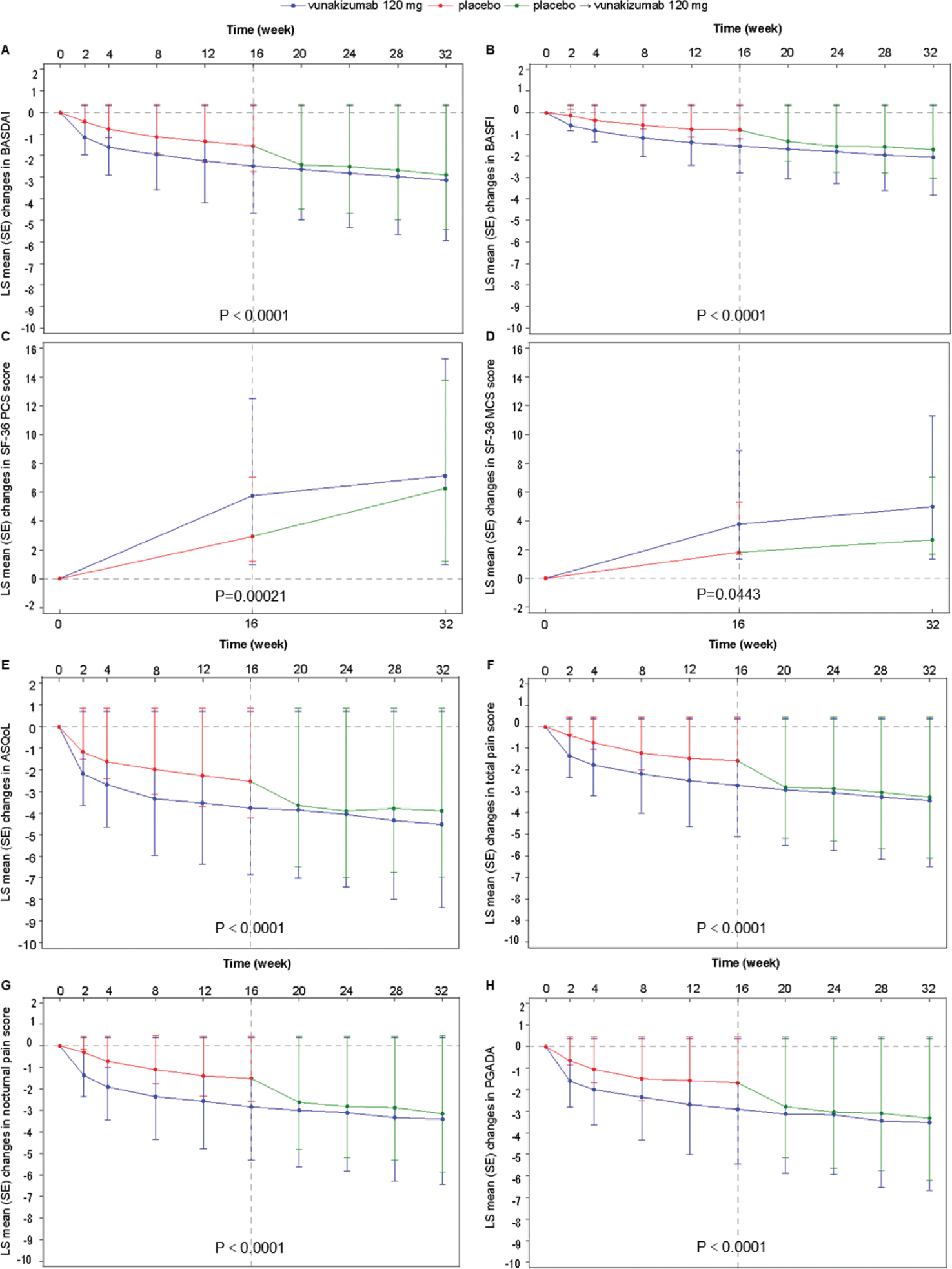
Results: Overall, 294 patients were allocated to vunakizumab 120 mg and 146 were to placebo. At week 16, patients treated with vunakizumab 120 mg showed significant improvement from baseline in BASDAI (-2.69 [1.67] vs. -1.74 [1.62], p<0.0001), BASFI (-1.72 [1.85] vs. -0.97 [1.76], p<0.0001), SF-36 PCS score (6.39 [6.58] vs. 3.64 [5.80], p=0.0002), SF-36 MCS score (3.69 [9.17] vs. 1.84 [8.54], p=0.0443), ASQoL (-3.47 [3.87] vs.-2.16 [3.69], p<0.0001), total back pain (-2.89 [2.11] vs. -1.83 [2.06], p<0.0001), nocturnal back pain (-3.06 [2.20] vs. -1.76 [2.20], p<0.0001), and patient’s global assessment of disease activity (-2.91 [2.02] vs. -1.66 [2.18], p<0.0001) when compared with patients treated with placebo. All improvements were sustained through week 32 (Figure 1).
Conclusion: Treatment with vunakizumab provides significant and sustained improvements in patient-reported disease activity, functional impairment, health-related quality of life, and pain in patients with active ankylosing spondylitis.
REFERENCES: [1] Keam SJ. Drugs 2024; 84:1481-1485.
[2] Huang F, et al. Annals of the Rheumatic Diseases 2024;83:904-905.
Least squares (LS) mean change from baseline through week 32 in the BASDAI (A), BASFI (B), SF-36 PCS score (C) and MCS score (D), ASQoL (E), total back pain (F); nocturnal back pain (G), and PGADA (H). BASDAI, Bath Ankylosing Spondylitis Disease Activity Index; BASFI, Bath Ankylosing Spondylitis Functional Index; SF-36, Short Form 36; PCS, physical component summary; MCS, mental component summary; ASQoL, Ankylosing Spondylitis Quality of Life; PGADA, patient’s global assessment of disease activity.
Acknowledgements: NIL.
Disclosure of Interests: None declared.
© The Authors 2025. This abstract is an open access article published in Annals of Rheumatic Diseases under the CC BY-NC-ND license (