fetching data ... 
Background: Enthesitis is a hallmark pathological feature of ankylosing spondylitis (AS) and is often associated with pain and a reduction in the patient’s quality of life, further exacerbating the burden of disease. Vunakizumab (SHR-1314) is a novel anti-interleukin-17A humanized monoclonal IgG1/κ antibody, which has been shown remarkable improvements in the signs and symptoms of active AS; however, its effect on enthesitis remains unknown in this population.
Objectives: The aim of this study was to explore the efficacy and safety of vunakizumab in patients with active AS and concomitant enthesitis at baseline.
Methods: This was a post-hoc analysis of a multicentre, randomized, placebo-controlled, double-blind, adaptive, seamless, phase 2/3 study. Data was derived from patients with active AS randomized to receive vunakizumab 120 mg or placebo for 16 weeks, followed by an extension of 120 mg vunakizumab treatment until week 32 for all patients. This analysis focused on those patients with concomitant enthesitis at baseline that was defined as a Maastricht ankylosing spondylitis enthesitis score (MASES) of > 0. Efficacy on enthesitis was assessed via by measuring the change from baseline in the MASES, and safety was by the incidence of treatment-relate adverse events (TRAEs).
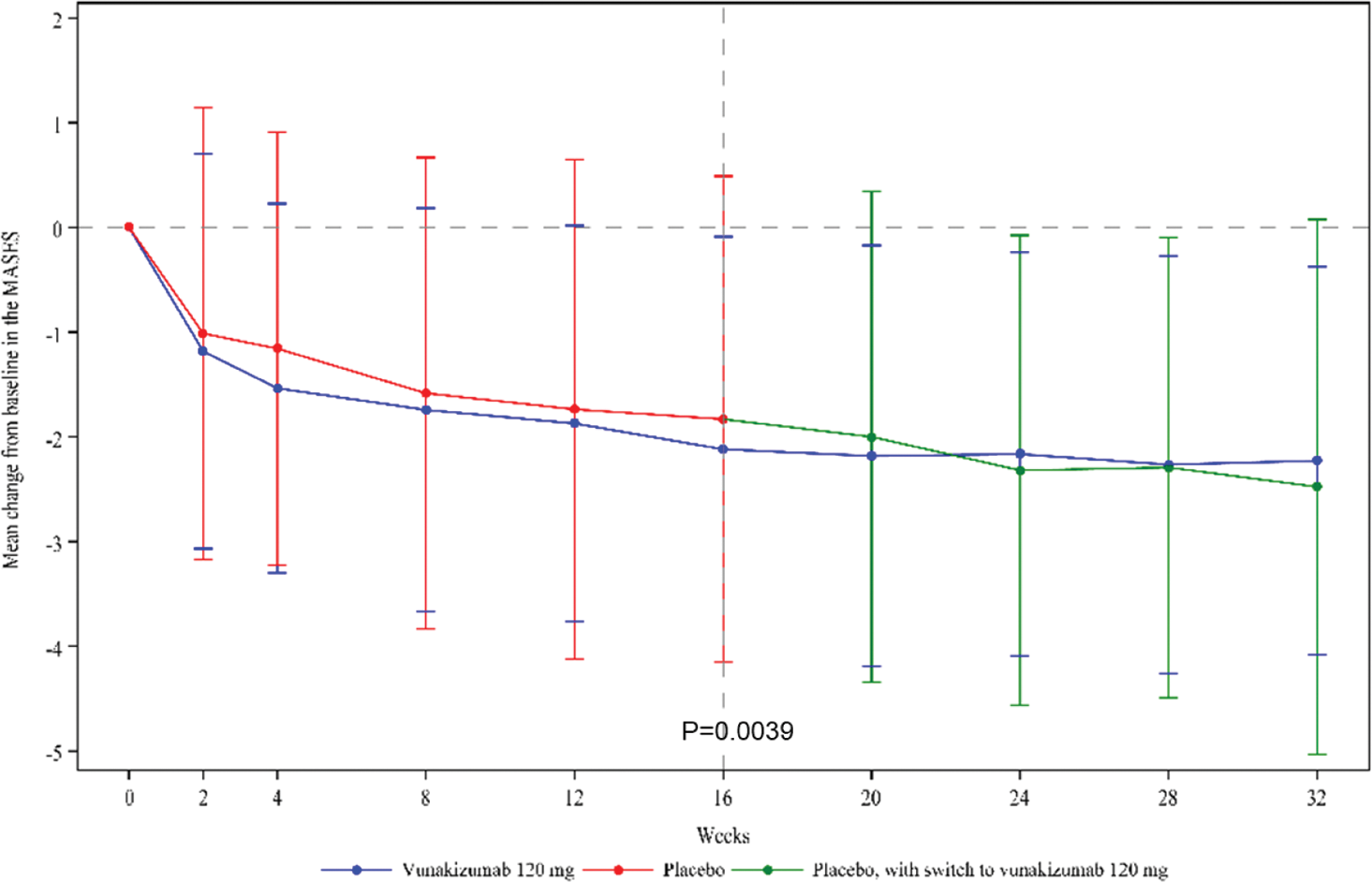
Results: A total of 256 patients with baseline MASES of > 0 were included in this analysis, with 174 patients in the vunakizumab group and 82 in the placebo group. At week 16, the mean (SD) change from baseline in the MASES was significantly greater in the vunakizumab group (-2.1 [2.03]) than that in the placebo group (-1.8 [2.32]), with the least-squares mean (LSMean) difference of -0.52 (95% CI -0.87 to -0.17, P = 0.0039; Figure 1). Additionally, at week 16, a significant increase in the complete resolution (CR) of enthesitis (i.e., MASES = 0) was observed in the vunakizumab group compared to that in the placebo group (58.6% [95% CI 50.9 to 66.0] vs. 40.2% [95% CI 29.6 to 51.7]; odds ratio 0.5 [95% CI 0.3 to 0.8], P = 0.0073). Patients who switched from placebo to vunakizumab at week 16 had a comparable outcome to those who continued on vunakizumab in terms of mean (SD) change from baseline in MASES at week 32 (-2.2 [1.85] vs. -2.5 [2.60]; LSMean difference -0.01 [95% CI -0.38 to 0.36]; Figure 1). At week 32, 62.6 % (95% CI 55.0 to 69.8) of patients in the vunakizumab group and 53.6% (95% CI 41.2 to 65.7) of patients switching from placebo to vunakizumab achieved CR of enthesitis. Regarding TRAEs, the incidence rates were 66.1% (115 of 174) in the vunakizumab group and 58.5% (48 of 82) in the placebo group, with the most common being upper respiratory infection (22.4% vs. 15.9%), alanine aminotransferase increased (11.5% vs. 9.8%) and injection site reaction (9.2% vs. 2.4%). No treatment-related deaths occurred.
Mean change from baseline in the MASES over the overall 32-week treatment period.
Conclusion: This post-hoc analysis showed that vunakizumab 120 mg significantly improved enthesitis, as measured by the MASES score, in comparison to placebo at week 16 in patients with active AS. Furthermore, subsequent switching from placebo to vunakizumab also resulted in considerable improvement in enthesitis in this population.
REFERENCES: NIL.
Acknowledgements: NIL.
Disclosure of Interests: None declared.
© The Authors 2025. This abstract is an open access article published in Annals of Rheumatic Diseases under the CC BY-NC-ND license (