fetching data ... 
Background: Belimumab, a human immunoglobulin G1-lambda (IgG1λ) monoclonal antibody that selectively binds to soluble B-lymphocyte stimulator (BLyS), was approved by the China National Medical Products Administration as add-on therapy for adult patients with active systemic lupus erythematosus (SLE) in 2019, and for paediatric patients with active SLE in 2020. Approval for paediatric patients in China was based on extrapolated data from mainly Western paediatric patients [1] and global studies in adult patients, including Northeast Asia [2-4]. This Phase 4 open-label study evaluated the efficacy and safety of intravenous (IV) belimumab in Chinese paediatric patients with SLE, where data are limited.
Objectives: To evaluate efficacy and safety of IV belimumab plus standard therapy (ST) in Chinese paediatric patients with active SLE.
Methods: This was a multicentre, single-arm, prospective, 52-week study (GSK Study 213560; NCT04908865) of belimumab 10 mg/kg IV in Chinese paediatric patients aged 5–17 years with active SLE, defined as a Safety of Estrogens in Lupus Erythematosus National Assessment-Systemic Lupus Erythematosus Disease Activity Index (SELENA-SLEDAI) score ≥8 at screening. Belimumab 10 mg/kg IV (plus ST) was administered on Days 0, 14, 28 and then every 28 days to Week 48. The primary efficacy endpoint was the proportion of SELENA-SLEDAI responders (≥4-point reduction from baseline) at Week 52. Secondary efficacy endpoints included: the change from baseline at Week 52 in Physician Global Assessment (PGA), Parent Global Assessment (ParentGA) and daily glucocorticoid (GC) dose (prednisone-equivalent); the proportion of patients with SELENA-SLEDAI flare index (SFI) flare (any flare: mild/moderate or severe) and severe flare over 52 weeks, including time to first on-study flare. The primary safety endpoint was the incidence of adverse events (AE) of special interest (AESI) through 52 weeks. Descriptive statistics were used to summarize the occurrence of AESIs, AEs, and serious AEs (SAE).
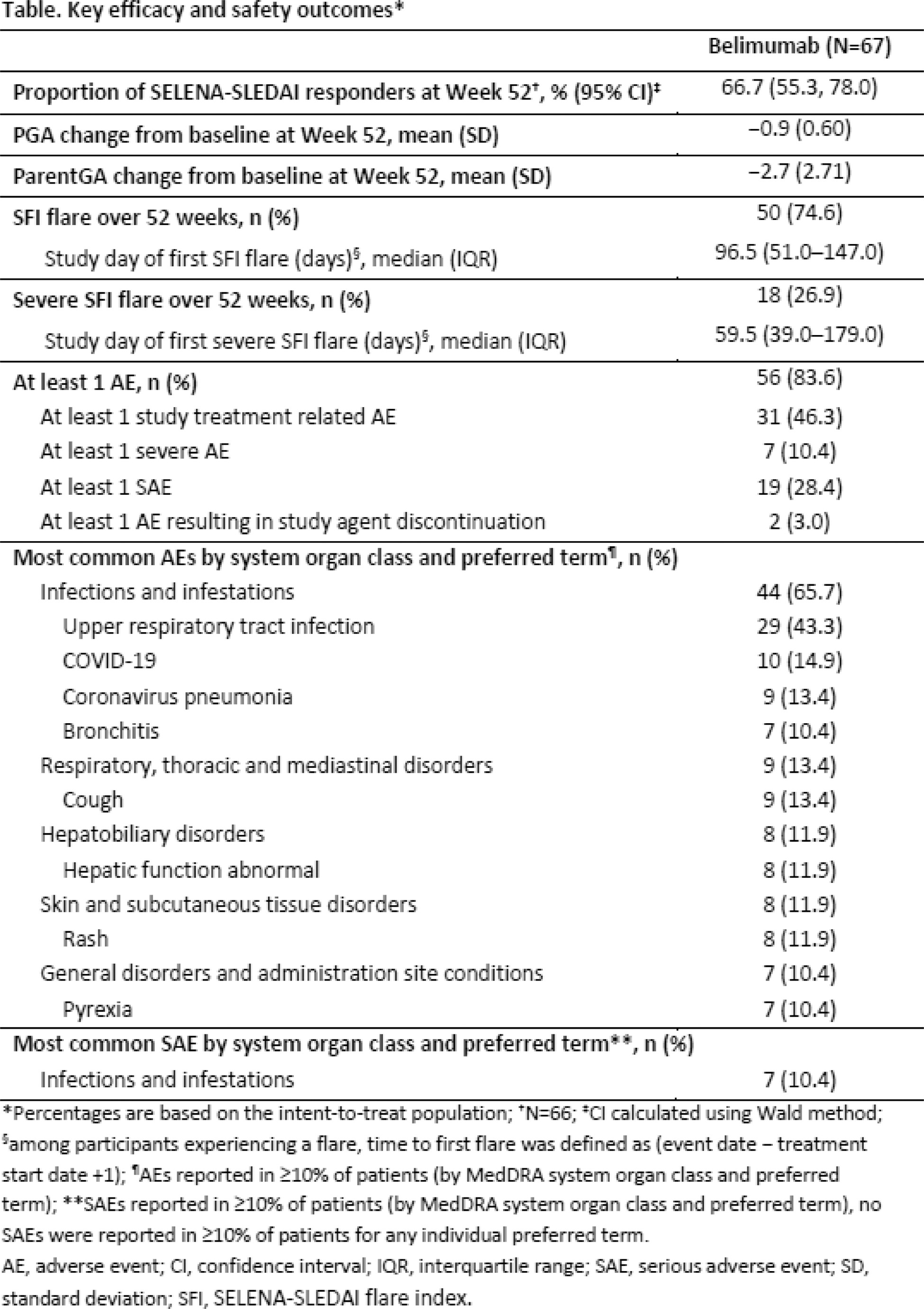
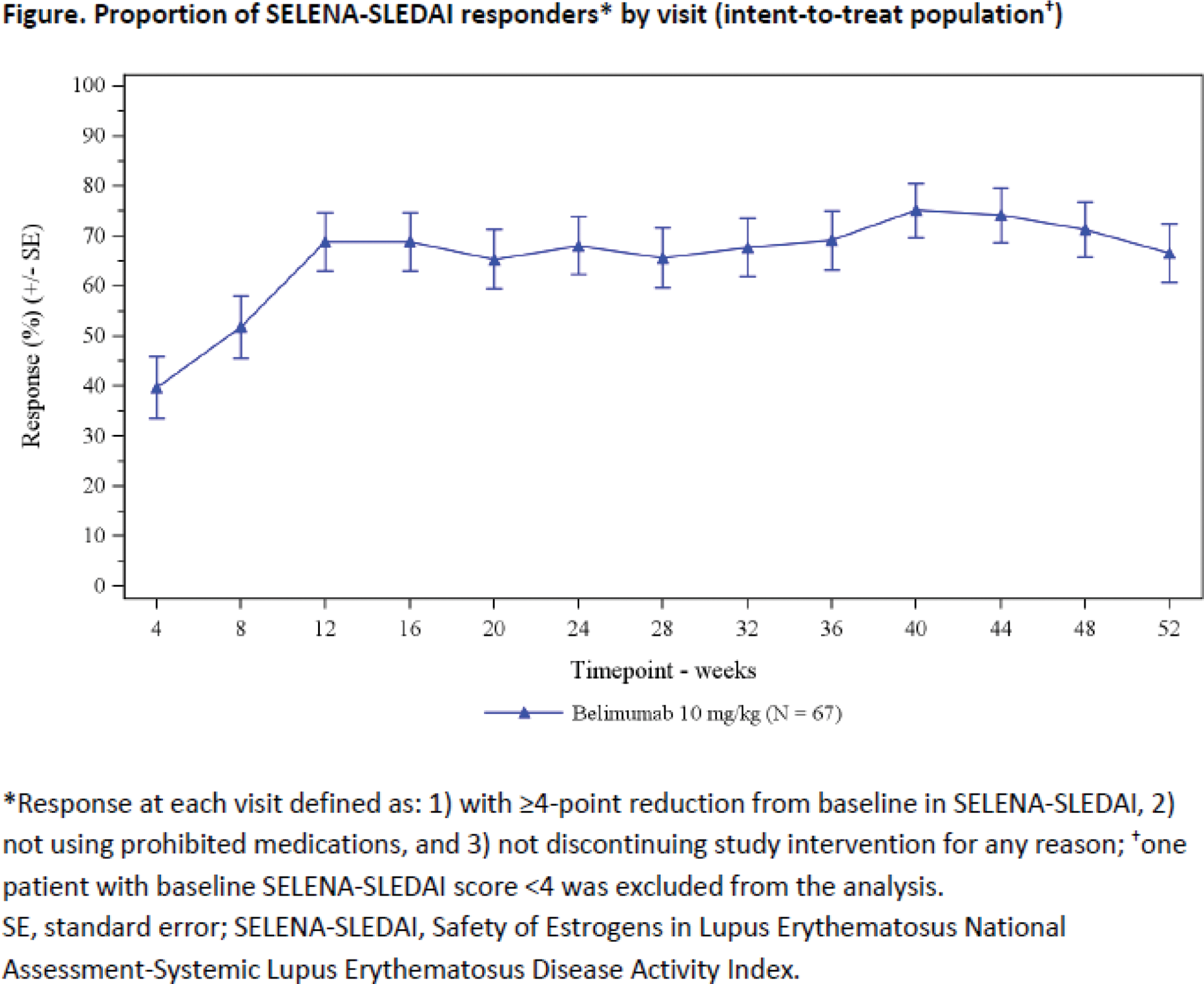
Results: A total of 67 patients received at least one dose of belimumab 10 mg/kg IV, of whom 59 (88.1%) completed the Week 52 visit. Most patients were female (n=51, 76.1%), with a mean (standard deviation [SD]) age of 13.0 (2.22) years and a body mass index of 21.6 (3.65) kg/m 2 . Baseline mean (SD) GC dose was 15.4 (8.19) mg/day. The proportion of SELENA-SLEDAI responders at Week 52 was 66.7% (Table 1). The proportion of SELENA-SLEDAI responders showed a rising trend over time, reaching a plateau at Week 12 and maintaining through Week 52 (Figure 1). Mean percentage change from baseline in SELENA-SLEDAI score showed a continuously decreasing trend over time and reached a nadir at Week 44 with a mean (SD) decrease of 62.8% (39.54). Mean PGA and ParentGA decreased from baseline to Week 52 (Table 1), reaching a nadir at Weeks 48 and 52, respectively. The proportion of patients with improvement in PGA (reduction of ≥0.3 points from baseline) generally increased over time and peaked at Week 44 (80.6%), with 76.1% having improved PGA at Week 52. Observed median (interquartile range, IQR) change in daily GC dose from baseline to Week 52 was −7.5 (−12.50–0.00) mg/day (n=59). Among the 64 participants receiving GC at baseline, the proportion of patients with a GC decrease from baseline increased through 52 weeks, reaching 69.4% at Week 52. Fifty (74.6%) and 18 (26.9%) patients experienced an SFI flare and severe flare, respectively, over 52 weeks (Table 1). Among these patients, the median (IQR) times to first on-study SFI flare and severe flare were 96.5 (51.0–147.0) and 59.5 (39.0–179.0) days, respectively (Table 1). No patients had AESIs (including serious infections, malignancy, serious depression or death). Most patients (83.6%) experienced at least one AE during the study (Table 1), of which the majority were mild or moderate in intensity. Thirty-one patients (46.3%) had ≥1 AE related to the study intervention (Table 1). Nineteen (28.4%) patients had ≥1 SAE (Table 1), the most common of which was bronchitis (n=3, 4.5%). Five patients (7.5%) had ≥1 SAE considered to be related to the study intervention (bronchitis, pneumonia, upper respiratory tract infection, cerebral infarction, headache and thrombocytopenia; all n=1).
Conclusion: This Phase 4 study demonstrated that belimumab 10 mg/kg IV (plus ST) has a positive benefit–risk profile in Chinese paediatric patients with SLE. This is supported by the observed improvements in SELENA-SLEDAI, PGA and ParentGA, and reduced GC use over 52 weeks. Additionally, no new safety concerns were identified in Chinese paediatric patients with active SLE receiving belimumab.
REFERENCES: [1] Brunner H et al. Ann Rheum Dis 2020;9:1340–8.
[2] Navarra SV et al. Lancet 2011;6;377:721–31.
[3] Furie R et al. Arthritis Rheum 2011;63:3918–30.
[4] Zhang F et al. Ann Rheum Dis 2018;77:355–63.
Acknowledgements: This study (GSK Study 213560) was funded by GSK. Medical writing support was provided by Claire Barron, MSc, and Liam Campbell, PhD, Fishawack Indicia Ltd, UK, part of Avalere Health, and was funded by GSK.
Disclosure of Interests: Caifeng Li: None declared, Junmei Zhang: None declared, Haiguo Yu: None declared, ZhiHui Li: None declared, Sirui Yang: None declared, Meiping Lu: None declared, Qihua Feng: None declared, Xiaoqing Li: None declared, Li Sun: None declared, Xuemei Tang: None declared, Jane Chen Shares: GSK, Employee: GSK, Chris Wang Shares: GSK, Employee: GSK, Deepak Assudani Shares: GSK, Employee: GSK.
© The Authors 2025. This abstract is an open access article published in Annals of Rheumatic Diseases under the CC BY-NC-ND license (