fetching data ... 
Background: One of the regularly reported issues in Patient Doctor communication reported by patients is a misalignment between their Health Care Professionals and themselves as to whether their lupus is, or not, under control. While clinicians use tools that involve a combination of clinical, laboratory, physician’s global assessment and patient-reported outcomes to assess whether systemic lupus erythematosus (SLE) is well controlled, the outcome may not always align with patient experience or expectations.
Objectives: To explore the concept of ‘lupus under control’ amongst European lupus patients.
Methods: As part of the Lupus Europe Living with lupus 2024 survey programme, a set of specific questions around the notion of lupus being under control was raised. The questionnaire contained five questions related to this topic.
Results: A total of 4360 SLE participants living in Europe (mean (±SD) age: 45.7 years ±12.8) participated in this section of the study. Male were 174 (4.0%); young participants (age<35) were 850 (19.5%), seniors (age>60) were 613 (14.1%), while 1085 (24.9%) had lupus nephritis. Overall, 2900 respondents (66.5%) stated they consider their lupus to be under control. In the seniors’ group and lupus nephritis group 71.3% (p=.01) and in 71% (p=.002) of respondents, respectively, considered their lupus to be under control. When asked to clarify under which of 7 different sets of circumstances they would consider their lupus to be “under control” (multiple choice possible), none of the proposed sets, nor a specific combination of them, obtained a majority of votes. On average, participants identified only 2.1 of the 7 possible situations as “lupus being under control”.
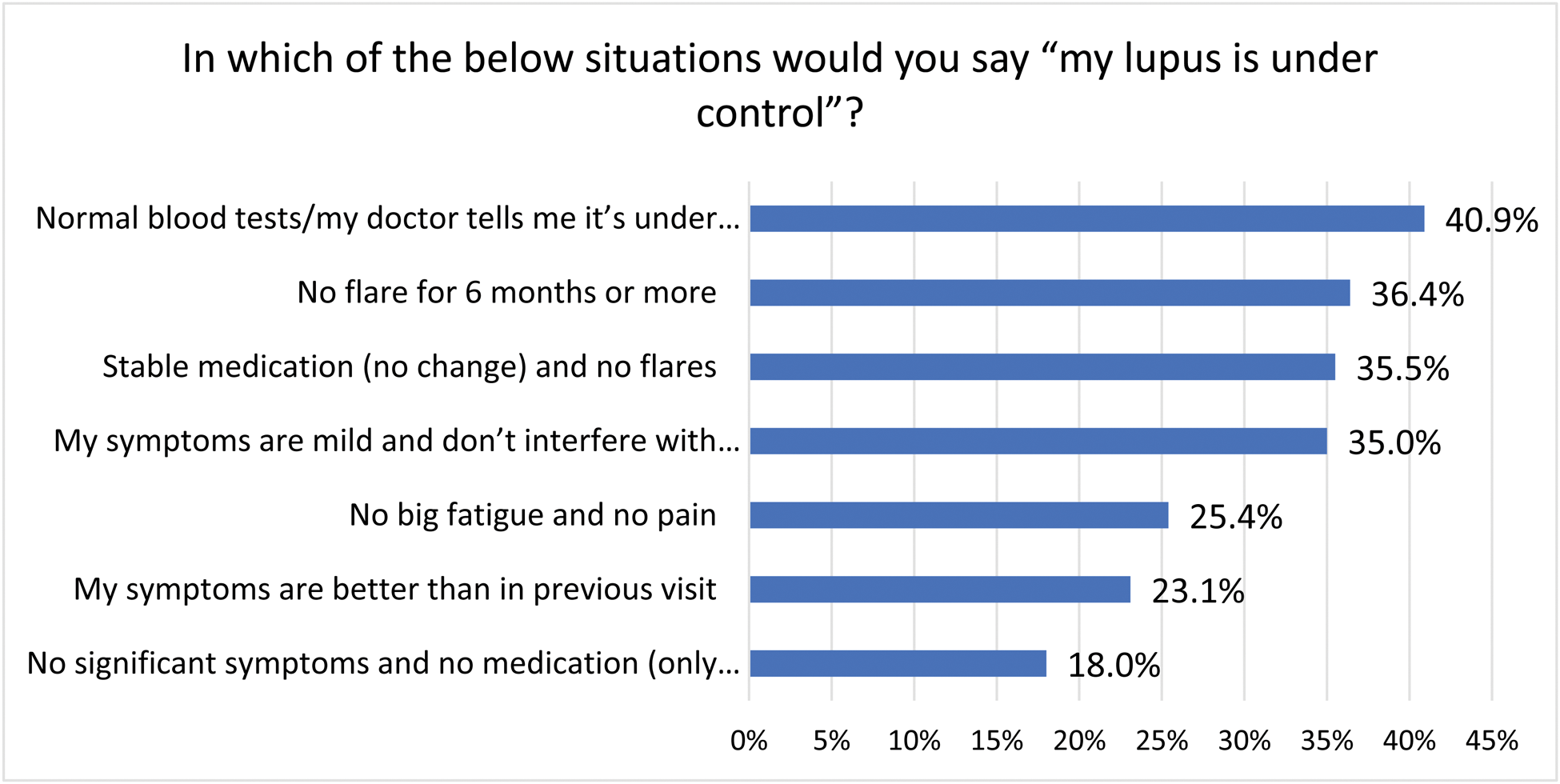
“ Normal blood tests/my doctor tells me it’s under control” reached the highest consensus (n=1698, 40.9%), followed by “ no flare for 6 months or more ” (n=1510, 36.4%), “ stable medication (no change) and no flares ” (1472, 35.5%) and “ my symptoms are mild and don’t interfere with my everyday life, even if I am under medication ” (n=1455, 35.0%). “ No big fatigue and no pain ” (1056, 25.4%), “ my symptoms are better than in previous visit ” (959, 23.1%), and “ no significant symptoms and no medication (only hydroxychloroquine and/or steroids at or below 5mg/day )” (n=749, 18.0%) were the less selected sets. Lupus being “under control” is also not equating to a Patient Acceptable Symptom Situation. To the question “ considering all the different ways your disease is affecting you, if you were to stay in this state for the next few months, do you consider your current state satisfactory ”, 1884 (47.6%) responded positively and 1876 (47.4%) negatively, 197 (5.0%) preferred not to answer.
Conclusion: While 66.5% of respondents state their lupus is under control, the reality covered by this statement is hugely variable, with no single situation reaching 50% agreement among respondents. Moreover, patients consider their situations satisfactory in just 47.4% of cases; this hints to the fact that, for patients, overall control and satisfaction may be related but distinct concepts. This study highlights the lack of a “universally accepted” patient understanding of the notion of under control and adds complexity and ambiguity in the patient doctor communication. Future studies should aim to address the gap between the patient perspective of ‘lupus under control’ and what patients consider ‘satisfactory’ while also providing a patient-driven definition of ‘lupus under control’.
REFERENCES: NIL.
Acknowledgements: NIL.
Disclosure of Interest: None declared.
© The Authors 2025. This abstract is an open access article published in Annals of Rheumatic Diseases under the CC BY-NC-ND license (