fetching data ... 
Background: Systemic juvenile idiopathic arthritis (sJIA) is an autoinflammatory disorder that affects children aged 16 years and younger. Biologic agents, including IL-1 and IL-6 receptor antagonists, play a pivotal role in the treatment of sJIA. Genakumab is a high-affinity, fully human monoclonal antibody targeting IL-1β, which selectively binds to and neutralizes IL-1β, effectively inhibiting its pro-inflammatory effects and providing therapeutic benefit in the treatment of sJIA. Results from a completed phase 1b/2a study have shown that genakumab rapidly alleviates the clinical symptoms of active sJIA and provides sustained efficacy over time.
Objectives: The objective of this study was to evaluate the efficacy and safety of genakumab in patients with active sJIA.
Methods: This multicenter, randomized, open-label phase 2 trial (NCT05925452) was conducted in China, enrolling patients aged ≥ 2 to < 18 years with active sJIA. Starting from the 4-week induction phase, eligible patients were randomly assigned (1:1:1) to receive either genakumab 3.0 mg/kg, genakumab 4.0 mg/kg (administered subcutaneously every 4 weeks), or tocilizumab (8-12 mg/kg, intravenously every 2 weeks). Patients who achieved an adapted JIA ACR Ped30 response by Day 28 proceeded to the 20-week maintenance phase, during which corticosteroid tapering was implemented according to the study protocol. Non-responders discontinued treatment and entered the 4-week follow-up phase. The primary endpoint was the proportion of patients achieving an adapted JIA ACR Ped30 response at Day 28. Secondary endpoints included adapted JIA ACR Ped50/70/90 responses, corticosteroid tapering over time, and safety outcomes. The data were analyzed up to the completion of the primary endpoint assessment (Day 28 visit) for the last enrolled patient.
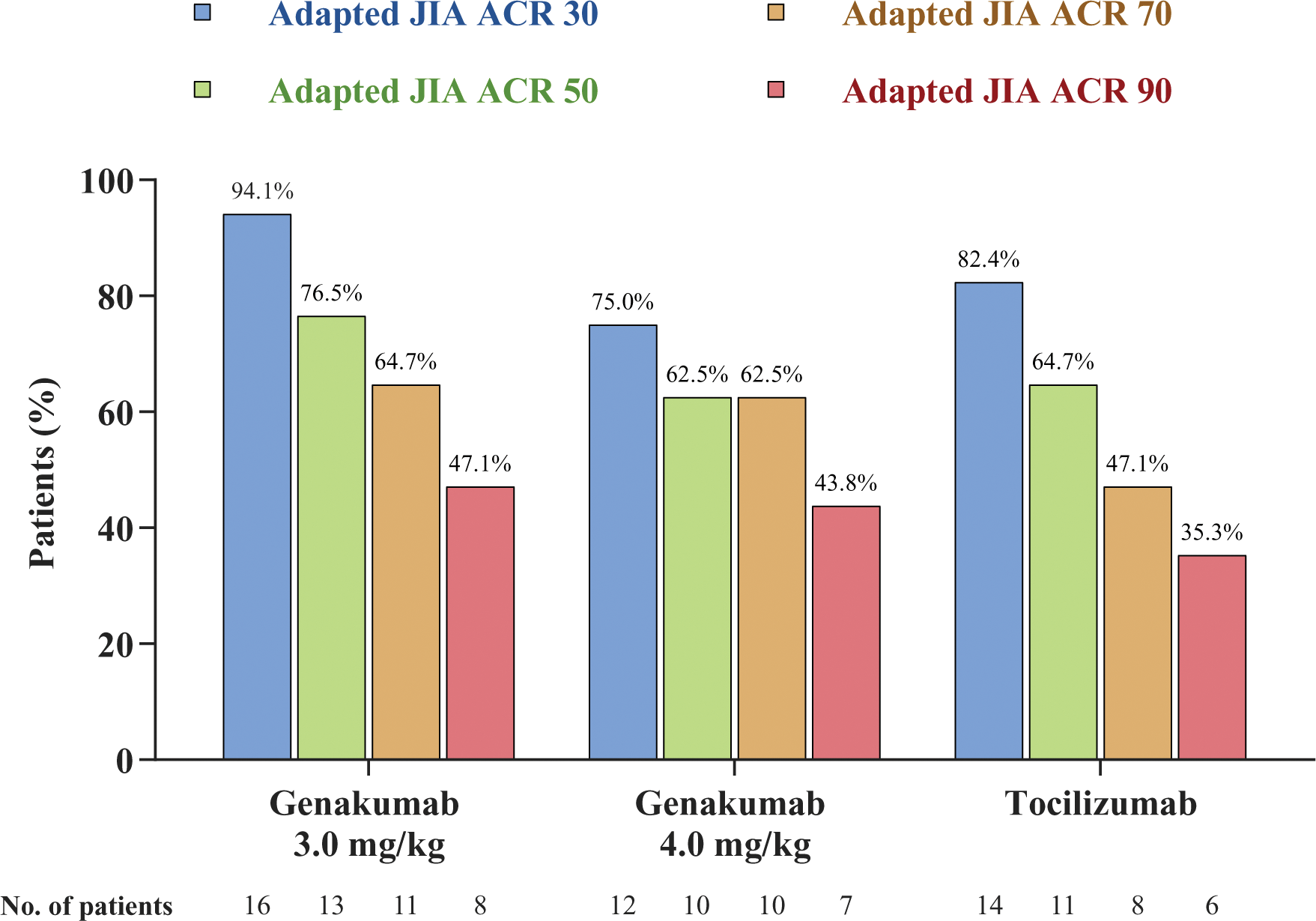
Results: A total of 50 patients were enrolled in the study and randomized into three treatment groups: genakumab 3.0 mg/kg (n=17), genakumab 4.0 mg/kg (n=16), and tocilizumab (n=17). The mean (SD) age was 9.8 (4.00) years, and the mean (SD) baseline body weight was 37.3 (17.74) kg. Approximately 58% (29/50) of patients were male. The demographic and baseline characteristics were well-balanced across the treatment groups. The primary endpoint analysis showed that 94.1% (16/17) of patients in the genakumab 3.0 mg/kg group, 75.0% (12/16) in the genakumab 4.0 mg/kg group, and 82.4% (14/17) in the tocilizumab group achieved the adapted JIA ACR Ped30 response at Day 28. Secondary efficacy endpoints showed consistent trends across all treatment groups. The response rates for adapted JIA ACR Ped50/70/90 at Day 28 were 76.5%, 64.7%, and 47.1%, respectively, for the genakumab 3.0 mg/kg group; 62.5%, 62.5%, and 43.8% for the genakumab 4.0 mg/kg group; and 64.7%, 47.1%, and 35.3% for the tocilizumab group (see Figure 1). Treatment emergency adverse events (TEAEs) were reported in 66.0% (33/50) of patients, with 52.9% (9/17) in the genakumab 3.0 mg/kg group, 68.8% (11/16) in the genakumab 4.0 mg/kg group, and 76.5% (13/17) in the tocilizumab group. Treatment-related adverse events (TRAEs) were observed in 23.5% (4/17) and 50.0% (8/16) of patients in the genakumab 3.0 mg/kg and 4.0 mg/kg groups, respectively, compared to 76.5% (13/17) in the tocilizumab group. Serious adverse events (SAEs) were observed in 18.8% (3/16) of the genakumab 4.0 mg/kg group and 17.6% (3/17) of the tocilizumab group, while no SAE was reported in the genakumab 3.0 mg/kg group. The most common TEAEs reported (defined as ≥3 patients in any treatment group, given the small sample size) across the genakumab dose groups by Day 28 visit for the last enrolled patient were upper respiratory tract infection, hyperuricemia and anemia. The TEAEs in both genakumab groups were predominantly of grade 1-2 severity. In the tocilizumab group, the most common TEAEs included upper respiratory tract infection, hypercholesterolemia, decreased blood cell counts (neutrophils, white blood cells, and lymphocytes), and alanine aminotransferase increased.
Conclusion: Genakumab demonstrated comparable efficacy to tocilizumab with a favorable safety profile in the treatment of active sJIA. Common TEAEs were consistent with the expected effects of IL-1 receptor antagonists. Both doses of genakumab showed promising therapeutic effects, with a lower incidence of TEAEs compared to tocilizumab. These findings advocate further clinical development of genakumab for active sJIA.
REFERENCES: NIL.
Response to Treatment at Day 28 (FAS )
Acknowledgements: This study is sponsored by Changchun GeneScience Pharmaceutical Co., Ltd.
Disclosure of Interests: Caifeng Li: None declared, Junmei Zhang: None declared, HAIGUO yu: None declared, Meiping Lu: None declared, Sirui Yang: None declared, Cuihua Liu: None declared, Ping zeng: None declared, Bo Zhao: None declared, Xiaoqing Li: None declared, Wenjie Zheng: None declared, Yue Du: None declared, Wei Zhang: None declared, ZhiHui li: None declared, Xiufen Hu: None declared, Jianming Lai: None declared, Qian Xu Employee of Changchun GeneScience Pharmaceutical Co., Ltd., Tianhong Luo Employee of Changchun GeneScience Pharmaceutical Co., Ltd.
© The Authors 2025. This abstract is an open access article published in Annals of Rheumatic Diseases under the CC BY-NC-ND license (