fetching data ... 
Background: The role of the gut microbiome has been increasingly implicated in the pathogenesis of gout. For instance, gout patients have shown depletions of bacteria that lower urate levels or produce anti-inflammatory short-chain fatty acids (SCFAs). Dietary fiber is fermented by the gut microbiota and produces beneficial microbial metabolites, including SCFAs [1]. Accordingly, greater dietary fiber (particularly cereal fiber) intake is also associated with lower levels of inflammatory biomarkers [2], which may be particularly relevant to gout. Indeed, prior work has found that a pro-inflammatory diet that is low in dark leafy and yellow vegetables as well as high in refined grains is associated with a nearly two-fold increased risk of gout among women [3]. Taken together, these data suggest that dietary fiber may play a role in gout prevention through the modulation of gut microbiota and corresponding inflammatory pathway.
Objectives: We aimed to prospectively examine whether long-term dietary fiber intake is associated with the risk of gout among women over 34 years of follow-up.
Methods: We analyzed data from 80,175 women in the Nurses’ Health Study with complete dietary data who were free from gout at baseline. We used a validated semi-quantitative food frequency questionnaire to collect repeated measures of usual intake of 130+ food and beverage items every four years. We calculated dietary fiber intakes for all participants using the Harvard University Food Composition Database, which is based primarily on USDA sources. In addition to total fiber, we calculated individual intakes of fiber sourced from cereals, fruits, vegetables, and legumes. Every two years, we collected updated data on relevant covariates as well as new confirmed cases of incident gout. We used multivariable Cox proportional hazard models to evaluate the associations between quintiles of dietary fiber intake and incident gout.
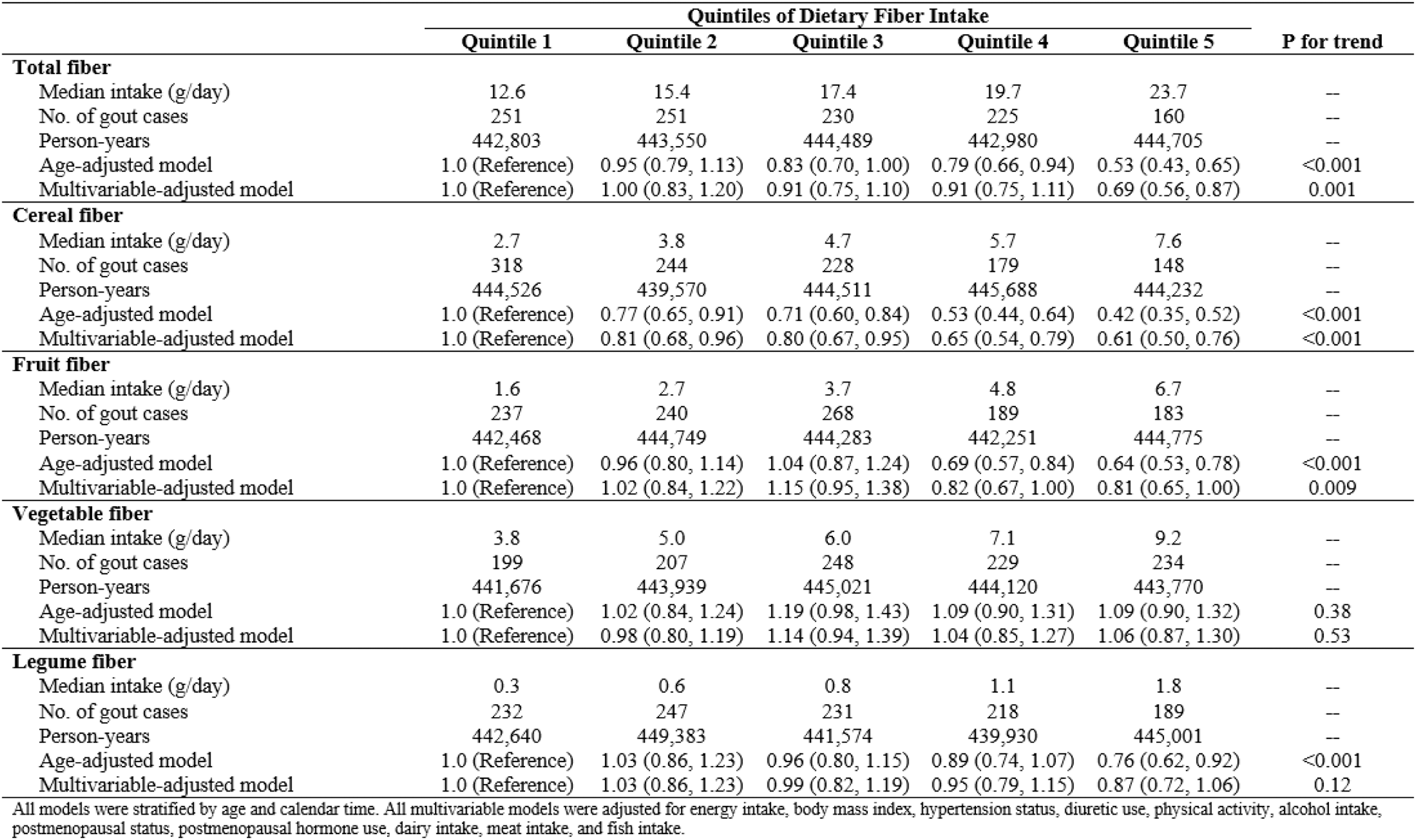
Results: We documented 1117 gout cases over 2,218,527 person-years of follow-up. At baseline, women consuming more total fiber tended to be older (Q1 vs. Q5: 49.3 vs. 53.3 years), more physically active (Q1 vs. Q5: 10.5 vs. 19.0 metabolic equivalent of task hours/week), and consume less alcohol (Q1 vs. Q5: 11.5 vs. 4.2 grams/day). After multivariable adjustment, greater intake of total dietary fiber was associated with a 31% lower risk of incident gout comparing extreme quintiles (hazard ratio [HR]=0.69 [95% confidence interval: 0.56 to 0.87]; P for trend=0.001) (Table 1). This protective association was primarily driven by cereal fiber (from food sources such as cold cereals, dark breads [e.g., rye, pumpernickel, wheat, oatmeal, or other whole grain breads], cooked oatmeal, and added bran) (multivariable HR comparing extreme quintiles=0.61 [0.50 to 0.76]; P for trend<0.001) and fruit fiber (multivariable HR comparing extreme quintiles=0.81 [0.65 to 1.00]; P for trend=0.009) (Table 1).
Conclusion: Long-term dietary intake of fiber, particularly fiber sourced from cereals and fruits, is independently associated with a lower risk of incident gout among women. These findings support a role for fiber in the pathogenesis of gout, potentially by modulating the gut microbiome.
Table 1. Multivariable-adjusted associations between dietary fiber intake and incident gout among women in the Nurses’ Health Study (1984-2018 )
REFERENCES: [1] Fu J et al. Microorganisms. 2022;10(12). PMID: 28208609.
[2] Shivakoti R et al. JAMA Netw Open. 2022;5(3):e225012. PMID: 35357453.
[3] Rai SK et al. Arthritis Rheumatol. 2025 (In Press).
Acknowledgements: NIL.
Disclosure of Interests: Sharan Rai: None declared, Natalie McCormick: None declared, Chio Yokose: None declared, Robert Terkeltaub Synlogic, Atom Bioscience, Crystalys, Dyve Biosciences, Generate, Convergence, Dylan Dodd: None declared, Lama Nazzal: None declared, Huilin Li: None declared, Qi Sun: None declared, Hyon Choi Ani, Protalix, Horizon, LG Chem, Shanton, LG Chem.
© The Authors 2025. This abstract is an open access article published in Annals of Rheumatic Diseases under the CC BY-NC-ND license (