fetching data ... 
Background: Cardiac involvement (CI) in idiopathic inflammatory myopathies (IIM) is uncommon but can lead to severe complications. Anti-mitochondrial antibodies (AMAs), the well-recognized biomarkers for primary biliary cholangitis (PBC), are also detected in IIM but their role remains under-explored. While previous studies suggest a potential link between AMAs and CI [1], the evidence remains limited due to small sample sizes and inconsistent findings.
Objectives: This study aims to evaluate the clinical characteristics, pathological features, and long-term prognosis of anti-mitochondrial M2 antibody (AMA-M2) positive IIM patients, focusing on its association with CI and its potential role as a marker for immune-mediated necrotizing myopathy (IMNM).
Methods: We conducted a single-center retrospective cohort study involving 987 hospitalized IIM patients between January 2008 and November 2020. Demographic, clinical, laboratory, and pathological data were collected from the hospital’s digital record system, and IIM diagnoses were retrospectively confirmed using the 2017 EULAR/ACR criteria. Propensity score matching was used to balance baseline heterogeneity between AMA-M2-positive and negative groups. Univariate and multivariate COX regression model were applied to identify independent risk factors with CI and mortality. Survival analyses were performed to evaluate the impact of AMA-M2 positivity on the endpoints.
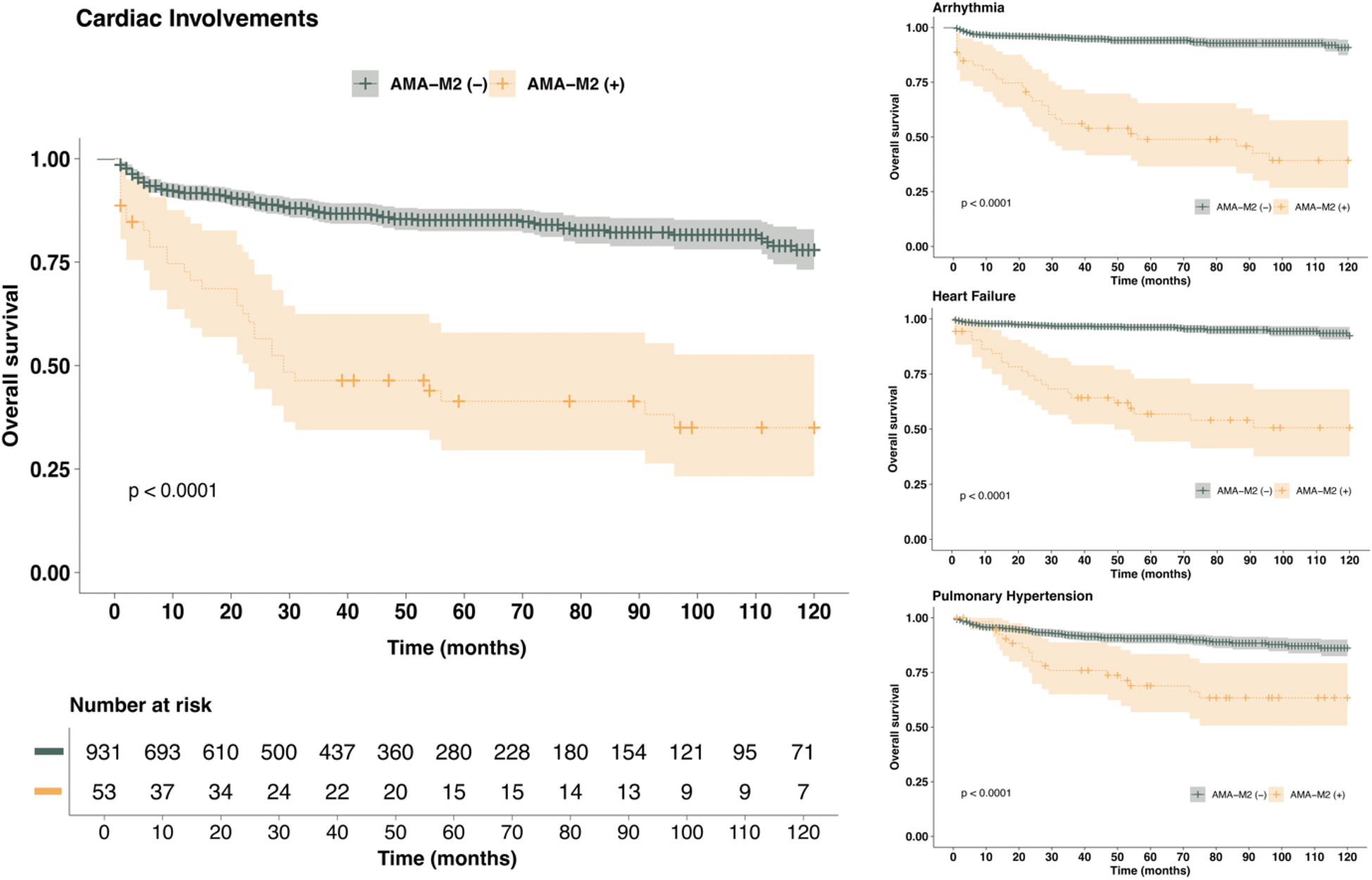
Results: Among 987 IIM patients, 55 (5.6%) tested positive for AMA-M2. These patients had a higher proportion of polymyositis subtype (56.4% vs. 23.5%, p<0.001), as well as elevated baseline levels of gamma-glutamyl transferase (GGT) (78.0 vs. 35.0, p<0.001) and alkaline phosphatase (ALP) (85.0 vs. 64.0, p<0.001) (Table 1). Throughout disease courses, AMA-M2 positive patients showed a significantly higher prevalence of CI (60% vs. 12.9%, p<0.001), including arrhythmias (52.7%), heart failure (41.8%), and pulmonary hypertension (30.9%) (Figure 1). Skeletal muscle biopsies of AMA-M2 positive patients predominantly exhibited IMNM features, while none of these patients were positive for anti-SRP or anti-HMGCR antibodies. Cardiac biopsies revealed varying degrees of myocardial degeneration and fibrosis but minimal inflammatory features, and all liver biopsies confirmed stage I or II PBC. Notably, in AMA-M2 positive subgroup, patients with comorbid hepatic involvement tend to have higher incidence of CI compared to those without (27/33 [81.8%] vs. 8/22 [36.4%], p<0.001). AMA-M2 positivity and elevated gamma-glutamyl transferase (GGT) levels were identified as independent risk factors for cardiac involvement (HR 3.156, p<0.001 and HR 1.622, p=0.026, respectively). Despite clinically significant CI, AMA-M2 positivity was not associated with worsened survival compared to the AMA-M2 negative group (mean survival: 103.9 months vs. 98.0 months, p=0.86).
Demographical, clinical, and laboratory features of AMA-M2 positive and negative IIM patients
| AMA-M2 positive
| AMA-M2 negative
| P-value | |
|---|---|---|---|
| Demographics and comorbidities | |||
| Age at onset, years (median [IQR]) | 51.0 [15.0] | 49.0 [20.0] | 0.239 |
| Gender, female (n, %) | 36 (65.5) | 633 (67.9) | 0.704 |
| Coronary artery disease (n, %) | 12 (21.8) | 6.3 (59) | <0.001 |
| Clinical manifestations (n, % ) | |||
| Polymyositis subtype | 31 (56.4) | 219 (23.5) | <0.001 |
| Skin involvements 1 | 16 (29.1) | 618 (66.3) | <0.001 |
| Digits vasculitis | 0 (0) | 118 (12.7) | 0.005 |
| Muscle weakness | 39 (70.9) | 625 (67.1) | 0.554 |
| Diaphragmatic muscle paralysis | 8 (14.5) | 18 (1.9) | <0.001 |
| Interstitial lung disease | 21 (38.2) | 590 (63.3) | <0.001 |
| Cardiac involvements | 33 (60.0) | 120 (12.9) | <0.001 |
| Pulmonary hypertension | 17 (30.9) | 74 (7.9) | <0.001 |
| Heart failure | 23 (41.8) | 34 (3.6) | <0.001 |
| Arrhythmia | 29 (52.7) | 48 (5.2) | <0.001 |
| Laboratory results (n, % ) | |||
| CK elevation | 47 (87) | 536 (58.3) | <0.001 |
| GGT elevation | 33/52 (63.5) | 325/863 (37.3) | <0.001 |
| ALP elevation | 19/51 (37.3) | 106/858 (12.4) | <0.001 |
[1] Skin involvements are defined as the presence of heliotrope rash, Gottron’s sign or papule, Shawl and V sign, or Mechanic’s hands.
Cardiac involvements of AMA-M2 positive and negative IIM patients
Conclusion: AMA-M2 positivity identifies a distinct subset of IIM patients with clinically significant cardiac involvement and hepatic involvement, but does not worsen the long-term survival. The overlap between cardiac and hepatic manifestations in AMA-M2 positive IIM raises questions about underlying mitochondrial dysfunction, which warrants further exploration on disease mechanisms.
REFERENCES: [1] Maeda, M., et al., Prevalence and risk surveillance of anti-mitochondrial antibody-positive myositis: Outcomes of a nationwide survey. J Neurol Sci, 2024. 467: p. 123287.
Acknowledgements: This study was supported by the Chinese National Key Technology R&D Program, Ministry of Science and Technology (2022YFC2504603), CAMS Innovation Fund for Medical Sciences (CIFMS) (2021-I2M-1-005, 2023-I2M-C&T-B-035, 2023-I2M-2-005) and National High Level Hospital Clinical Research Funding (2022-PUMCH-C-020, 2022-PUMCH-D-009).
Disclosure of Interests: None declared.
© The Authors 2025. This abstract is an open access article published in Annals of Rheumatic Diseases under the CC BY-NC-ND license (