fetching data ... 
Background: Cryoglobulinemic vasculitis (CryoVas) is a rare immune-complex-mediated disorder, often associated with hepatitis C virus (HCV) infection, autoimmune diseases (ADs), or other etiologies. Despite its clinical relevance, data on the prevalence and diagnostic yield of cryoglobulin testing remain scarce.
Objectives: This study aims to evaluate the prevalence, clinical manifestations, outcomes, and underlying etiologies of CryoVas among patients with positive cryoglobulin tests over a 10-year period in a specialized laboratory.
Methods: We conducted a retrospective monocentric study analyzing all cryoglobulin tests performed in a specialized laboratory from 2013 to 2023. A total of 13,607 tests were performed, of which 1,593 (11.7%) yielded positive results. These tests corresponded to 596 individual patients, considering the duplication of tests in single patients. Medical records of these patients were reviewed to confirm the diagnosis of CryoVas, in according to CryoVas classification criteria [1].
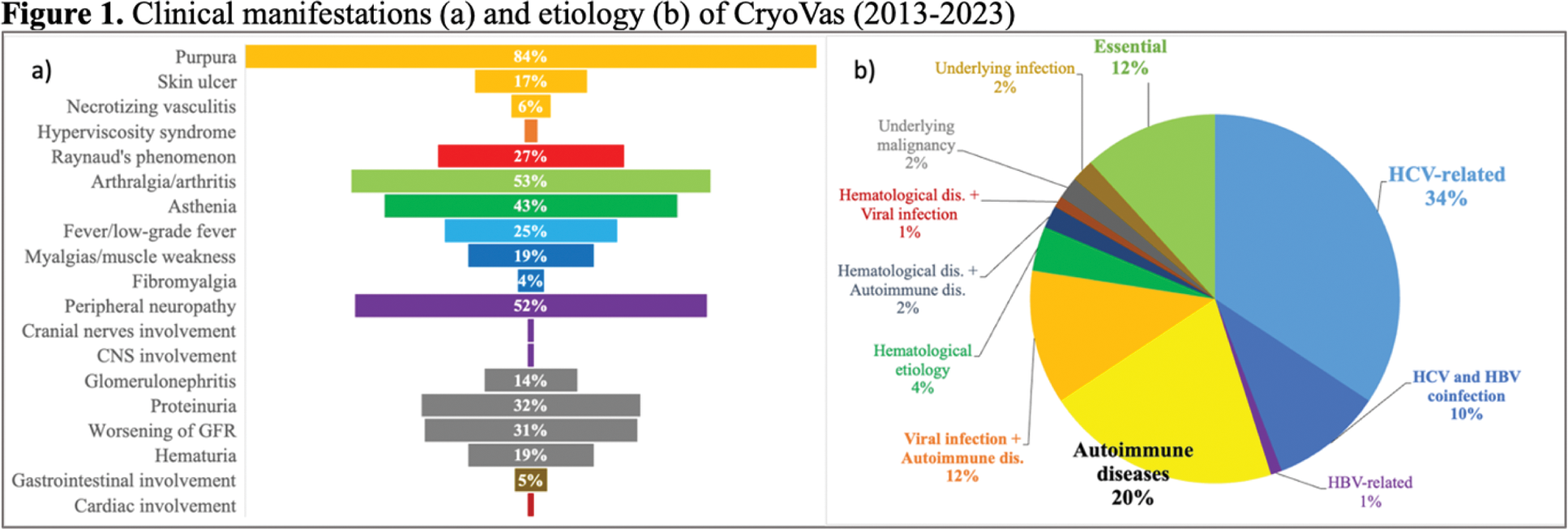
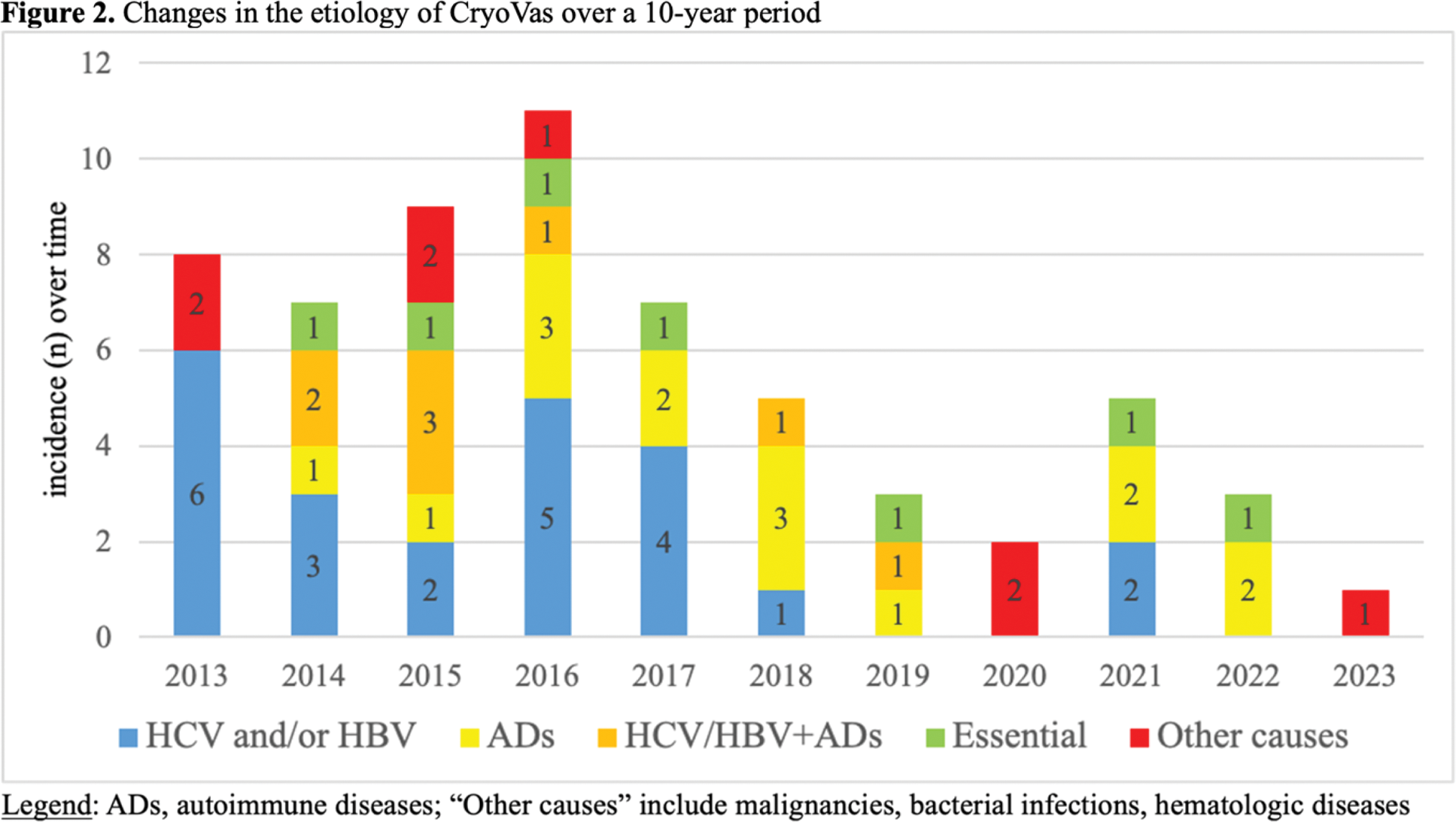
Results: Among the 596 patients with positive cryoglobulin tests, 102 (17%) were diagnosed with CryoVas. The median age at the onset of CryoVas was 65 years (IQR 56-73), and females accounted for 66/102 (65%). Figure 1A shows the clinical manifestations at disease onset. The main underlying etiologies included HCV-related vasculitis (35/102, 34%), ADs (21/102, 20%), and essential CryoVas (12/102, 12%) (Figure 1B). Among ADs, Sjögren’s disease was the most common cause (14/21, 67%). The diagnosis of CryoVas was made prior to 2013 in 41 out of 102 (40%) patients, of whom 27 (66%) had an HCV and/or HBV infection. For the remaining patients, the changes in the etiology of CryoVas over a 10-year period are shown in Figure 2. Since the introduction of pan-genotypic regimens for the treatment of HCV in 2017 (e.g., Sofosbuvir/Velpatasvir and Glecaprevir/Pibrentasvir), the mean incidence of CV decreased from 8.4 cases (±1.7) during the period 2013–2017 to 3 cases (±1.6) during the period 2018–2023 ( p-value 0.001 ). At the onset of CryoVas, the median BVASv3 score was 6 (IQR 2–9). Skin ulcers, necrotizing vasculitis, and hyperviscosity syndrome were more frequent in type I CryoVas (43% [p-value 0.521], 43% [ p-value 0.001 ], and 14% [p-value 0.403], respectively). Raynaud’s phenomenon was more commonly observed in CryoVas related to ADs (52%) ( p-value 0.025 ). Glomerulonephritis and gastrointestinal involvement were more frequent in essential CryoVas (42% [ p-value 0.011 ] and 17% [p-value 0.380], respectively). The median RF value was higher in essential CryoVas (473 UI/L [IQR 92–602]) ( p-value 0.010 ). Two-thirds of patients with CryoVas related to ADs received Rituximab (RTX), while Belimumab (BEL) was used exclusively in CryoVas related to ADs and essential CryoVas (10% and 8%, respectively). During follow-up (FU) (median 7 years [IQR 3-11]), at least one relapse occurred in 71% of patients with CryoVas related to autoimmune diseases (ADs), compared to a median of 42% in other patients (p-value 0.097). Additionally, nearly a quarter of patients with CryoVas related to ADs were already receiving RTX treatment at the last FU. Despite a high rate of clinical remission (94%), cryoglobulins disappeared in just 60% of CryoVas patients by the last FU.
Conclusion: CryoVas remains a significant clinical condition, with its etiology progressively evolving in recent years. Treatment approaches varied by etiology, with RTX serving as a cornerstone for CryoVas associated with ADs, while BEL demonstrated potential in select cases. Despite advancements in treatment and high rate of complete clinical response, relapse rates remain high, particularly in autoimmune-related CryoVas. Additionally, cryoglobulin clearance was achieved in approximately 60% of patients during follow-up, reflecting a partial immunological response.
REFERENCES: [1] Quartuccio, L.; Isola, M.; Corazza, L.; Ramos-Casals, M.; Retamozo, S.; Ragab, G.M.; Zoheir, M.N.; El-Menyawi, M.A.-M.; Salem, M.N.; Sansonno, D.; et al. Validation of the Classification Criteria for Cryoglobulinaemic Vasculitis. Rheumatology (Oxford ) 2014 , 53 , 2209–2213, doi:10.1093/rheumatology/keu271.
Acknowledgements: NIL.
Disclosure of Interests: None declared.
© The Authors 2025. This abstract is an open access article published in Annals of Rheumatic Diseases under the CC BY-NC-ND license (