fetching data ... 
Background: There remains a significant unmet medical need in the management of non-radiographic axial spondyloarthritis (nr-axSpA), particularly for patients who have an inadequate response to non-steroidal anti-inflammatory drugs (NSAIDs). Although newer therapeutic classes have been introduced, uncertainty persists regarding which options may provide superior outcomes, especially in biologic DMARD-naïve populations. Addressing this gap is critical for optimizing treatment strategies and improving patient outcomes.
Objectives: This study aims to compare the relative efficacy of biologic and targeted synthetic DMARDs for the treatment of nr-axSpA with intolerance or inadequate responses to NSAIDs.
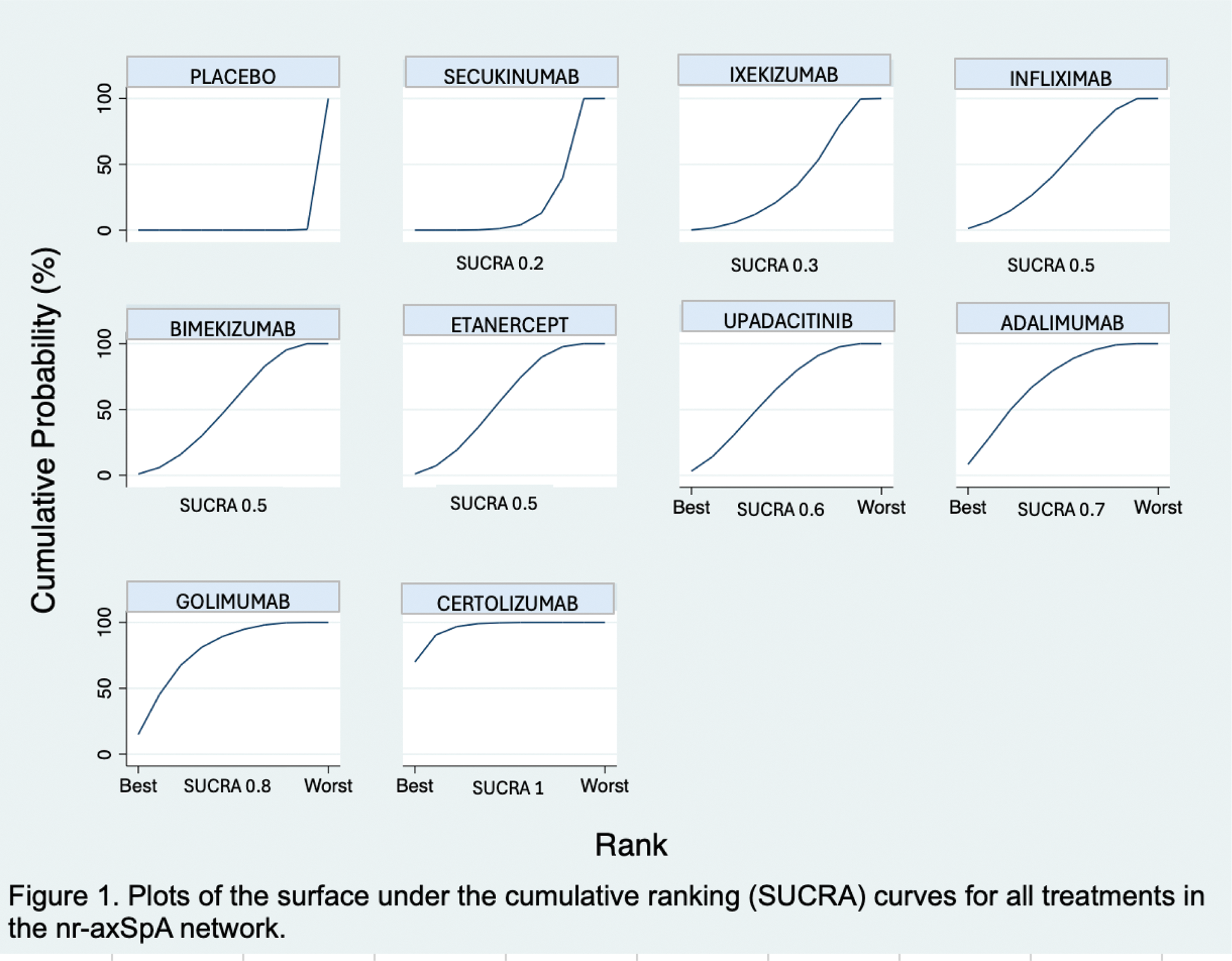
Methods: A Bayesian network meta-analysis (NMA) was conducted, incorporating randomized clinical trials (RCTs) assessing biologic and targeted synthetic DMARDs in patients with active nr-axSpA predominantly biologic naïve (Less than 20% of patients on trials included had previous biologic exposure). Systematic searches were performed in PubMed and Cochrane databases up to August 2024. Odds ratios (OR) with 95% credible intervals (CrI) were calculated to assess efficacy, and Surface Under Cumulative Ranking curve (SUCRA) analysis was employed to rank therapies in terms of achievement of ≥40% of the Assessment of Spondyloarthritis International Society Criteria (ASAS40) at 12-16 weeks. Treatments were arbitrarily stratified into tiers based on SUCRA scores: optimal (SUCRA ≥0.7), good (SUCRA 0.6–0.5), and effective (SUCRA ≤0.4).
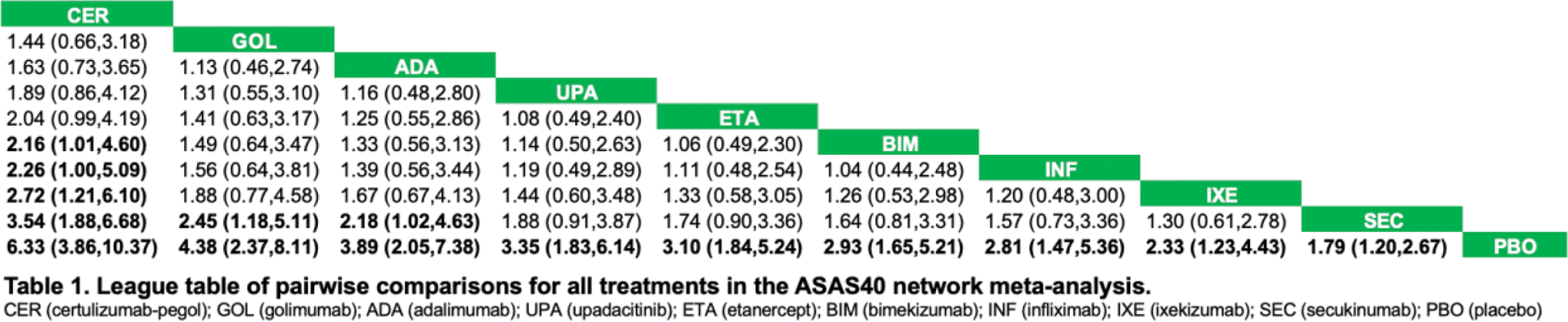
Results: We identified 14 RCTs enrolling 2,523 patients with active nr-axSpA with inadequate response/intolerance to NSAIDs. A total of 45 pairwise comparisons were analyzed, including 9 direct comparisons of 9 interventions. All active therapies significantly improved ASAS40 response rates compared to placebo (Table 1). Certolizumab (OR 6.33, 95% CrI 3.86–10.37) and golimumab (OR 4.38, 95% CrI 2.37–8.11) were the most effective therapies, followed by adalimumab (OR 3.89, 95% CrI 2.05–7.38). The ranking probabilities based on the SUCRA indicated that certolizumab (SUCRA = 1.0), golimumab (SUCRA = 0.8), and adalimumab (SUCRA = 0.7) were the optimal therapies with the highest probability of achieving the best outcomes. Upadacitinib, etanercept, bimekizumab and infliximab were good (SUCRA 0.6–0.5) and ixekizumab and secukinumab (SUCRA <0.4) were considered effective compared to placebo (Figure 1).
Conclusion: In this network meta-analysis, the relative efficacy of biologic and targeted synthetic DMARDs for nr-axSpA showed that certolizumab and golimumab exhibited the highest efficacy for achieving ASAS40 response, with adalimumab and upadacitinib providing strong alternatives. These findings underscore the importance of individualized treatment strategies in the evolving nr-axSpA treatment landscape.
REFERENCES: [1] Deodhar A, et al. Clin Rheumatol. 2020 Aug;39(8):2307-2315.
Acknowledgements: NIL.
Disclosure of Interests: None declared.
© The Authors 2025. This abstract is an open access article published in Annals of Rheumatic Diseases under the CC BY-NC-ND license (