fetching data ... 
Background: Standard therapy (ST) for SLE includes AM, GC and IS [1]. However, chronic GC and IS use contributes to damage accrual and increased mortality risk [2]. The 2023 EULAR SLE management update states that prior IS failure is not required to initiate biologics in patients not responding to AM and GC [1]. BEL, a human IgG1λ monoclonal antibody that selectively binds to soluble B-lymphocyte stimulator (BLyS), is a biologic immunosuppressant with proven efficacy in SLE [3]. Although the impact of BEL on outcomes in patients not previously receiving IS has not been specifically investigated in clinical trials, real-world evidence (RWE) has shown the benefits of initiating BEL without prior IS treatment [4, 5].
Objectives: Assess efficacy and safety of initiating BEL relative to being on IS at baseline, in combination with ST (AM and GC), using pooled data from past clinical trials in patients with SLE.
Methods: This post hoc summary pooled Week 52 data for adults with active SLE from 5 Phase 3 trials (BLISS-52 [NCT00424476]; BLISS-76 [NCT00410384]; North East Asia [NCT01345253]; BLISS-SC [NCT01484496]; EMBRACE [NCT01632241]), with similar study designs and eligibility criteria [6–10]. In the original studies, patients were randomised to receive BEL or placebo (PBO) in addition to ST. This summary grouped patients by study treatment into an IS cohort (patients who received PBO and IS at baseline, defined as pre-treatment) and a BEL cohort (patients who received BEL 10 mg/kg intravenous or 200 mg subcutaneous, and no baseline IS); all patients received AM and GC at baseline. Efficacy endpoints included proportion of patients with SLE Responder Index-4 (SRI-4) response through 52 weeks, time to first SELENA-SLEDAI Flare Index (SFI) flare over 52 weeks and cumulative GC dose (mg) and mean dose change (expressed as prednisone equivalent, mg/day) between baseline and Week 52. Adverse events (AEs) and serious AEs (SAEs), which also included data from an additional Phase 2 trial (LBSL02 [NCT00071487]) [11], and baseline demographic and outcome data were summarised descriptively.
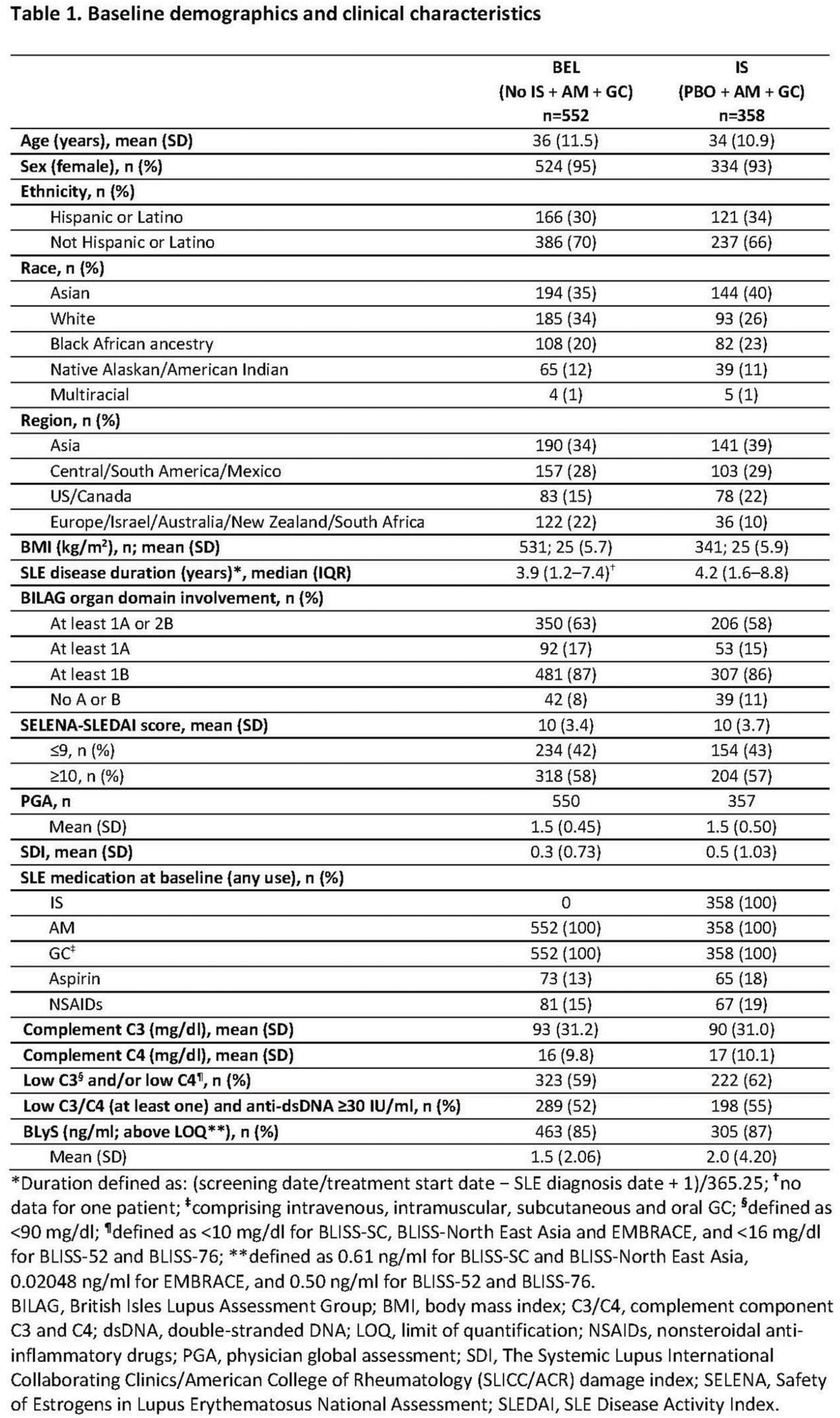
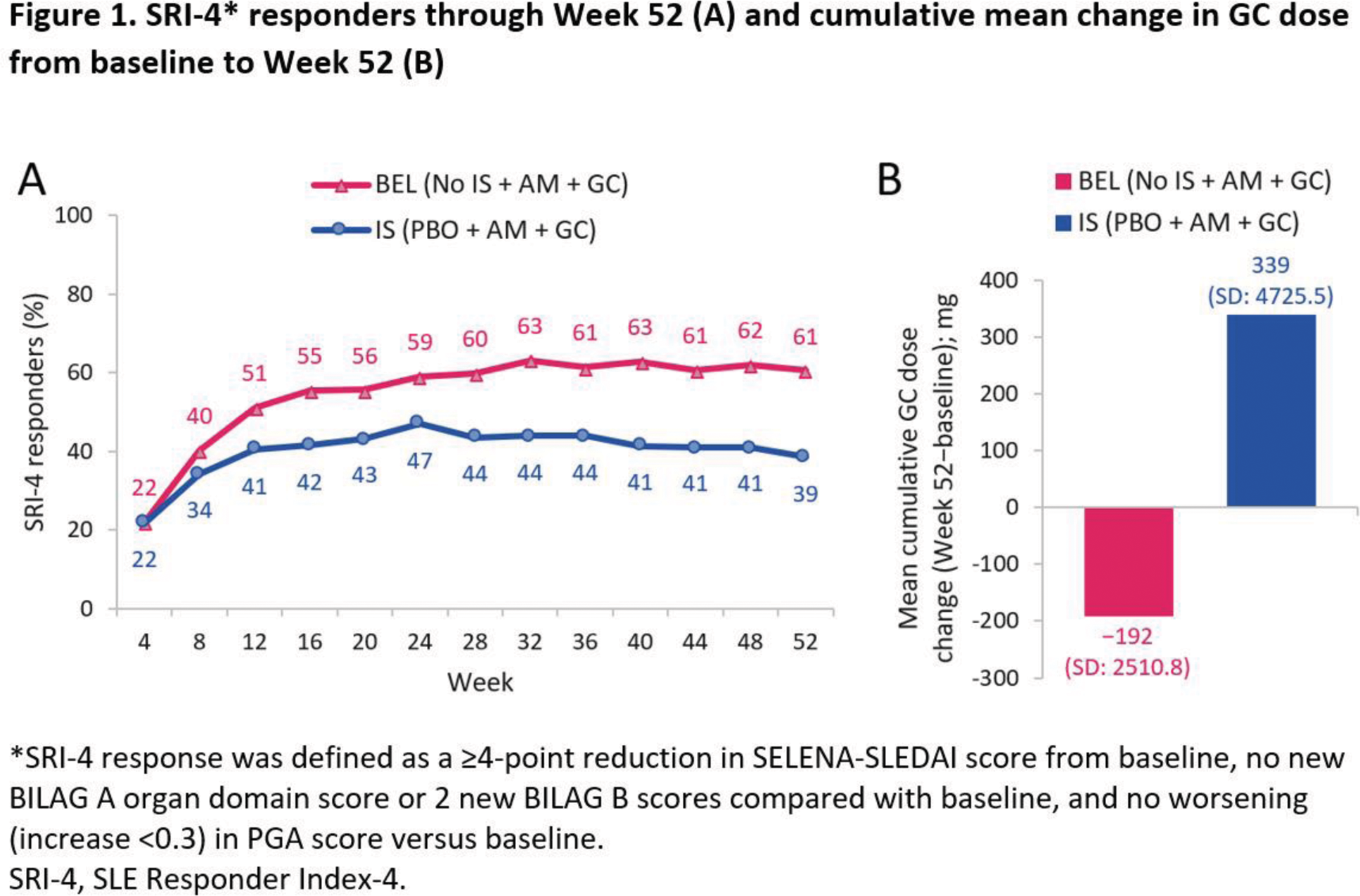
Results: Of the entire pooled population (N=3086), 552 patients were in the BEL cohort and 358 patients were in the IS cohort. Baseline demographics and clinical characteristics were broadly similar between cohorts (Table 1). Overall, patients had mean (standard deviation [SD]) baseline age of 35 (11.3) years and mean (SD) SDI of 0.3 (0.73) and 0.5 (1.03) for the BEL and IS cohorts, respectively. The median (interquartile range [IQR]) duration of SLE was similar between both cohorts (BEL: 3.9 [1.2–7.4] years; IS: 4.2 [1.6–8.8] years). The mean (SD) daily GC dose was 13 (9.0) and 15 (9.9) mg/day in the BEL and IS cohorts, respectively. A higher proportion of patients in the BEL versus IS cohort were SRI-4 responders at most time points, with an observed difference of 22% at Week 52 between the BEL (61%) and IS (39%) cohorts (Figure 1A). Numerically, fewer patients experienced an SFI flare in the BEL versus IS cohort (59% vs 81%), and patients with flares had numerically longer median [IQR] time to first on-study flare (85.0 [44.0–168.0] days vs 69.0 [32.0–134.0] days). Compared with the IS cohort, the BEL cohort had a numerically lower cumulative baseline GC dose (× 365 days; mean [SD]: 4729 [3268.2] mg vs 5340 [3613.8] mg), and cumulative dose through Week 52 (mean [SD]: 4536 [3092.1] mg vs 5679 [5361.2] mg). The mean (SD) cumulative GC dose decreased by −192 (2510.8) mg from baseline to Week 52 in the BEL cohort, and increased by 339 (4725.5) mg in the IS cohort (Figure 1B). Safety data were available for 588 and 395 patients in the BEL and IS cohorts, respectively. Overall, fewer patients had AEs and SAEs in the BEL versus IS cohort (AEs: 79% vs 90%; SAEs: 11% vs 20%), with one death reported in the BEL cohort (due to pneumonia; unrelated to treatment). Fewer patients in the BEL versus IS cohort discontinued their treatment due to AEs (6% vs 8%). Most common AE by system organ class (SOC; ≥10% in either group; BEL vs IS) were infections and infestations (53% vs 64%), gastrointestinal disorders (23% vs 31%), musculoskeletal and connective tissue disorders (21% vs 35%), nervous system disorders (25% vs 25%), skin and subcutaneous disorders (18% vs 26%), general disorders and administration site conditions (16% vs 25%), respiratory, thoracic and mediastinal disorders (12% vs 22%), injury, poisoning and procedural complications (9% vs 13%), investigations (10% vs 13%), psychiatric disorders (7% vs 11%) and renal and urinary disorders (6% vs 10%). The most frequently reported SAE by SOC was infections and infestations (BEL: 4% vs IS: 8%).
Conclusion: In line with available RWE, and 2023 EULAR recommendations for initiating BEL earlier in the treatment paradigm [1], this post hoc summary adds clinical data supporting the benefits of initiating BEL in patients not receiving IS at baseline versus PBO and IS at baseline, in those not well controlled with AM and GC at baseline. Patients treated with BEL but not IS were also able to reduce GC dose even if taper was not mandated in trials, and had fewer AEs.
REFERENCES: [1] Fanouriakis A et al. Ann Rheum Dis 2024;83:15–29
[2] Bruce IN et al. Ann Rheum Dis 2015;74:1706–13
[3] Levy RA et al. Lupus 2021;30:1705–21
[4] Rubin B et al. Rheumatol Ther 2024;11:947–62
[5] Materne E et al. Arthritis Rheumatol 2023;75:1994–2002
[6] Furie R et al Arthritis Rheum 2011;63:3918–30
[7] Ginzler E et al Arthritis Rheumatol 2022;74:112–23
[8] Navarra SV et al. Lancet 2011;377:721–31
[9] Stohl W et al. Arthritis Rheumatol 2017;69:1016–27
[10] Zhang F et al. Ann Rheum Dis 2018;77:355–63
[11] Wallace DJ et al. Arthritis Rheum 2009;61:1168–78
Acknowledgements: This post hoc summary of GSK studies BEL110751, BEL110752, BEL112341, BEL113750, BEL115471 and LBSL02 was funded by GSK. Medical writing support was provided by Marta Budzinska, PhD, Fishawack Indicia Ltd, UK, part of Avalere Health, and was funded by GSK.
Disclosure of Interests: Mariele Gatto Paid speaker: GSK, AstraZeneca, Boeringer, Financial grants: GSK, Karen H. Costenbader Paid consultant: Abbvie, Amgen, Astra Zeneca, Biogen, BMS, Cabaletta Bio, GSK, Nimbus, Financial grants: Cabaletta Bio, Gilead, Merck, Andreas Schwarting Paid speaker: GSK, Financial grants: GSK, Vifor, Abbvie, Galapagos, Astra Zeneca, Julia H. N. Harris Shares: GSK, Employee: GSK, Ciara O’Shea Shares: GSK, Employee: GSK, Roger A. Levy Shares: GSK, Employee: GSK, Andrea Doria Paid speaker: Abbvie, GSK, AstraZeneca, Otsuka, BMS, Biogen, Paid consultant: GSK, AstraZeneca, Otsuka, BMS, Biogen.
© The Authors 2025. This abstract is an open access article published in Annals of Rheumatic Diseases under the CC BY-NC-ND license (