fetching data ... 
Background: Patient involvement in research prioritization ensures that research priorities are aligned with the most pressing needs and concerns of those affected. While interest in patient involvement in research has increased, most projects only involve 1-2 Patient Research Partners (PRPs) [1]. In order to identify the concerns of the larger patient group with Rheumatic and Musculoskeletal Diseases (RMDs), we conducted a large-scale Priority Setting Partnership (PSP) process in collaboration between researchers, clinicians and patient organisations. This project was initiated by the Norwegian Rheumatism Association and engaged five patient organizations for RMDs to identify the patients’ top research priorities using the James Lind Alliance (JLA) methodology. In this abstract the final shortlist of 20 critical questions specifically from patients with rheumatic conditions are presented for the first time.
Objectives: The objective of this study was to actively involve a larger number of patients in a structured priority-setting process to identify and rank knowledge gaps, aligning research priorities with patient needs, enhancing patient-oriented medical research agendas, and reducing avoidable research waste. By fostering collaboration in the early stages of research planning, the project aimed to ensure that scientific efforts address the most relevant uncertainties for patients, helping to direct limited research resources towards high-impact areas. A secondary goal was to empower individual PRPs in their collaboration with researchers by equipping them with a summary of patients’ prioritized research questions as part of their training.
Methods: A steering group comprising four PRPs, three multidisciplinary clinicians, and six researchers was established to develop the protocol for the project. Through a nationwide invitation disseminated by the patient organizations, 239 questions were collected. These questions spanned six broad themes: diagnosis, treatment, etiology, symptoms and comorbidities, healthcare systems, and daily life. After excluding out-of-scope submissions, removing duplicates, and merging similar entries, 56 questions were included in a web-based ranking survey distributed to over 40,000 members of the patient organizations. The survey received 5,346 responses, and the results were used to create a shortlist of 20 questions, in accordance with the JLA methodology. Fourteen patient representatives from all five organizations participated in a final prioritization workshop held in Oslo, Norway, in September 2022. The results of this final prioritization have been presented at national research seminars in rheumatology and at ACR in 2023.
Results: Among the 5,346 respondents, 4,520 were members of the Norwegian Rheumatism Association and had one or more rheumatic conditions. The resulting shortlist of prioritised research questions show a variety of topics that these specific patients want more research on. Their Top 3 ranked questions were:
What criteria should be used for diagnosing musculoskeletal disorders?
Who is best suited to make the correct diagnosis?
How can a patient contribute to leading a healthier life?
In comparison, the top three questions from the broader cohort of individuals with RMDs, including those with chronic back, pelvic, and neck pain, were:
Which interventions can prevent persistent RMDs?
How is overall health affected by living with persistent musculoskeletal pain?
Are there higher rates of gastrointestinal issues in people with RMDs?
Of the 56 questions in the survey, the lowest-ranked were:
54. How many people with RMDs develop fibromyalgia?
55. Should men and women have different medical treatments?
56. What is helpful support from family and friends?
These questions, receiving between 311 and 405 votes, did not qualify for the shortlist. Below is the final ranked list of questions with corresponding vote counts.
Table showing the Top 20 research questions prioritized by patients with Rheumatic conditions
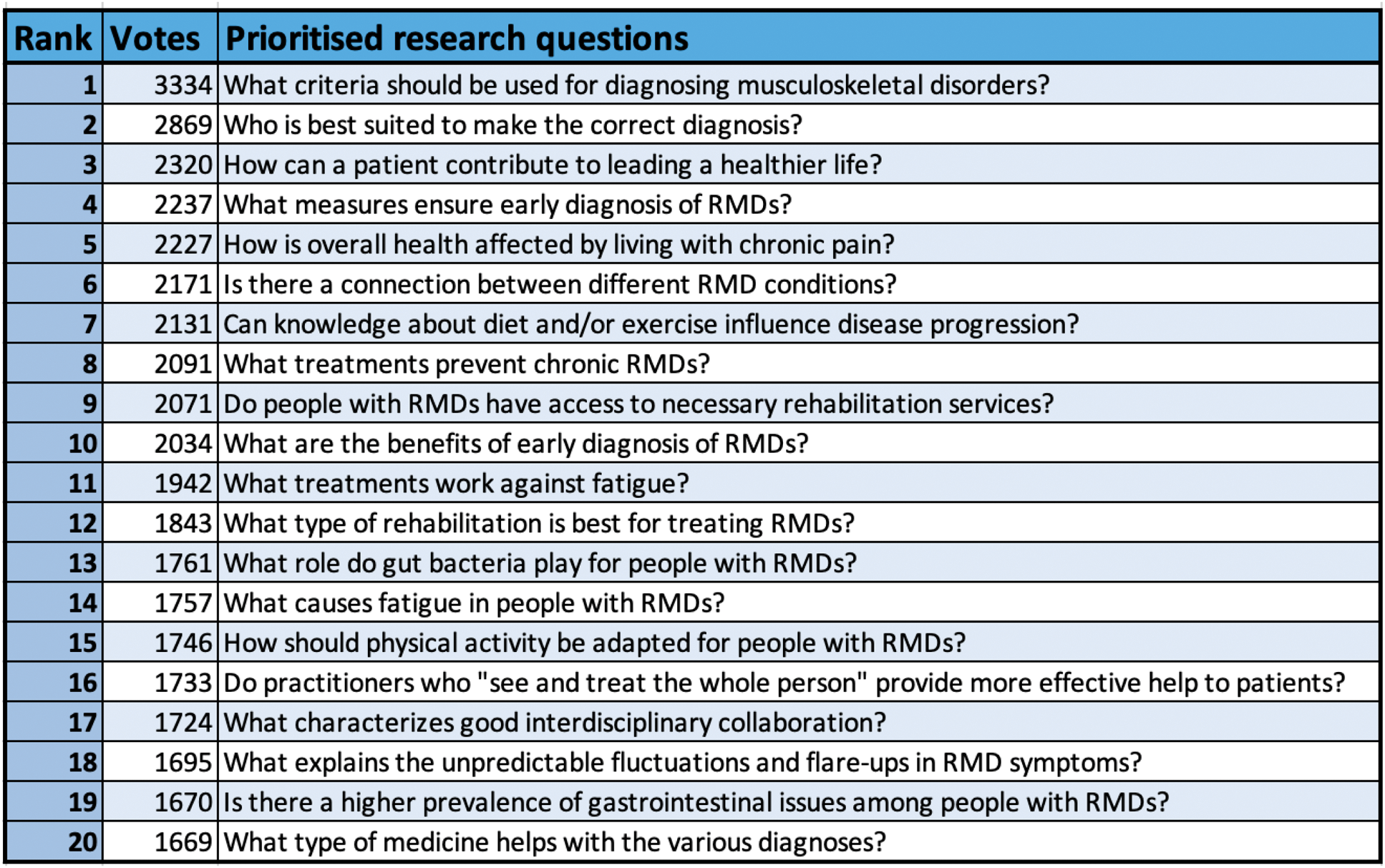
Conclusion: Among the Top 20 questions, three focus on diet, gut bacteria, and gastrointestinal health, highlighting areas of significant patient interest. Fatigue and exercise are each addressed in two questions, while others explore symptom fluctuation and the prevention of chronic RMDs. These priorities underscore the lived experiences and unmet needs of Norwegian RMD patients and should inform future research aimed at enhancing outcomes and quality of life.
REFERENCES: [1] de Wit M, Aouad K, Elhai M , et al . EULAR recommendations for the involvement of patient research partners in rheumatology research: 2023 update. Annals of the Rheumatic Diseases 2024; 83: 1443-1453.
[2] National Institute for health research, the James Lind alliance Guidebook: version 10, 2021. Available:
[3] Fryxelius a, Martinsen A, Løchting I, Hartford Kvæl L, Lunestad A, Bergland A, Storheim K. Nothing About Us Without Us: Top 10 Research Priorities from Patients – A James Lind Alliance Project for Public and Patient Involvement (PPI) [abstract].
Arthritis Rheumatol.
2023; 75 (suppl 9).
Acknowledgements: Amy Martinsen, Kjersti Storheim, Linda Aimee Hartford Kvæl, Astrid T. Lunestad, Brita Blenne Lien, Ida Stange Foss, Anne Sirnes Hagland, Bente Hamnes, Astrid Bergland, Margreth Grotle, Gerd Jenny Aanerud, Karin Magnusson, Ida Løchting.
Disclosure of Interests: Anna Fryxelius held a workshop for Pfizer in 2010, Ida Løchting: None declared. Kjersti Storheim: None declared. Amy Elise Martinsen: None declared.
© The Authors 2025. This abstract is an open access article published in Annals of Rheumatic Diseases under the CC BY-NC-ND license (