fetching data ... 
Background: Uncontrolled rheumatoid arthritis (RA) requires increasing the dosage of medications or combination therapy, leading to higher costs and increased risks of adverse events.
Objectives: This study aimed to assess the impact of Ivarmacitinib, a selective Janus kinase 1 inhibitor, on the need for additional RA medications in a phase III trial (NCT04333771) [1].
Methods: Patients received 4 mg (n=189) or 8 mg (n=189) Ivarmacitinib or placebo (n=188) once daily until week 24 (W24). From W24 to W52, patients with placebo switched to Ivarmacitinib 4 mg, while patients with Ivarmacitinib continued the initial treatment. Elevation of concomitant medication, defined as increased dosage or new medication addition for RA treatments other than the study drug, was investigated.
Results: Ivarmacitinib 4 mg and 8 mg groups had significantly lower rates of elevation of concomitant medication, at 7.4% and 5.3% respectively, compared to 22.3% in the placebo group within W24 (both P <0.001); from W24 to W52, the rates were 4.2% for Ivarmacitinib 4 mg and 3.2% for 8 mg group compared with 12.2% for the switched group (both P <0.01) (Figure 1). Specifically, patients in Ivarmacitinib groups presented a lower elevation of concomitant oral glucocorticoids than the control group. Within W24, elevation of concomitant non-steroidal anti-inflammatory drugs was lower in Ivarmacitinib 4 mg and 8 mg groups than in the placebo group. No statistical significance was observed between groups in elevation of other concomitant medications (Table 1).
Conclusion: Ivarmacitinib reduces the need for additional RA medications, thereby decreasing treatment burden.
REFERENCES: [1] Liu J, Jiang Y, Zhang S, et al. Ivarmacitinib, a selective Janus kinase 1 inhibitor, in patients with moderate-to-severe active rheumatoid arthritis and inadequate response to conventional synthetic DMARDs: results from a phase III randomised clinical trial. Ann Rheum Dis. Published online November 27, 2024. doi:10.1136/ard-2024-226385
Comparison of the percentage of patients with elevation of concomitant medication among groups.
**, P <0.01 in Ivarmacitinib 4 mg group compared with control group (placebo group or placebo-Ivarmacitinib 4 mg group, according to the time period of analysis); ***, P <0.001 in Ivarmacitinib 4 mg group compared with control group (placebo group or placebo-Ivarmacitinib 4 mg group, according to the time period of analysis); ##, P <0.01 in Ivarmacitinib 8 mg group compared with control group (placebo group or placebo-Ivarmacitinib 4 mg group, according to the time period of analysis); ###, P <0.001 in Ivarmacitinib 8 mg group compared with control group (placebo group or placebo-Ivarmacitinib 4 mg group, according to the time period of analysis)
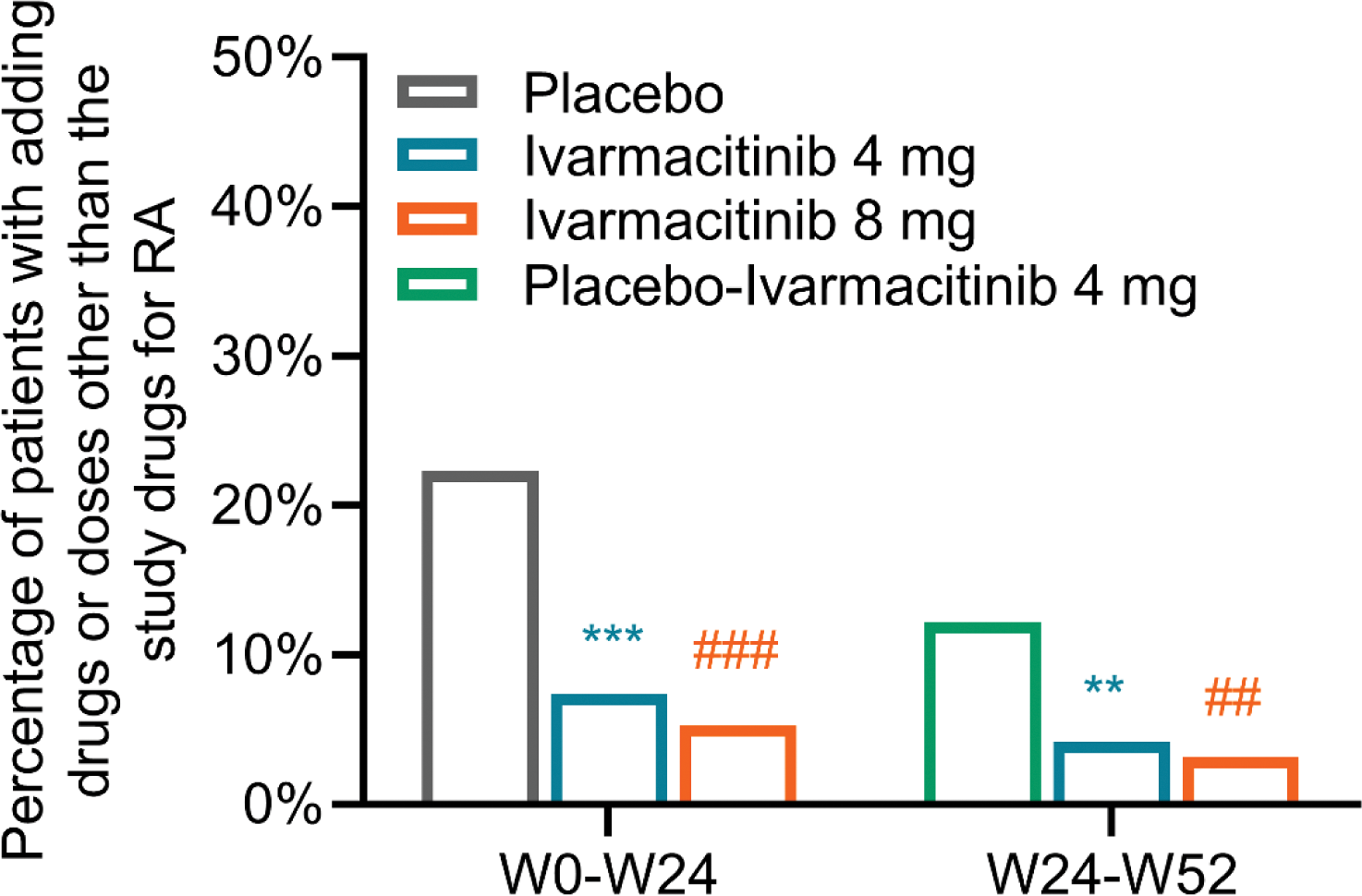
Patients with adding drugs or doses other than the study drugs for RA.
| Items | W0-W24 | W24-W52 | ||||
|---|---|---|---|---|---|---|
| Placebo | Ivarmacitinib 4 mg | Ivarmacitinib 8 mg | Placebo-Ivarmacitinib 4 mg | Ivarmacitinib 4 mg | Ivarmacitinib 8 mg | |
| All, No. (%) | 42 (22.3) | 14 (7.4)*** | 10 (5.3)### | 23 (12.2) | 8 (4.2)** | 6 (3.2)## |
| csDMARDs, No. (%) | 1 (0.5) | 0 (0.0) | 1 (0.5) | 1 (0.5) | 0 (0.0) | 1 (0.5) |
| Oral glucocorticoids, No. (%) | 11 (5.9) | 2 (1.1)* | 1 (0.5)## | 13 (6.9) | 3 (1.6)* | 1 (0.5)## |
| Intravenous/intramuscular corticosteroids, No. (%) | 1 (0.5) | 0 (0.0) | 0 (0.0) | 1 (0.5) | 2 (1.1) | 0 (0.0) |
| Systemic immunosuppressants, No. (%) | 0 (0.0) | 0 (0.0) | 0 (0.0) | 1 (0.5) | 0 (0.0) | 0 (0.0) |
| NSAIDs, No. (%) | 38 (20.2) | 13 (6.9)*** | 8 (4.2)### | 8 (4.3) | 4 (2.1) | 4 (2.1) |
*, P <0.05 for ivarmacitinib 4 mg vs placebo; **, P <0.01 for ivarmacitinib 4 mg vs placebo; ***, P <0.001 for ivarmacitinib 4 mg vs placebo. ##, P <0.01 for ivarmacitinib 8 mg vs placebo; ###, P <0.001 for ivarmacitinib 8 mg vs placebo.
RA, rheumatoid arthritis; W24, 24 weeks; W52, 52 weeks; csDMARDs, conventional synthetic disease-modifying antirheumatic drugs; NSAIDs, non-steroidal anti-inflammatory drugs.
Acknowledgements: NIL.
Disclosure of Interests: None declared.
© The Authors 2025. This abstract is an open access article published in Annals of Rheumatic Diseases under the CC BY-NC-ND license (