fetching data ... 
Background: Ivarmacitinib (SHR0302), a selective Janus kinase 1 inhibitor, has demonstrated efficacy in patients with moderate-to-severe rheumatoid arthritis (RA) who have inadequate response to conventional synthetic disease-modifying antirheumatic drugs (csDMARDs).
Objectives: This post-hoc study focuses on the impact of Ivarmacitinib on patient-reported outcomes (PROs).
Methods: This study was a post-hoc analysis derived from a phase III clinical trial (NCT04333771) [1]. Patients were randomized to receive Ivarmacitinib 4 mg (n=189), Ivarmacitinib 8 mg (n=189) or placebo (n=188) once daily. After 24 weeks, patients with placebo switched to 4 mg Ivarmacitinib, while the others continued their regimen. PROs included morning stiffness duration and severity, Health Assessment Questionnaire-Disability Index (HAQ-DI), 36-Item Short Form Health Survey (SF-36), Patient Global Assessment of Disease Activity (PtGA) and pain by visual analog scale.
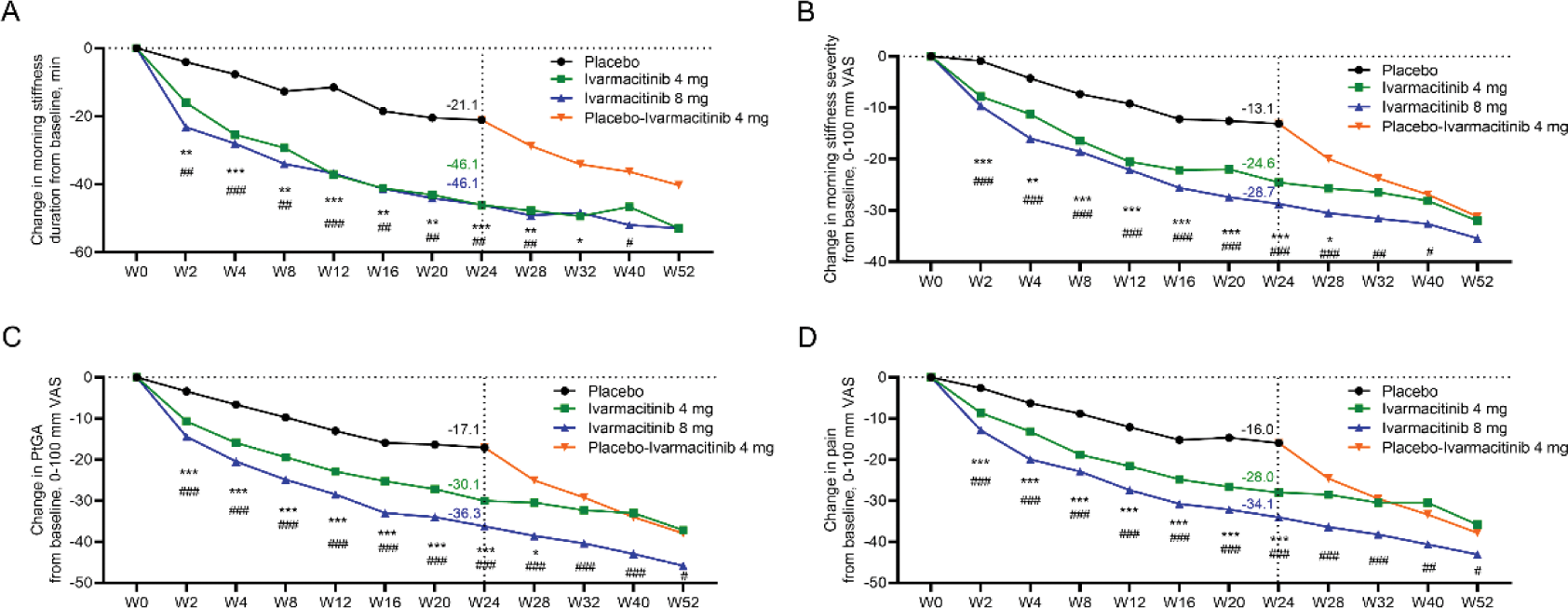
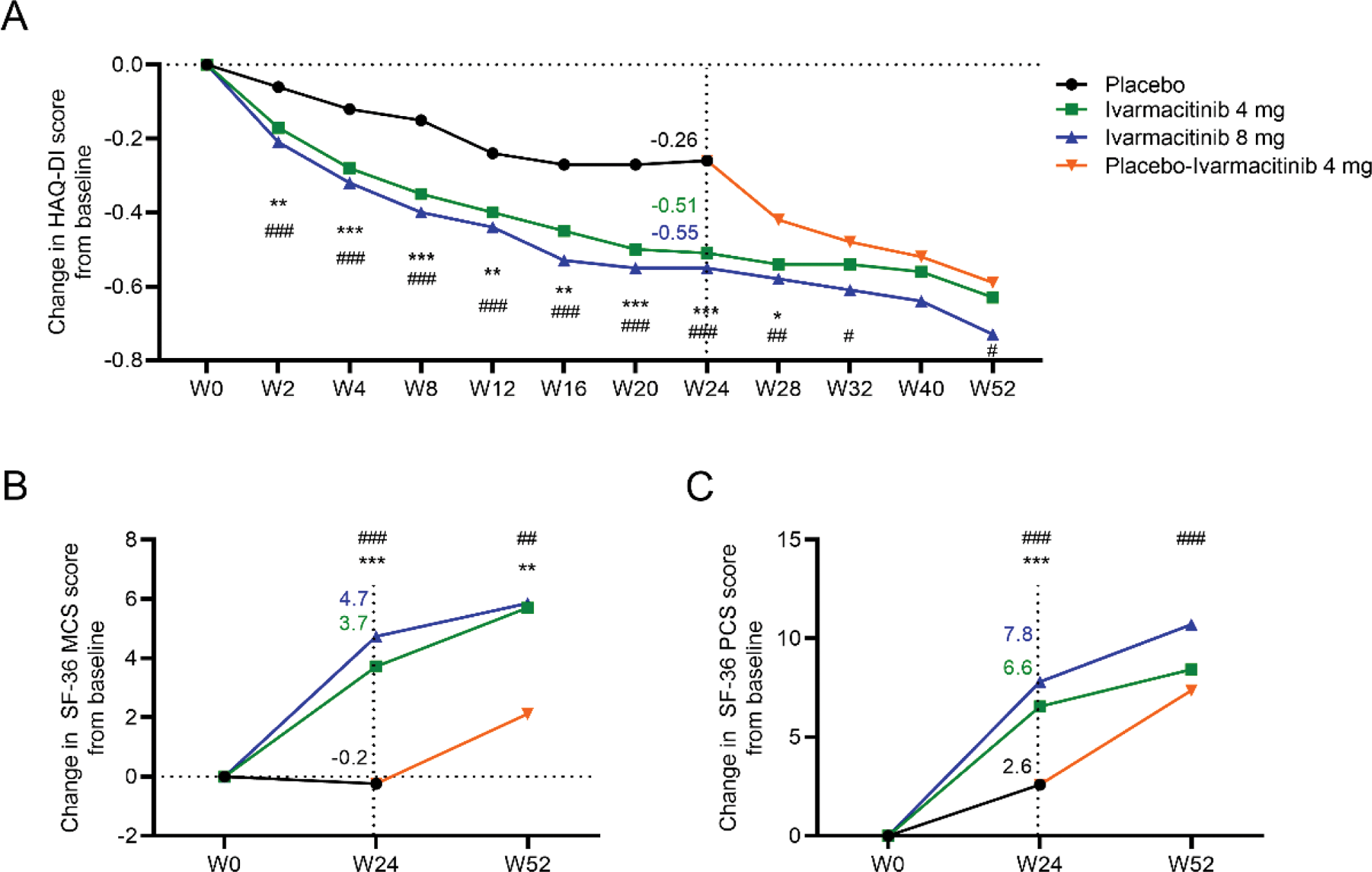
Results: At week 24, patients treated with Ivarmacitinib 4 mg and 8 mg showed significant improvements in morning stiffness duration and severity, PtGA, and pain compared to those with placebo (all P <0.05, Figure 1). Differences between the placebo-Ivarmacitinib 4 mg group and Ivarmacitinib groups diminished gradually from week 24 to week 52. Furthermore, Ivarmacitinib 4 mg and 8 mg groups exhibited significant improvements in HAQ-DI score, SF-36 physical or mental component score compared to placebo group at week 24 (all P <0.05, Figure 2); similarly, the differences between the placebo-Ivarmacitinib 4 mg group and Ivarmacitinib groups gradually diminished by week 52.
Conclusion: Ivarmacitinib significantly and sustained improves patient-reported outcomes in patients with moderate-to-severe RA who have not responded well to csDMARDs.
REFERENCES: [1] Liu J, Jiang Y, Zhang S, et al. Ivarmacitinib, a selective Janus kinase 1 inhibitor, in patients with moderate-to-severe active rheumatoid arthritis and inadequate response to conventional synthetic DMARDs: results from a phase III randomised clinical trial. Ann Rheum Dis. Published online November 27, 2024. doi:10.1136/ard-2024-226385
Comparison of the changes in morning stiffness duration ( A ), severity ( B ), PtGA ( C ), and change in pain ( D ) from baseline among groups. *, P <0.05 for Ivarmacitinib 4 mg vs placebo; **, P <0.01 for Ivarmacitinib 4 mg vs placebo; ***, P <0.001 for Ivarmacitinib 4 mg vs placebo; #, P <0.05 for Ivarmacitinib 8 mg vs placebo; ##, P <0.01 for Ivarmacitinib 8 mg vs placebo; ###, P <0.001 for Ivarmacitinib 8 mg vs placebo.
Comparison of the changes in HAQ-DI score ( A ), SF-36 physical component score ( B ), and SF-36 mental component score ( C ) from baseline among groups. *, P <0.05 for Ivarmacitinib 4 mg vs placebo; ***, P <0.001 for Ivarmacitinib 4 mg vs placebo; #, P <0.05 for Ivarmacitinib 8 mg vs placebo; ##, P <0.01 for Ivarmacitinib 8 mg vs placebo; ###, P <0.001 for Ivarmacitinib 8 mg vs placebo.
Acknowledgements: NIL.
Disclosure of Interests: None declared.
© The Authors 2025. This abstract is an open access article published in Annals of Rheumatic Diseases under the CC BY-NC-ND license (