fetching data ... 
Background: Although axial spondyloarthritis (axSpA) primarily affects the axial skeleton, peripheral musculoskeletal manifestations (i.e. peripheral arthritis, enthesitis and dactylitis) also occur frequently in this patient population and contribute to the burden of disease. Currently, a comprehensive synthesis on the effect of biological and targeted synthetic therapies on these manifestations is lacking.
Objectives: To evaluate the efficacy of biological or targeted synthetic DMARDs (bDMARDs/tsDMARDs) on peripheral musculoskeletal manifestations in axSpA.
Methods: A systematic literature review (SLR) was conducted (PROSPERO registration CRD42024532666). Previously conducted SLRs on bDMARD/tsDMARD efficacy for the 2016 and 2022 updates of the ASAS-EULAR management recommendations for axSpA were used as a starting point to identify studies of interest (covering the literature ≤2021).[1-3] In addition, an updated search was conducted to cover the period from 2022 to March 2024. The PICOT framework was used to identify studies in adult patients with axSpA (P) that assessed the effect of bDMARDs/tsDMARDs (I) compared to any active treatment or placebo (C) on peripheral arthritis, enthesitis and dactylitis (O), and had a randomised/clinical controlled trial design (T). Titles and abstracts were screened by two reviewers, and data were extracted using a standardized extraction form. Risk of bias (RoB) was assessed using the Cochrane RoB tool for RCTs. Quantitative synthesis focused on change from baseline for each peripheral manifestation, calculating standardized mean differences (SMDs; <0.5 small, 0.5-0.8 moderate, >0.8 large effect; negative SMDs indicating effects that favour intervention over control), and also considered complete resolution of each peripheral manifestation. If reported data were insufficient to calculate SMDs for change from baseline, outcome values at follow-up (post-intervention) were considered instead.
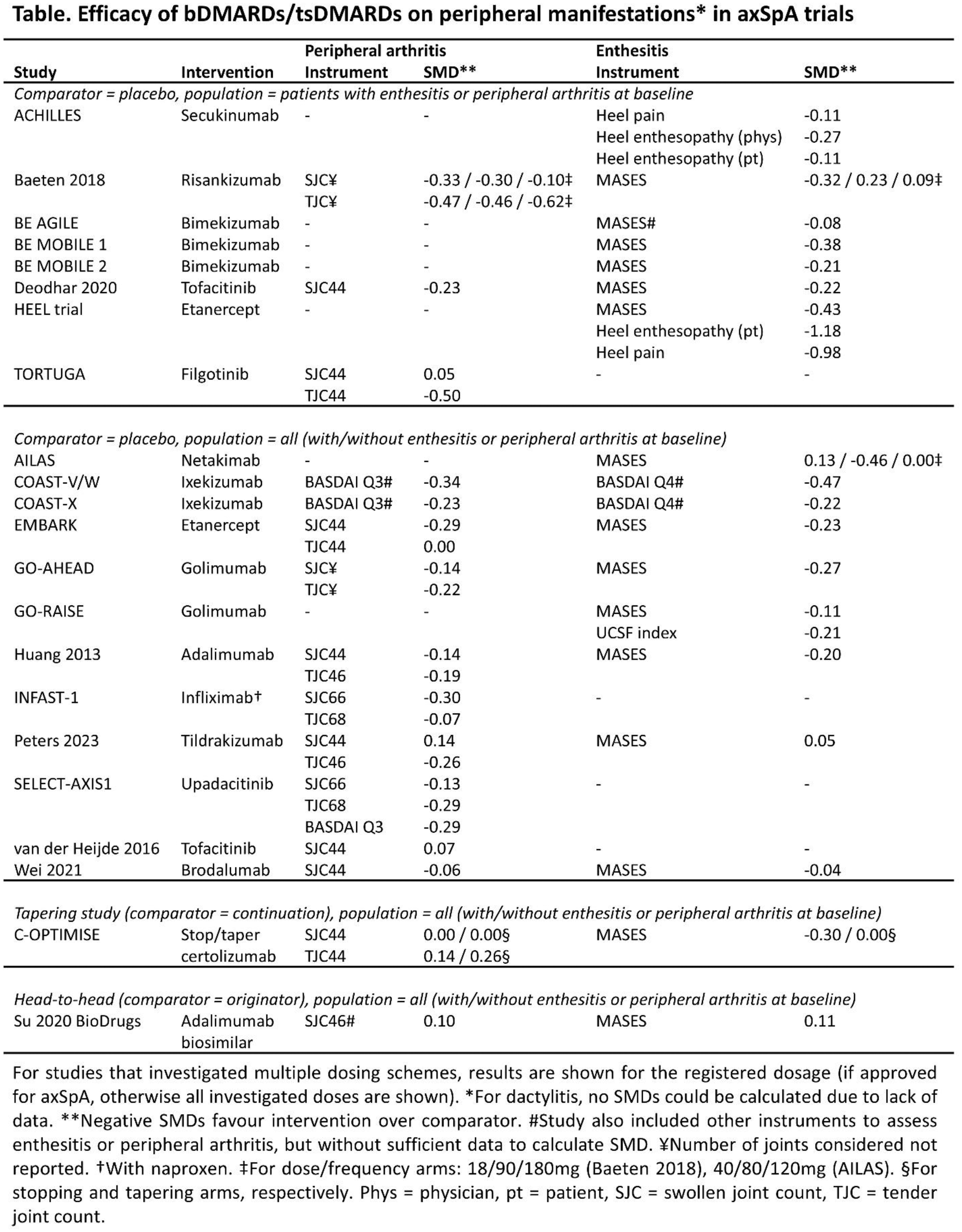
Results: The previously conducted SLRs included 83 trials on bDMARD/tsDMARD efficacy (≤2021), and the updated search (2022-2024; 5287 records) yielded another 17, resulting in a total of 100 trials. Of these, 50 reported efficacy results on any of the peripheral manifestations and were included in the current review. Radiographic axSpA was the most frequent subtype included in these studies (n=32 studies [64%]). Most included studies investigated bDMARDs, especially TNF inhibitors (n=24 [48%]) and IL-17 inhibitors (n=13 [26%]), while few focused on tsDMARDs (n=6 [12%]), mainly JAK inhibitors (n=5 [10%]). Studies typically compared active treatment to placebo (n=35 [70%]), although some studies involved a head-to-head comparison (n=6 [13%], usually in the context of a biosimilar versus originator comparison). Several studies (n=4 [8%]) focused on tapering or complete withdrawal of bDMARDs/tsDMARDs. Studies were generally of low RoB (n=33 [66%]) or unclear RoB (n=10 [20%]). Of the 50 included studies, 37 (74%) reported results on peripheral arthritis, 46 (92%) on enthesitis and only 1 (2%) on dactylitis. For peripheral arthritis, most studies reported results based on a 44-joint swollen and/or tender joint count (n=14 [38%]). SMDs indicated mainly small effects on peripheral arthritis for both bDMARDs and tsDMARDs (n=16 studies), with most SMDs ranging from -0.5 to 0 (Table 1). Of note, only a minority of studies reported results in the subgroup with peripheral arthritis at baseline, showing slightly higher effects. Complete resolution of peripheral arthritis in those affected at baseline (n=2 studies, both investigating bimekizumab) was 58-64% for bimekizumab and 36-42% for placebo. For enthesitis, most studies (n=36 [78%]) reported results based on the MASES. Similar to peripheral arthritis, SMDs indicated mainly small to moderate effects on enthesitis for both bDMARDs and tsDMARDs (n=19 studies, Table 1). Complete resolution of enthesitis (n=5 studies) occurred in 34-52% of patients for various bDMARDs and 14-33% for placebo. Studies for which no SMD could be calculated showed similar results on peripheral arthritis and enthesitis (e.g. similar between-group differences at follow-up). Finally, for dactylitis, the only available study was a TNF inhibitor tapering study. Dactylitis counts were similar in both study arms (median of 0 in both), although the majority of patients did not have active dactylitis at baseline.
Conclusion: In axSpA, bDMARDs and tsDMARDs have small to moderate effects on peripheral arthritis and enthesitis. For dactylitis, efficacy data for these drugs are very scarce in axSpA. Most studies do not report results in the population of interest (those affected at baseline), possibly resulting in an underestimation of intervention effects.
Table 1.
REFERENCES: [1] Sepriano A, Regel A, van der Heijde D, et al. RMD Open 2017;3:e000396.
[2] Webers C, Ortolan A, Sepriano A, et al. Ann Rheum Dis. 2023;82:130-141.
[3] Ortolan A, Webers C, Sepriano A, et al. Ann Rheum Dis. 2023;82:142-152.
Acknowledgements: This SLR was funded by the Assessment of SpondyloArthritis international Society (ASAS) as part of the ASAS-SPARADISE project.
Disclosure of Interests: Casper Webers Novartis, Augusta Ortolan AbbVie, Astra Zeneca, Janssen, Novartis, AbbVie, Elena Nikiphorou UCB, Pfizer, Gilead, Galapagos, AbbVie, Eli Lilly, Alfasigma, Fresenius, Pfizer, UCB, Pfizer, Gilead, Galapagos, AbbVie, Eli Lilly, Alfasigma, Fresenius, Pfizer, Pfizer, Eli Lilly, Alexandre Sepriano AbbVie, Lilly, Abbvie, Lilly, UCB, Novartis, Louise Falzon: None declared, Clementina López-Medina Janssen, Eli Lilly, AbbVie, UCB, Novartis, AbbVie, Janssen, Novartis, Eli Lilly, AbbVie, UCB and Eli Lilly, Dafne Capelusnik: None declared, Désirée van der Heijde AbbVie, Alfasigma, ArgenX, BMS, Elly-Lilly, Grey-Wolf Therapeutics, Janssen, Novartis, Pfizer, Takeda, UCB Pharma, Anna Moltó Abbvie, Biogen, BMS, Galapagos, Johnson & Johnson, Lilly, Novartis, Pfizer, UCB, Viatris, Abbvie, Biogen, UCB, Sofia Ramiro Eli Lilly, Novartis, UCB, AbbVie, Eli Lilly, Galapagos/Alfasigma, Janssen, MSD, Pfizer, UCB, Sanofi, AbbVie, Galapagos/Alfasigma, MSD, Novartis, Pfizer, UCB.
© The Authors 2025. This abstract is an open access article published in Annals of Rheumatic Diseases under the CC BY-NC-ND license (