fetching data ... 
Background: Ankylosing spondylitis (AS) is a chronic inflammatory disorder predominantly affecting the spine and other joints, commonly manifesting in adolescents and young adults. It is marked by progressive inflammation that can result in pain, stiffness, and potential fusion of the spinal vertebrae, severely impacting mobility and quality of life. There remains a need for more effective treatment options for patients who respond inadequately to non-steroidal anti-inflammatory drugs (NSAIDs). Vunakizumab, a humanized monoclonal IgG1/k antibody targeting IL-17A, has demonstrated significant improvements in the signs and symptoms of AS compared to placebo in a randomized, double-blind, phase 2/3 trial (NCT04840485).
Objectives: The objective was to assess the efficacy and safety of 120 mg of vunakizumab in patients with AS, stratified by BMI (18 kg/m² ≤ BMI < 24 kg/m² vs. BMI ≥ 24 kg/m²), based on data from a phase 2/3 trial in which patients were treated with either a placebo or 120 mg of vunakizumab.
Methods: The phase 2/3 trial included patients with AS who had an inadequate response to NSAIDs, or who were contraindicated or intolerant to NSAIDs. In phase 2, patients were randomized in a 2:2:1 ratio to receive either 120 mg or 240 mg of vunakizumab, or placebo. At week 16, patients in the placebo group were re-randomized in a 1:1 ratio to receive either 120 mg or 240 mg of vunakizumab. In phase 3, patients were randomized in a 2:1 ratio to receive either 120 mg of vunakizumab or placebo. Treatments were administered at weeks 0, 2, 4, 8, and 12, followed by every four weeks through week 32. The primary endpoint was the Assessment of Spondyloarthritis International Society 20 (ASAS20) response criteria at week 16. This study evaluated ASAS20, ASAS40, and ASAS5/6 response rates at weeks 2, 16, and 32, as well as treatment-emergent adverse events (TEAEs) during the 16-week period.
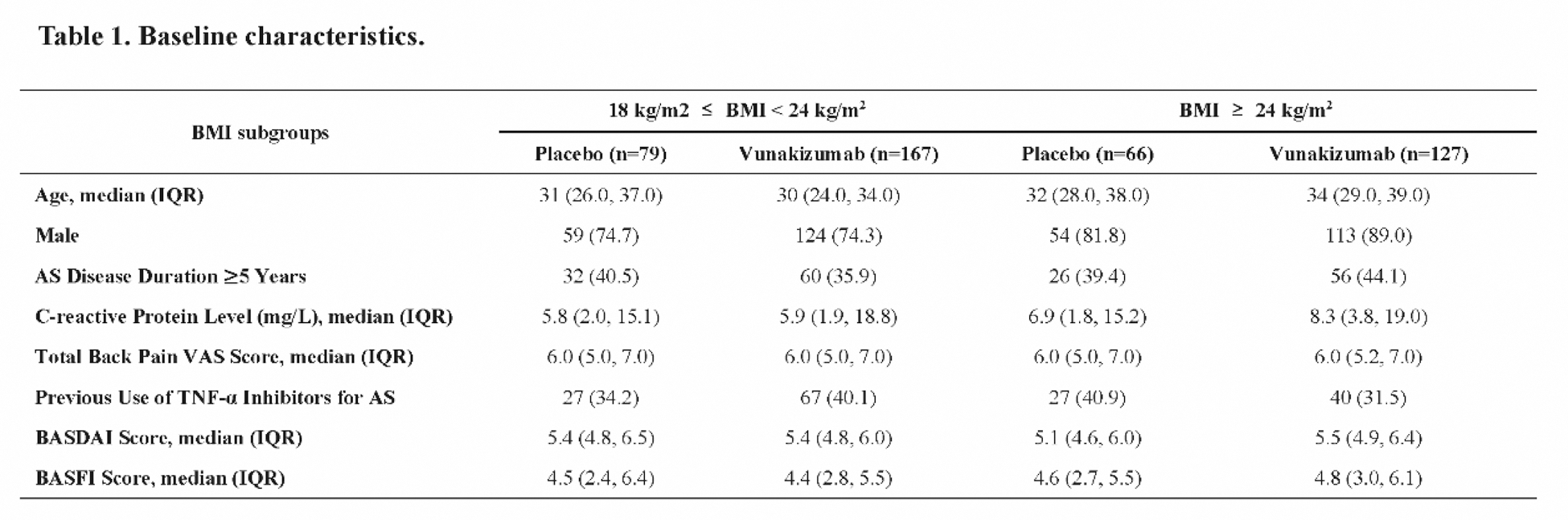
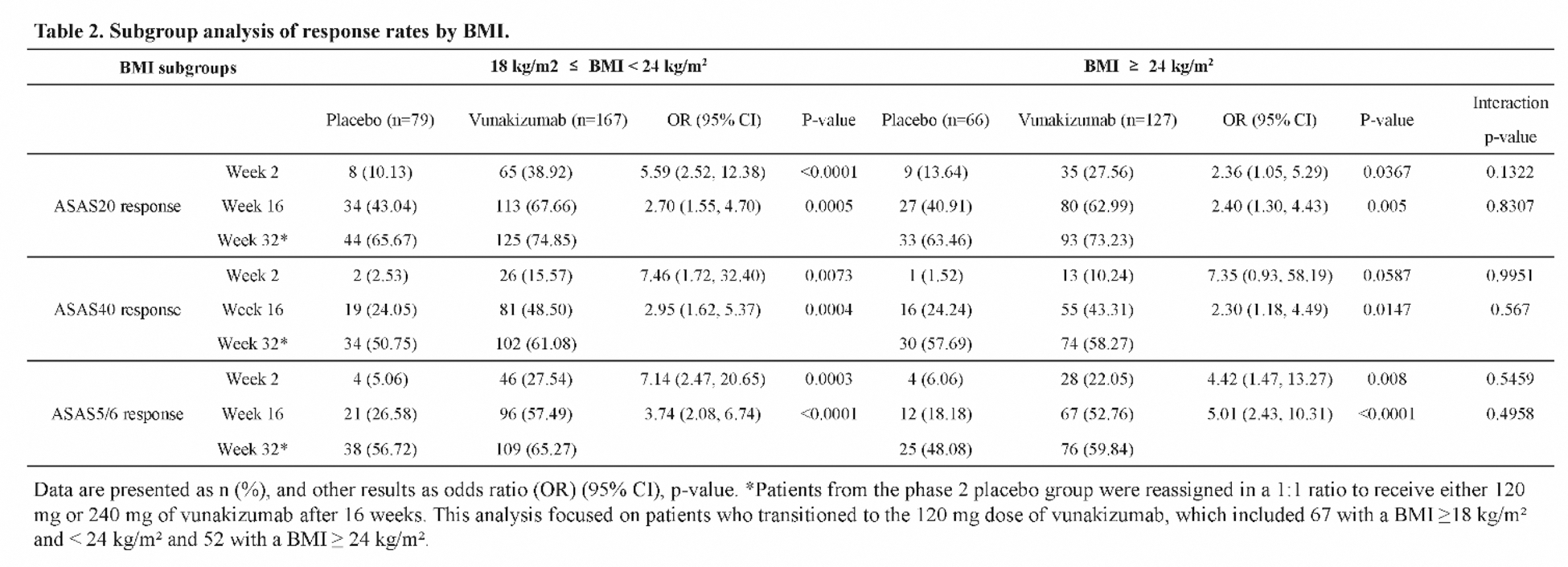
Results: In the BMI subgroups, patients with a BMI ≥18 kg/m² and < 24 kg/m² included 79 in the placebo group and 167 in the vunakizumab 120 mg group. For those with a BMI of ≥24 kg/m², 66 received a placebo and 127 received vunakizumab 120 mg. Baseline characteristics were generally balanced across BMI subgroups between the placebo and vunakizumab groups. However, among those with a BMI of ≥24 kg/m², prior use of TNF-α inhibitors for AS was more common in the placebo group (40.9%) compared to the vunakizumab group (31.5%) (Table 1). Vunakizumab showed a rapid onset of action with higher response rates than placebo by week 2 across BMI subgroups. In patients with a BMI ≥18 kg/m² and < 24 kg/m², ASAS20, ASAS40, and ASAS5/6 rates were 38.92% vs. 10.13% (p < 0.0001), 15.57% vs. 2.53% (p = 0.0073), and 27.54% vs. 5.06% (p = 0.0003), respectively. In patients with a BMI ≥ 24 kg/m², rates were 27.56% vs. 13.64% (p = 0.0367), 10.24% vs. 1.52% (p = 0.0587), and 22.05% vs. 6.06% (p = 0.008). At week 16, in patients with a BMI ≥18 kg/m² and < 24 kg/m², ASAS20 responses were 67.66% in the vunakizumab group and 43.04% in the placebo group (p = 0.0005). ASAS40 responses were 48.50% versus 24.05% (p = 0.0004). For ASAS5/6, the responses were 57.49% versus 26.58% (p < 0.0001). In those with a BMI ≥ 24 kg/m², ASAS20, ASAS40, and ASAS5/6 responses were all higher for vunakizumab than for placebo (62.99% vs. 40.91%, p = 0.005; 43.31% vs. 24.24%, p = 0.0147; 52.76% vs. 18.18%, p < 0.0001). There were no significant differences in response rates for ASAS20, ASAS40, and ASAS5/6 between the vunakizumab and placebo groups across BMI subgroups at week 2 and 16 by logistic regression analysis. Additionally, the placebo group, which transitioned to receiving 120 mg of vunakizumab, showed improved ASAS20, ASAS40, and ASAS5/6 response rates at week 32 compared to their rates at week 16 (Table 2). Over the period of 16 weeks, the majority of TEAEs were classified as mild. Among patients with a BMI ≥18 kg/m² and < 24 kg/m², 92.41% in the placebo group and 86.83% in the vunakizumab group experienced mild TEAEs. For patients with a BMI ≥ 24 kg/m², the rates were 89.39% for the placebo group and 93.70% for the vunakizumab group. The most frequently reported TEAE was upper respiratory tract infection. In the BMI ≥18 kg/m² and < 24 kg/m² subgroup, 35.44% of patients in the placebo group and 30.54% in the vunakizumab group reported upper respiratory tract infections. For those with a BMI ≥ 24 kg/m², the rates were 27.27% for placebo and 29.13% for vunakizumab.
Conclusion: Vunakizumab 120 mg significantly improved AS symptoms across BMI categories, with consistent efficacy and rapid response observed in both subgroups. These results highlight its potential as a valuable treatment option for AS patients, regardless of BMI.
REFERENCES: NIL.
Acknowledgements: NIL.
Disclosure of Interests: None declared.
© The Authors 2025. This abstract is an open access article published in Annals of Rheumatic Diseases under the CC BY-NC-ND license (