fetching data ... 
Background: Anti-nuclear antibody (ANA) assessment plays a key role in the diagnosis, clinical stratification and prognostic evaluation of patients with systemic sclerosis (SSc). Hallmark SSc antibodies such as anti-topoisomerase (ATA) anti-RNA polymerase III (ARA) or anti-centromere (ACA) have established associations with specific organ manifestations such as interstitial lung disease (ILD) and are a useful tool to evaluate risk and inform clinical management.
Objectives: Few studies have evaluated the less common nucleolar antibodies (ANoA) including anti-U3 RNP (or fibrillarin), anti-Th/To, and PmScl which also carry associations with SSc. In this analysis, we sought to investigate clinical associations of ANoA in a well characterised SSc cohort.
Methods: We evaluated 246 SSc patients retrospectively from a large tertiary centre with confirmed diagnosis of SSc and had a positive ANA nucleolar pattern on serum analysis between 2019-2024. Primary ANA pattern was identified by indirect immunofluorescence (IIF) on human epithelial type 2 (HEp-2) cells (titre >1:80) and presence of antigens detected by IIF and line immunoblot assay (LIA). ANA nucleolar patterns were analysed with respect to SSc subsets and clinical characteristics by organ involvement. Statistical analyses was performed using Microsoft Excel and GraphPad Prism.
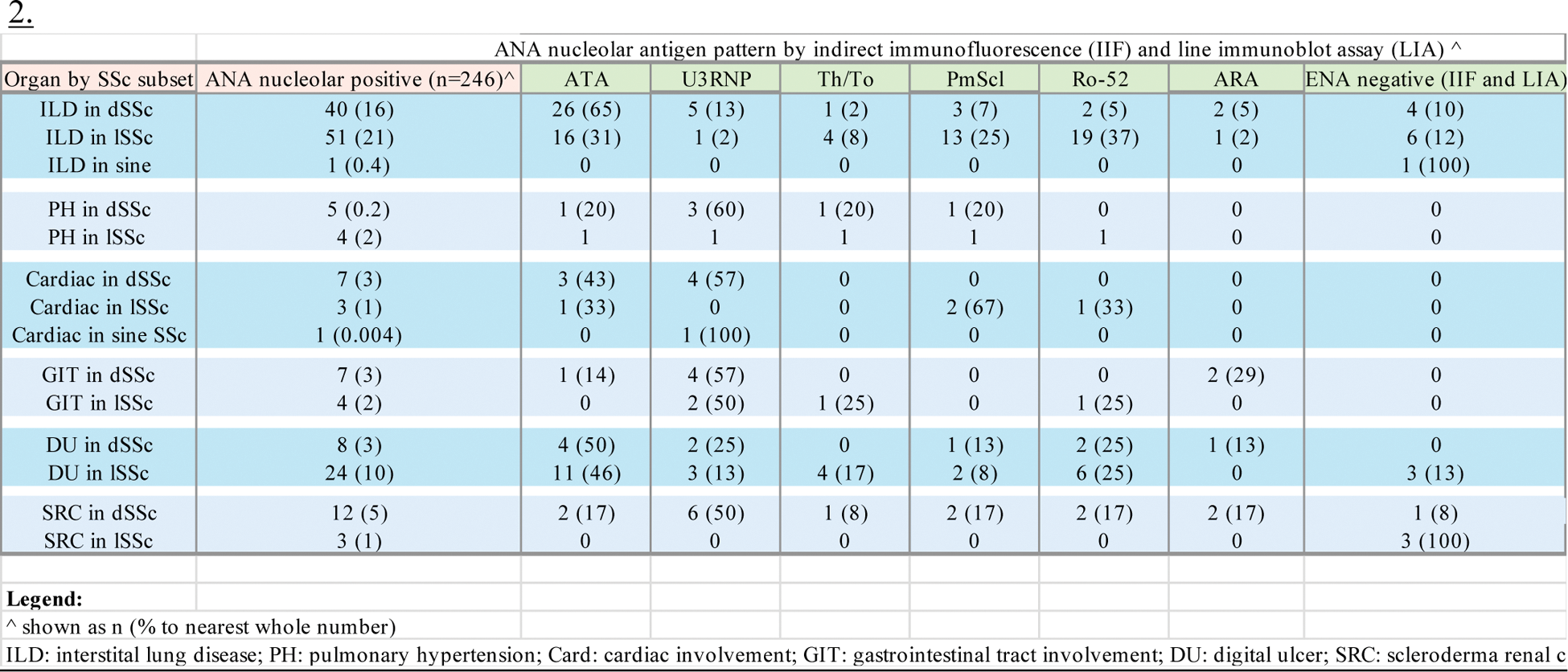
Results: Baseline characteristics of the study cohort of SSc patients and presence of antigen reactivity by IIF and LIA including U3RNP, Th/To, PmScl, Ro 52, ENA negative as well as known hallmark ATA and ARA antibodies are shown (Tables 1 and 2). Analysis of ILD association in the Th/To and ENA negative antigen subgroups was performed by Fisher’s exact test and Koopman’s asymptotic score to calculate relative risk and confidence interval respectively. 37% (92/246) of the ANoA cohort had ILD. Amongst them, 11/92 (12%) were ENA negative. 11/45 (24%) of the ENA negative group had ILD. The relative risk of ILD in the ANoA with ENA negative group compared to ANoA with any antigen group was 0.57 (95% CI 0.3266 to 0.9384); p value 0.0275 . Th/To was positive in 15/246 ANoA samples and a third (5/15) had ILD. Moschetti et al* recently described 40% (4/10 patients) cases of ILD amongst Th/To positive patients in a European cohort of 608 SSc patients. We analysed Th/To and ILD association compared to other ANoA antigens. The relative risk of ILD in Th/To positive compared to ANoA positive with any antigen was 0.86 (95% CI 0.3885 to 1.565); p value 0.7889. Similarly when the Th/To positive and ENA negative subsets were compared, RR was 1.36 (95% CI 0.5476 to 3.055); p value 0.5156.
Conclusion: Our analysis further highlights the heterogeneity across SSc subtypes by the less widely studied ANoA and demonstrates statistically significant relative risk of ILD in the ANoA positive but ENA negative subgroup. Future prospective studies in larger cohorts and long term follow up are needed to further characterise both the ENA negative and Th/To groups.
REFERENCES: [1] *Moschetti L et al. Clin Exp Rheumatol 2023; 41(8): 1589-98.
Table 1. Baseline characteristics of ANA nucleolar positive SSc patients by specific nucleolar antigen.
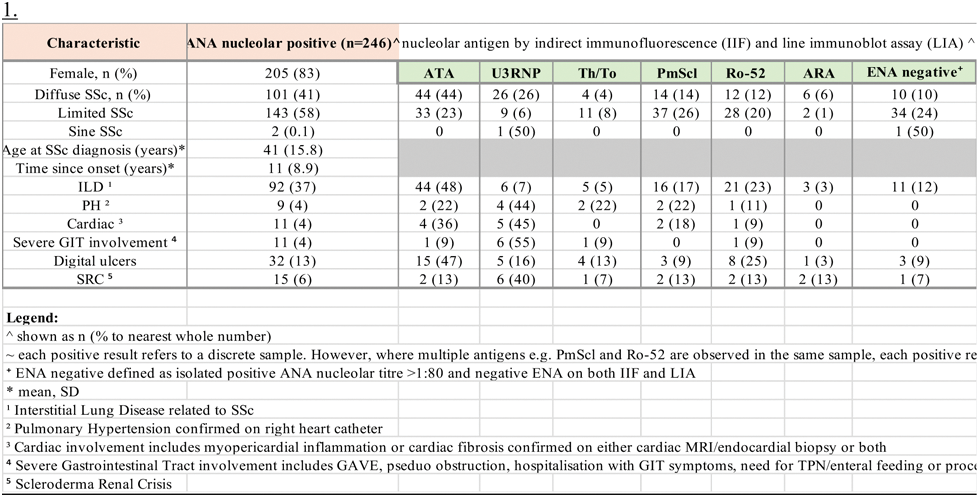
Table 2. Organ based characteristics of the SSc subsets with positive ANA nucleolar by specific nucleolar antigen.
Acknowledgements: NIL.
Disclosure of Interests: Medha Kanitkar: None declared, Christopher Denton Boehringer Ingelheim, Corbus, Janssen, Abbvie, Janssen, GlaxoSmithKline, Bayer, Sanofi-Aventis, Galapagos, Inventiva, Boehringer Ingelheim, Roche, CSL Behring, Corbus, Acceleron, Horizon, Arxx Therapeutics, Lilly, Novartis, Certa, Zurabio;, Abbvie, Arxx Therapeutics, Horizon, GlaxoSmithKline, CSL Behring, Servier; Voon H Ong: None declared.
© The Authors 2025. This abstract is an open access article published in Annals of Rheumatic Diseases under the CC BY-NC-ND license (