fetching data ... 
Background: B cell-mediated production of autoantibodies is a pivotal step in pathogenesis of autoimmune diseases (AID) such as systemic lupus erythematosus (SLE). Autologous CD19 chimeric antigen receptor (CAR)-T cells offer a novel approach to deeply deplete B cells in patients with AID, representing a promising treatment strategy. Previous studies have demonstrated that a single infusion of CD19-CAR T-cells is well-tolerated in patients with systemic lupus erythematosus (SLE) and other autoimmune diseases such as systemic sclerosis (SSc) and idiopathic inflammatory myopathy (IIM), inducing sustained, drug-free remission [1, 2]. As CD19-CAR T-cell therapy deeply intervenes in the adaptive immune system and has also shown to alter serum IgA levels we were interested on how this treatment affects the gut microbiome and fecal IgA levels.
Objectives: To elucidate the gut microbial composition and fecal IgA levels before and CD19-CAR T-cell therapy in patients with AID.
Methods: Patients with severe SLE, SSc or IIM received a single infusion of 1x10 6 /kg body weight autologous CD19-CAR T-cells, manufactured by lentiviral-based transfection of T-cell with a vector encoding a second-generation CAR with a CD19 binder and a 4-1BB costimulation domain (MB-CART19.1; Miltenyi). Fecal samples were collected before and 6 months after CD19-CAR T-cell therapy. DNA was extracted from the faecal samples. These samples were analysed for gut microbiota composition by metagenomic shotgun sequencing. In addition, faecal IgA content, was analysed by ELISA, as previously described [3].
Results: Ten patients with AID (4 SLE, 5 SSc and 1 IIM) were analysed (Figure 1A). Microbiome was assessed in 6 patients, fecal IgA content was evaluated in all 10 patients. At the genus level, Bifidobacterium tended to decrease after the therapy (P = 0.06). Among bacterial species, Streptococcus species such as Streptococcus gallolyticus , Enterococcus species such as E. wangshanyuanii and E. lactis , significantly decreased after therapy by linear discriminant analysis effect size (LEfSe) analysis (Figure 1B). Streptococcus spp. and Enterococcus spp. are potential gut pathobionts for SLE, as previously reported [4, 5]. Four out of 6 patients showed a decrease in bacterial α-diversity after the therapy (Figure 1C). Additionally, in viral species, Skunavirus spp. were significantly altered after CD19-CAR T-cell therapy. Fecal IgA levels tended to decrease after CD19-CAR T-cell therapy (P = 0.2). Seven out of 10 patients showed decreased fecal IgA levels after the therapy, consistent with a reduction in serum IgA levels (Figure 1D).
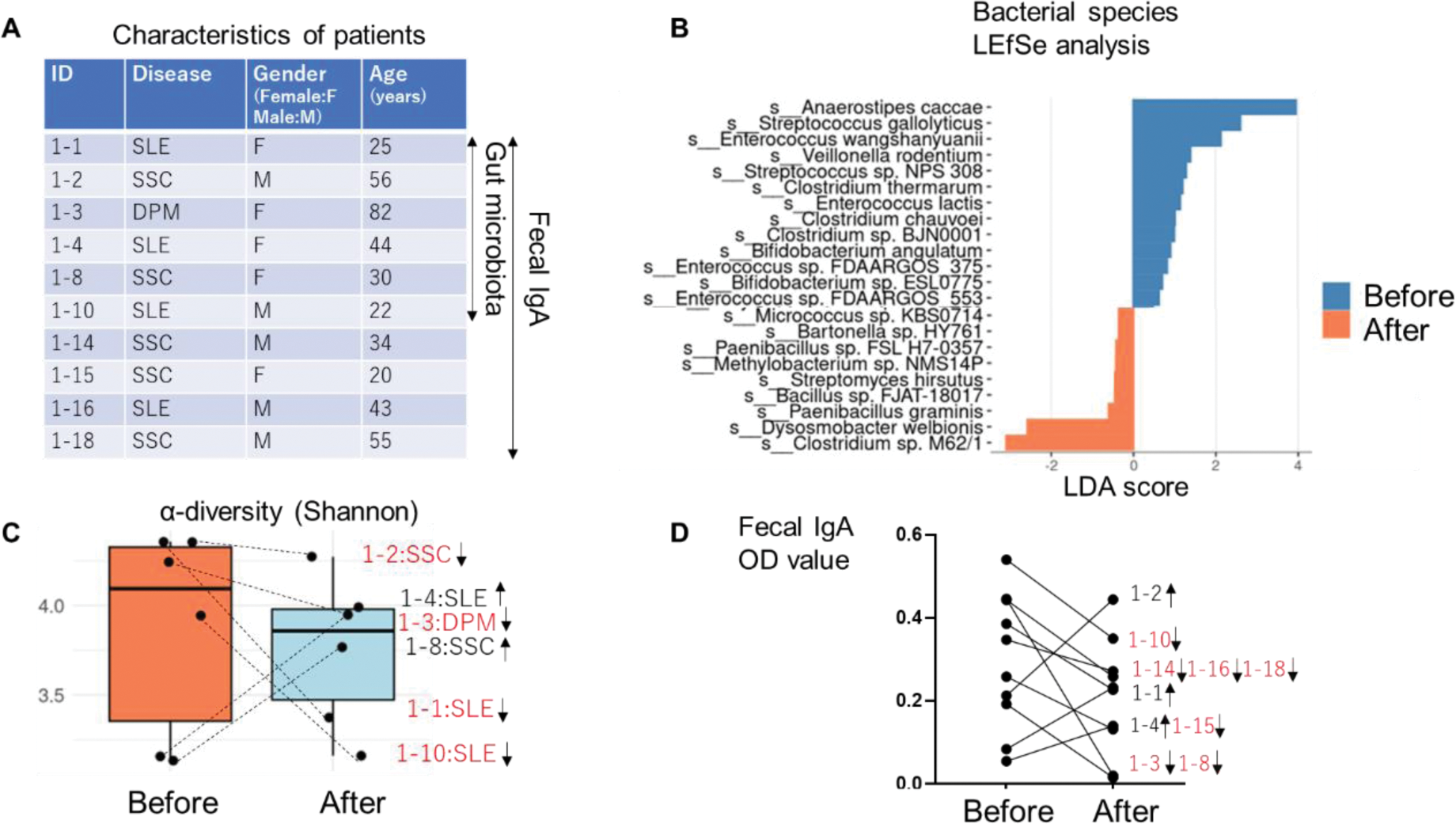
Conclusion: We show that CD19-CAR T-cell therapy changes gut microbiota composition in patients with AID. Prevalence of pathobionts associated with SLE, such as Enterococcus and Streptococcus species, decrease after CD19-CAR T-cell therapy. These changes may contribute to long-term remission in patients with AID.
REFERENCES: [1] Mougiakakos D et al. N Engl J Med 2021;385:567-569.
[2] Mackensen A. et al. Nat Med 2022 Oct; 28(10):2124-21.
[3] Masahata K, et al. Nat Commun. 2014 Apr 10;5:3704.
[4] Tomofuji Y, Maeda Y. et al. Ann Rheum Dis. 2021 Dec;80(12):1575-1583.
[5] Manfredo Vieira S, Kriegel MA. et al. Science. 2018 Mar 9;359(6380):1156-1161.
Acknowledgements: NIL.
Disclosure of Interests: Yuichi Maeda Dr. Rolf M:Schwiete Foundation, Mannheim, Germany, Stefan Wirtz: None declared, Melanie Hagen: None declared, Tobias Rothe: None declared, Andreas Wirsching: None declared, Ricardo Grieshaber-Bouyer: None declared, Ilia Gimaev: None declared, Eva Schmid: None declared, Martin Kriegel: None declared, Fabian Müller AstraZeneca, Abbvie, Beigene, BMS, Janssen, Kite/Gilead, Miltenyi, Novartis, Sobi, Taketa, AstraZeneca, BMS, CRISPR Therapeutics, Janssen, Kite/Gilead, Miltenyi, Novartis, Sobi, MedImmune/AstraZeneca, Kite/Gilead, BMS, Andreas Mackensen: None declared, Georg Schett: None declared, Mario M. Zaiss Dr. Rolf M:Schwiete Foundation, Mannheim, Germany.
© The Authors 2025. This abstract is an open access article published in Annals of Rheumatic Diseases under the CC BY-NC-ND license (