fetching data ... 
Background: Psoriatic arthritis (PsA) affects ~20-30% of patients with psoriasis (PsO) [1, 2, 3]. PsA causes articular inflammation and damage, fatigue, pain, and impaired physical function, leading to profound negative impacts on health-related quality of life (HRQoL) [4]. The IL-23 pathway plays a pivotal role in the pathogenesis of PsO and PsA [5]. Injectable biologics inhibiting the IL-23p19 subunit have demonstrated a favorable benefit-risk profile with durable efficacy. While oral therapies are available for the treatment of PsA, a substantial unmet need remains for highly efficacious and safe oral therapy options. Icotrokinra, a novel targeted oral peptide that binds directly to the IL-23R and inhibits proximal IL-23R signaling and downstream effector functions (eg, cytokine secretion), showed greater clinical response rates vs placebo (PBO) and a favorable safety profile in participants with moderate-to-severe plaque PsO in the Phase 2b FRONTIER 1&2 studies [6, 7]. Icotrokinra is being evaluated in Phase 3 studies in participants with moderate-to-severe PsO and in a Phase 2 study of participants with moderately-to-severely active ulcerative colitis.
Objectives: To leverage exploratory serum biomarker, Patient Reported Outcomes Measurement Information Systems (PROMIS-29), and Psoriasis Area and Severity Index 75% improvement (PASI75) data from a subset of FRONTIER 1 participants with PsO and a medical history of PsA (PsO+PsA) in support of conducting the Phase 3 ICONIC-PsA 1 and ICONIC-PsA 2 studies.
Methods: Mean log fold-changes (logFC) in serum levels of β-Defensin-2 (BD-2), IL-22, IL-17A, and IL-17F were summarized for FRONTIER participants with PsO only and those with PsO+PsA. Participants completed the PROMIS-29 questionnaire to assess their HRQoL across distinct domains (physical function, anxiety, depression, fatigue, sleep disturbance, ability to participate in social roles and activities, pain interference, and pain intensity). Improvements ≥5-points in PROMIS-29 domain scores (or ≥2-points for pain), and in the physical/mental component summary (PCS/MCS) scores to which they contribute, are considered clinically meaningful [8]. Sample sizes for the Phase 3 PsA studies were informed both by ample safety data to support a regulatory submission and estimates derived from model-based analyses. Specifically, a meta-analysis employed FRONTIER 1 PASI75 response rates to bridge to expected ACR20 response at Week (W) 16 (primary endpoint), and meta-regression modeling bridged between ACR20 response and secondary endpoints of interest, including more stringent joint disease activity (ACR50/70), skin (PASI90/100), and multi-domain (Minimal Disease Activity) outcomes.
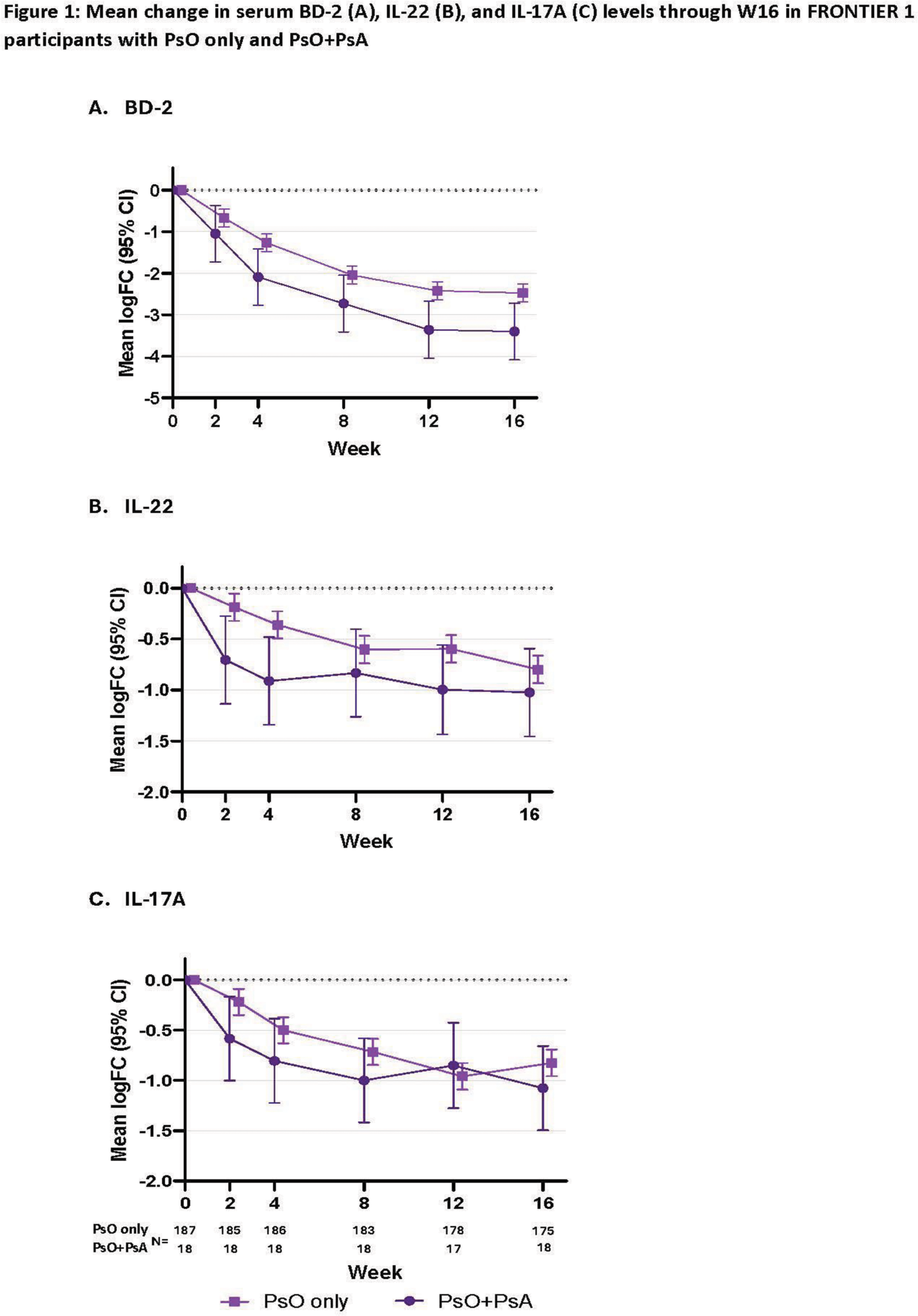
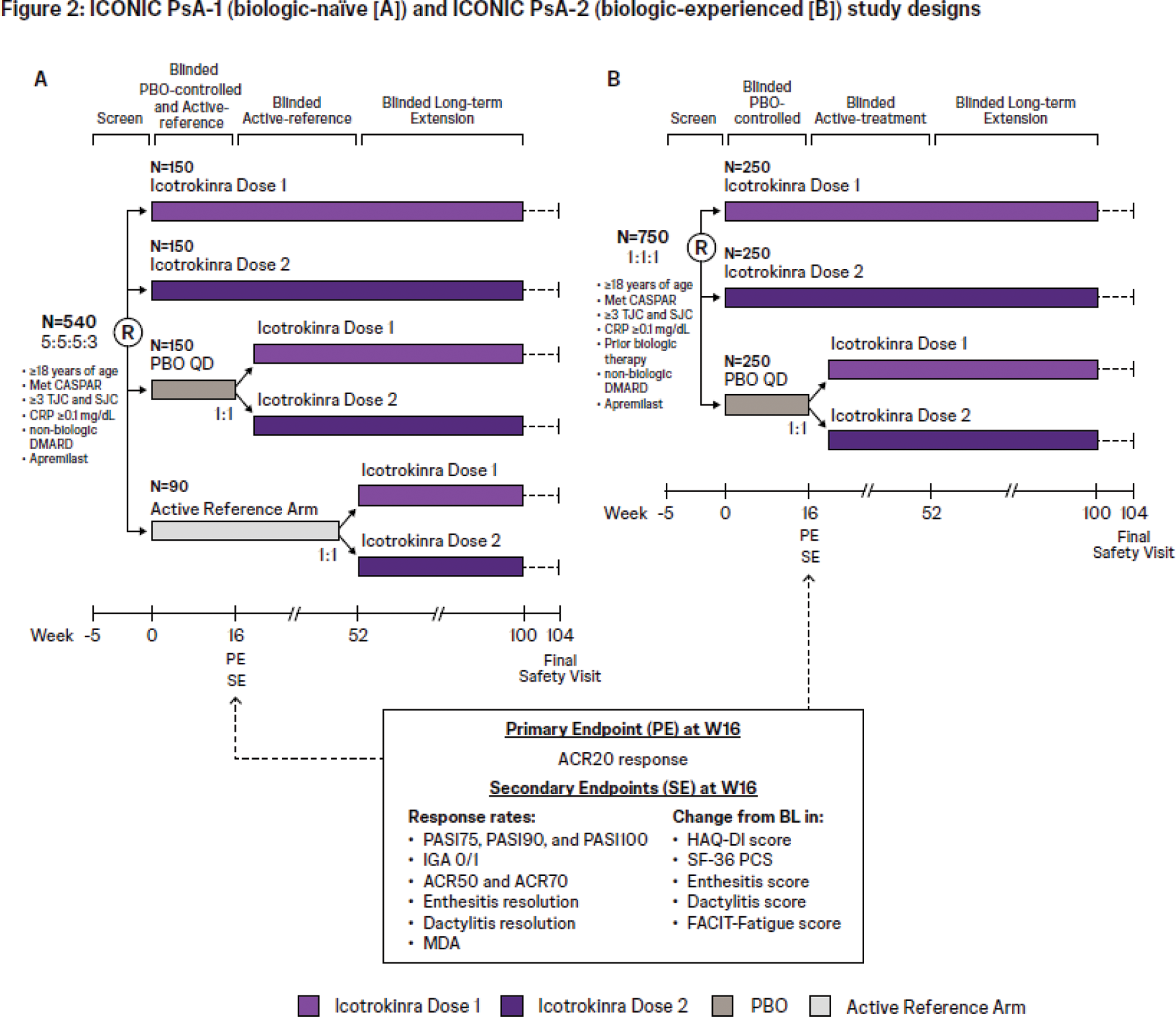
Results: Of the 91 FRONTIER 1 participants, 23 (25%) had PsO+PsA (20 icotrokinra, 3 PBO). Among those with evaluable biomarker data, mean logFC in serum BD-2, IL-22, IL-17A (Figure 1A-C ), and IL-17F (data not shown) over time indicated consistent pharmacodynamic (PD) effect of icotrokinra between participants with PsO only and those with PsO+PsA. Numerically greater changes from baseline (BL) at W16 were seen in icotrokinra vs PBO-treated PsO+PsA participants across PROMIS-29 domains relevant to PsA, i.e., improvements in physical function (7.7 vs 1) and reductions in fatigue (-7.4 vs 2.3 [worsening]), pain interference (-10.7 vs -1.3), and pain intensity (-3.5 vs -1.5). Among the 20 icotrokinra-treated participants with PsO+PsA, 45% and 70%, respectively, reported ≥5-point improvement from BL in the PROMIS-29 PCS and MCS scores vs no participants receiving PBO. For both ICONIC-PsA 1 (biologic-naïve) and ICONIC-PsA 2 (biologic-experienced), the primary endpoint is ACR20 response at W16, and sample size estimation employed model-based meta-analyses. Respective sample sizes of 540 (randomized 5:5:5:3 to icotrokinra Dose 1 or 2, PBO, or active reference arm [no formal statistical comparisons]; Figure 2A) and 750 (1:1:1 to icotrokinra Dose 1 or 2 or PBO; Figure 2B) were estimated to provide ≥90% power to detect a significant difference between icotrokinra and PBO. Given that minorities are often under-recruited in PsA trials, this Phase 3 PsA program plans to assess a diverse patient population, including representation of individuals with different racial/ethnic backgrounds. This will be achieved through multiple strategies, including targeted outreach to under-represented communities to enhance recruitment, as well as collaboration with patient advocacy groups to increase awareness and support the enrollment of these populations. Both studies will continue through 2 years.
Conclusion: Exploratory assessments from the Phase 2 FRONTIER 1 study showed icotrokinra PD effects were comparable between participants with PsO only and those with PsO who also had PsA, and numerically greater patient-reported improvements in PROMIS-29 domains relevant to PsA with icotrokinra vs PBO. Informed by these post hoc analyses and model-based meta-analyses that bridged data from PsO to PsA, the multicenter, double-blind, PBO-controlled ICONIC-PsA 1 and ICONIC-PsA 2 studies will comprehensively evaluate the novel targeted oral peptide icotrokinra in a diverse population of participants with active PsA.
REFERENCES: [1] Lemke S. doi:10.1093/rheumatology/keae198.
[2] Ocampo D. doi:10.12688/f1000research.19144.1.
[3] Merola J. doi:10.1016/j.jaad.2021.09.019.
[4] Gladman D. doi:10.1136/rmdopen-2019-000928.
[5] Qin-Yi S. doi:10.1080/14712598.2024.2401148.
[6] Bissonnette R. doi: 10.1056/NEJMoa2308713.
[7] Ferris L. doi:10.1016/j.jaad.2024.10.076.
[8] Terwee C. doi:10.1007/s11136-021-02925-y.
Acknowledgements: NIL.
Disclosure of Interests: Joseph F. Merola: Consultant - AbbVie, Amgen, AstraZeneca, Biogen, Boehringer Ingelheim, Bristol Myers Squibb, Dermavant, Eli Lilly, Incyte, Janssen, Leo Pharma, Moonlake, Novartis, Pfizer, Sanofi-Regeneron, Sun Pharma, and UCB, Philip J. Mease: Speaker - AbbVie, Amgen, Eli Lilly, Janssen, Novartis, Pfizer, and UCB, Consultant - AbbVie, Acelyrin, Amgen, Bristol Myers Squibb, Eli Lilly, Immagene, Janssen, Novartis, Pfizer, UCB, and Ventyx, Grants - AbbVie, Acelyrin, Amgen, Bristol Myers Squibb, Eli Lilly, Janssen, Novartis, and UCB, Laura C. Coates: Speaker - AbbVie, Amgen, Biogen, Celgene, Eli Lilly, Galapagos, Gilead, GlaxoSmithKline, Janssen, Medac, Novartis, Pfizer, and UCB, Consultant - AbbVie, Amgen, Bristol Myers Squibb, Celgene, Eli Lilly, Gilead, Galapagos, Janssen, Moonlake, Novartis, Pfizer, and UCB, Grants - AbbVie, Amgen, Celgene, Eli Lilly, Janssen, Novartis, Pfizer, and UCB, Iain B. McInnes: Shareholder - Causeway and Evelo Compugen, NHS GGC Board Member, Evelo Board of Directors, and Versus Arthritis Trustee, Consultant - AbbVie, Amgen, AstraZeneca, Bristol Myers Squibb, Cabaletta, Compugen, Eli Lilly, Gilead, GlaxoSmithKline, Janssen, Novartis, Pfizer, Roche, Sanofi, and UCB, Grants - Amgen, AstraZeneca, Bristol Myers Squibb, Eli Lilly, GlaxoSmithKline, Janssen, Novartis, Roche, and UCB, Peter Nash: Consultant - AbbVie, Amgen, Boehringer Ingelheim, Bristol Myers Squibb, Celgene, Eli Lilly, Galapagos, GlaxoSmithKline, Janssen, Novartis, Pfizer, Sun, and UCB, Grants - AbbVie, Amgen, Boehringer Ingelheim, Bristol Myers Squibb, Celgene, Eli Lilly, Galapagos, GlaxoSmithKline, Janssen, Novartis, Pfizer, Sun, and UCB, Alexis Ogdie: Consultant - AbbVie, Amgen, BMS, Celgene, CorEvitas, Gilead, GSK, Janssen, Eli Lilly, Novartis, Pfizer, and UCB, Grants - AbbVie to Penn, Pfizer to Penn, Novartis to Penn, Amgen to Forward/NDB, NIAMS, Rheumatology Research Foundation, National Psoriasis Foundation, and University of Pennsylvania, Lihi Eder: Consultant - AbbVie, Bristol Myers Squibb, Eli Lilly, Janssen, Moonlake, Novartis, Pfizer, and UCB, Grants - AbbVie, Eli Lilly, Fresenius Kabi, Janssen, Novartis, Pfizer, Sandoz, and UCB, Mitsumasa Kishimoto: Speaker - AbbVie, Amgen, Asahi-Kasei Pharma, Astellas, Ayumi, Bristol Myers Squibb, Chugai, Daiichi-Sankyo, Eisai, Eli Lilly, Gilead, Janssen, Novartis, Pfizer, Tanabe-Mitsubishi, and UCB, Consultant - AbbVie, Amgen, Asahi-Kasei Pharma, Astellas, Ayumi, Bristol Myers Squibb, Chugai, Daiichi-Sankyo, Eisai, Eli Lilly, Gilead, Janssen, Novartis, Pfizer, Tanabe-Mitsubishi, and UCB, Anna Beutler: Shareholder - Johnson & Johnson, Employee - Johnson & Johnson, Konstantina Psachoulia: Shareholder - Johnson & Johnson, Employee - Johnson & Johnson, Shana Hamm: Shareholder - Johnson & Johnson, Employee - Johnson & Johnson, Shihong Sheng: Shareholder - Johnson & Johnson, Employee - Johnson & Johnson, Bei Zhou: Shareholder - Johnson & Johnson, Employee - Johnson & Johnson, Mehrdad Javidi: Shareholder - Johnson & Johnson, Employee - Johnson & Johnson, Chandni Valiathan: Shareholder - Johnson & Johnson, Employee - Johnson & Johnson, Charles Iaconangelo: Shareholder - Johnson & Johnson, Employee - Johnson & Johnson, Ya-Wen Yang: Shareholder - Johnson & Johnson, Employee - Janssen Pharmaceutical Companies of Johnson & Johnson, Arun Kannan: Shareholder - Johnson & Johnson, Employee - Johnson & Johnson, Chetan S Karyekar: Shareholder - Johnson & Johnson, Employee - Johnson & Johnson, Tasneam Shagroni: Shareholder - Johnson & Johnson, Employee - Johnson & Johnson.
© The Authors 2025. This abstract is an open access article published in Annals of Rheumatic Diseases under the CC BY-NC-ND license (