fetching data ... 
Background: Early proteinuria reduction following treatment initiation is associated with improved long-term kidney survival and overall mortality in lupus nephritis (LN) [1, 2]. Treatment guidelines are based upon achieving urine protein creatinine (UPCR) targets, with UPCR <0.5-0.7 g/g after 12 months often considered to be a complete renal response (CRR) [3, 4]. However, studies demonstrate that significant histologic activity can persist even at UPCR levels <0.5 g/g [5]. In addition, even low levels of proteinuria are associated with progressive CKD and mortality [6]. Therefore, lower UPCR targets may be clinically meaningful. Voclosporin, a second generation calcineurin inhibitor, is approved for the treatment of active LN, and voclosporin-based immunosuppressive regimens are recommended in recently updated treatment guidelines as an option for initial LN therapy [3, 4]. The 52-week, Phase 3 AURORA 1 study showed that the addition of voclosporin to low-dose glucocorticoids and mycophenolate mofetil (MMF) led to significantly greater and earlier reductions in proteinuria compared to treatment with low-dose glucocorticoids and MMF alone [7].
Objectives: Our objective in performing a post hoc analysis of data from the AURORA 1 study was to demonstrate that achievement of UPCR targets <0.5 g/g is feasible and enhanced with the use of voclosporin.
Methods: Key inclusion criteria for the AURORA 1 study included biopsy-proven active LN, UPCR ≥1.5 g/g (≥2 g/g for Class V) and estimated glomerular filtration rate (eGFR) >45 mL/min/1.73 m 2 . Participants were randomized to either voclosporin (23.7 mg) or matching placebo (control) twice daily, in combination with MMF (target 2 g/day) and low-dose glucocorticoids (intravenous methylprednisolone on Days 1 and 2 [total 1 g], followed by oral prednisone at a starting dose of 20-25 mg/day, tapered to ≤2.5 mg/day by Week 16). Achievement of UPCR targets ≤0.4 g/g, ≤0.3 g/g, ≤0.2 g/g was assessed. Safety outcomes are described for the subgroup of participants who achieved a UPCR ≤0.4 g/g.
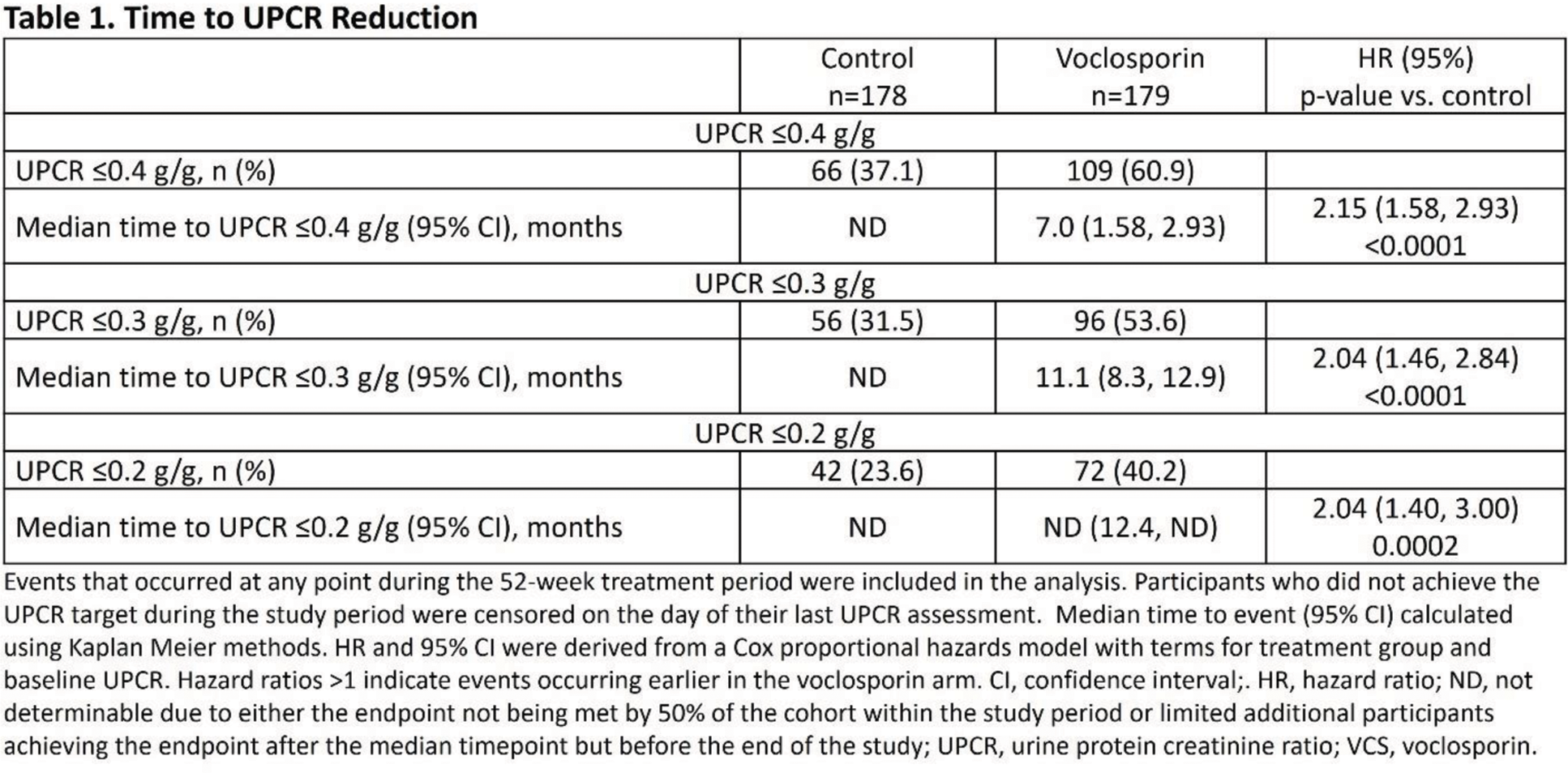
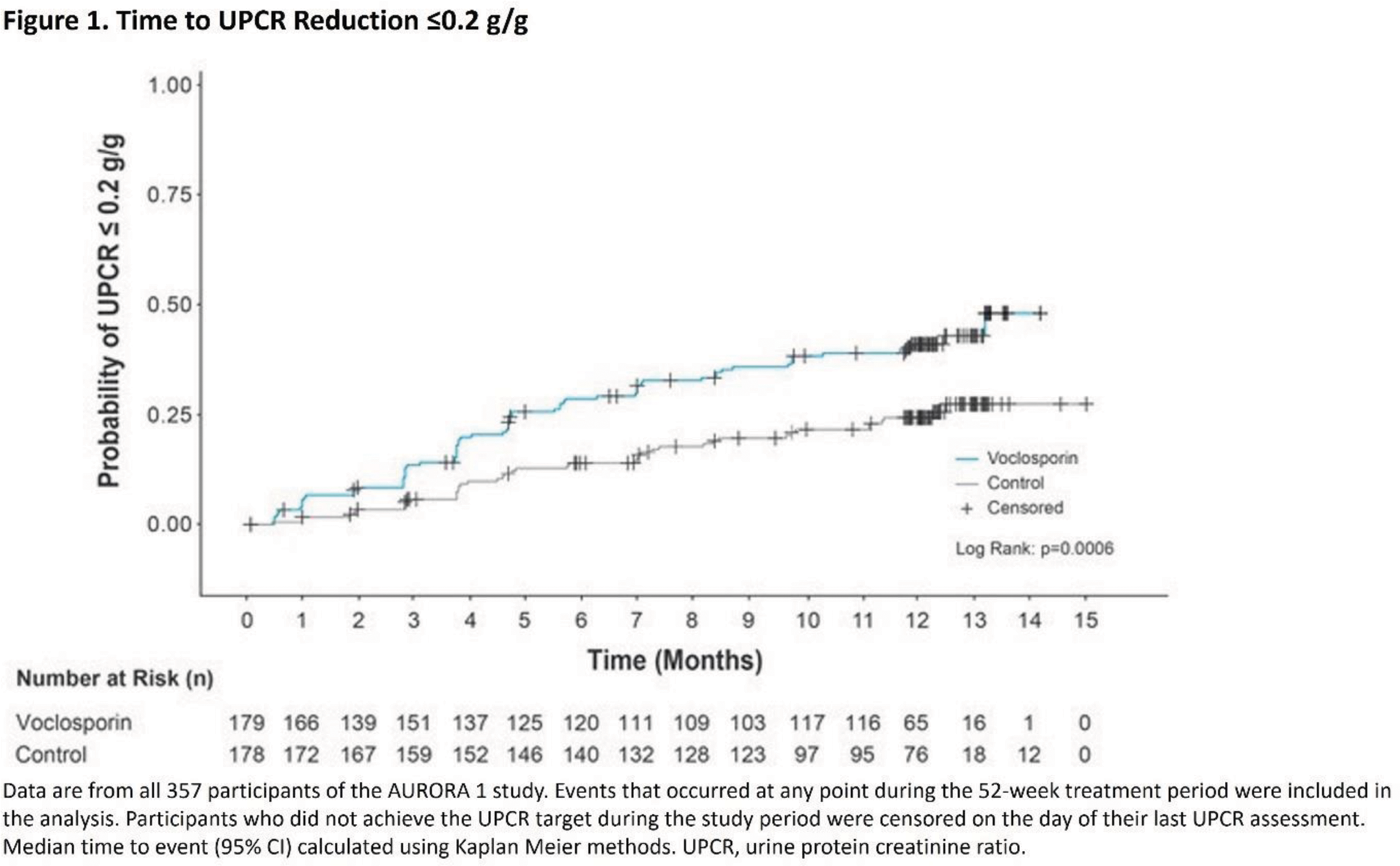
Results: Nearly half (49.0%) of participants in AURORA 1 achieved a UPCR ≤0.4 g/g at least once during the 52-week study. Of participants treated with voclosporin, 109 (60.9%) achieved a UPCR ≤0.4 g/g, with a mean (SD) minimum UPCR achieved at any point during the study of 0.16 (0.10) g/g. In the control group, 66 (37.1%) participants achieved a UPCR ≤0.4 g/g (mean [SD] minimum, 0.18 [0.098] g/g). The median time to UPCR ≤0.4 g/g for the voclosporin group was 7.0 months; a median time was not determinable for the control group as less than 50% achieved the endpoint within the study period (difference between groups hazard ratio [HR] 2.15; 95% confidence interval [CI] 1.58, 2.93; p<0.0001, Table 1). Similar trends were observed regarding achievement of UPCR ≤0.3 g/g (HR 2.04; 95% CI 1.46, 2.84; p<0.0001) and UPCR ≤0.2 g/g (HR 2.04; 95% CI 1.40, 3.00; p=0.0002; Table 1, Figure 1). The overall incidence of adverse events was similar between participants of both treatment groups achieving ≤0.4 g/g (voclosporin, 89.9%; control, 83.3%); mean eGFR remained stable and within the normal range in both groups.
Conclusion: Nearly half of the AURORA 1 population achieved a UPCR ≤0.4 g/g at least once during the 52-week study, surpassing treatment targets recommended by current guidelines for the management of LN. A greater proportion of participants treated with voclosporin achieved UPCR ≤0.4 g/g and did so significantly earlier than control-treated participants, with comparable rates of adverse events. Participants achieving this target also demonstrated stable mean eGFR throughout the 52-week study. These data suggest that achievement of lower UPCR targets is feasible and enhanced with the use of voclosporin-based triple immunosuppressive therapy.
REFERENCES: [1] Dall’Era M, Stone D, Levesque V, Cisternas M, Wofsy D. Arthritis Care Res (Hoboken ). Mar 2011;63(3):351-7.
[2] Ugolini-Lopes MR, Seguro LPC, Castro MXF, et al. Lupus Sci Med . 2017;4(1):e000213.
[3] Rovin BH, Ayoub IM, Chan TM, et al. Kidney Int . 2024;105(1):31-34.
[4] Fanouriakis A, Kostopoulou M, Andersen J, et al. Ann Rheum Dis . Jan 2 2024;83(1):15-29.
[5] De Rosa M, Rocha AS, De Rosa G, Dubinsky D, Almaani SJ, Rovin BH. Kidney Int Rep . Jul 2020;5(7):1066-1068.
[6] Chedid A, Rossi GM, Peyronel F, et al. Kidney International Reports . 2020;5(12):2333-2340.
[7] Rovin BH, Teng YKO, Ginzler EM, et al. The Lancet . 2021;397(10289):2070-2080.
Acknowledgements: NIL.
Disclosure of Interests: Maria Dall’Era Annexon Biosciences, AstraZeneca, Aurinia Pharmaceuticals Inc., Biogen, GSK plc, and Pfizer, Annexon Biosciences and GSK plc, Brad H. Rovin Alexion, AstraZeneca, Aurinia Pharmaceuticals Inc., Bristol Myers Squibb, Exagen, Genenetech, GSK plc, Kezar Life Sciences, Kyverna, Novartis, and Otsuka, Biogen, Salem Almaani Cantor Fitzgerald., Amgen, Otsuka, Cabaletta Bio, Kezar, and Aurinia Pharmaceuticals., Lucy Hodge Aurinia Pharmaceuticals Inc., Aurinia Pharmaceuticals Inc., Vanessa Birardi Aurinia Pharmaceuticals Inc., Aurinia Pharmaceuticals Inc., Ernie Yap Aurinia Pharmaceuticals Inc., Aurinia Pharmaceuticals Inc.
© The Authors 2025. This abstract is an open access article published in Annals of Rheumatic Diseases under the CC BY-NC-ND license (