fetching data ... 
Background: Psoriatic arthritis (PsA), the most prevalent comorbidity of psoriasis, is an immune-mediated, chronic, inflammatory musculoskeletal disease characterized by diverse and heterogenous clinical features accompanied by postponed diagnosis and treatment [1]. Idiopathic pulmonary fibrosis (IPF) is a chronic, progressive and fibrotic lung disease of unknown etiology featured by worsening respiratory symptoms and aggregated lung scarring, leading to impaired quality of life and ultimate mortality [2]. Although previous observational researches have indicated that psoriatic arthritis patients were more vulnerable to develop pulmonary impairment [3], the causal association between PsA and IPF has not been clarified.
Objectives: Mendelian randomization (MR) is a genetic approach with the ability to assess and estimate the magnitude of a causal effect of an exposure on an outcome. Herein, this investigation aimed to elucidate whether PsA causally associates with IPF by leveraging MR approach.
Methods: Genetic summary statistics for PsA were extracted from publicly available Genome-Wide Association Study (GWAS) catalog, involving 26351 individuals of European ancestry (5,065 cases and 21,286 controls). IPF-related data summaries were retrieved from a meta-analysis by Richard J Allen et al, incorporating 4,125cases and 20,464 controls of predominantly European ancestry. Latent Heritable Confounder MR (LHC-MR) was a newly developed genetic approach to evaluate bi-directional causal effects, direct heritabilities, and confounder effects while accounting for sample overlap, which has proved superior to several traditional MR methods. LHC-MR was utilized to determine the bi-directional associations between PsA and IPF. The threshold of P-value < 0.05 was considered statistically significant.
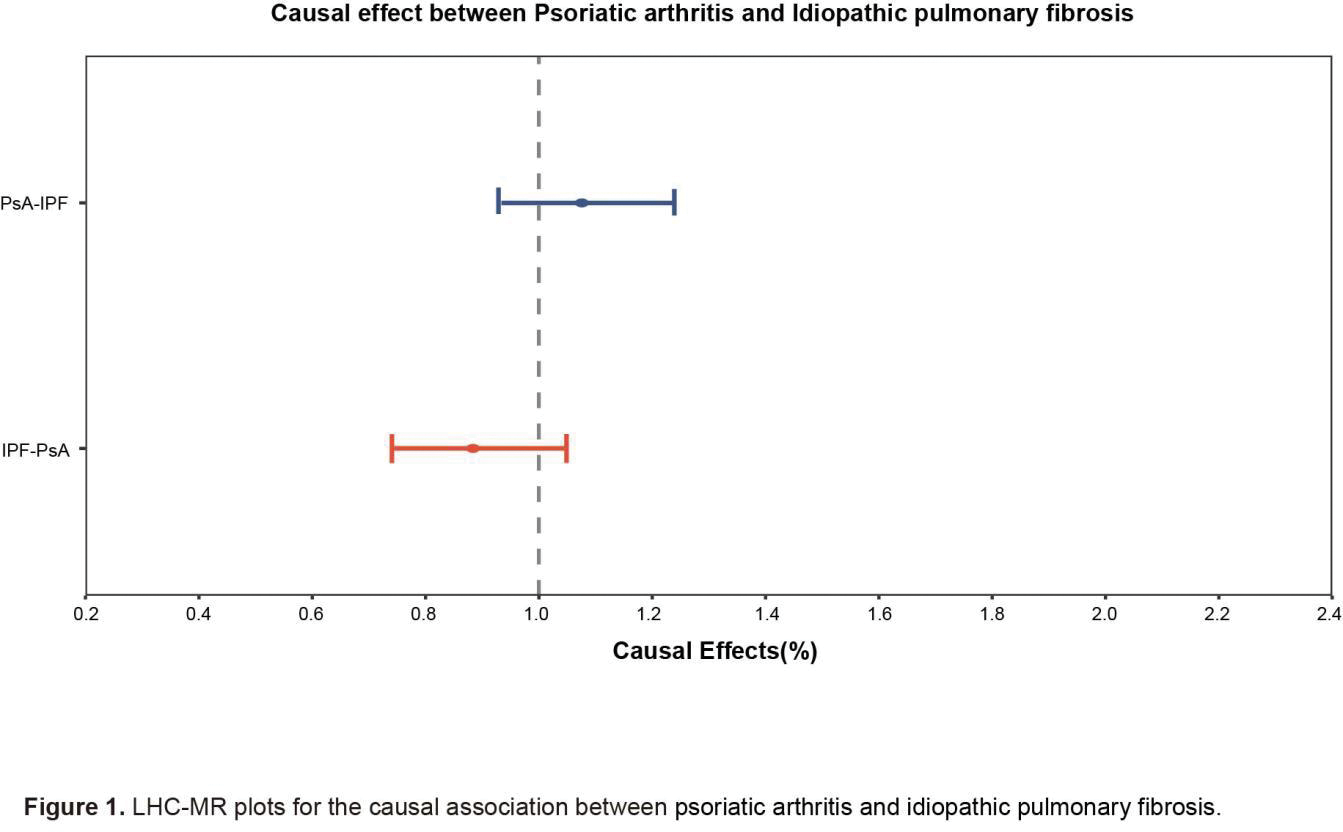
Results: Based on the LHC-MR genetic approach, no evident association was determined between genetically predicted PsA and IPF risk (OR=1.076, 95% CI=0.934-1.239, P = 0.311). In the reverse analysis, genetically proxied IPF demonstrated no significant causal relationship with PsA by utilizing LHC-MR(OR=0.884, 95% CI=0.745-1.049, P = 0.157). This investigation using LHC-MR indicated that PsA was not causally associated with genetically predicted IPF, and vice versa.
Conclusion: In this investigation, the outcomes from LHC-MR indicated no evidence supporting the causal effect between PsA and IPF. Further systematic studies with more abundant statistics and multiple ancestries to explore the causality between PsA and IPF are still demanded.
REFERENCES: [1] Ritchlin CT, Colbert RA, Gladman DD. Psoriatic Arthritis. N Engl J Med. 2017 Mar 9;376(10):957-970. doi: 10.1056/NEJMra1505557.
[2] Martinez FJ, Collard HR, Pardo A, Raghu G, Richeldi L, Selman M, Swigris JJ, Taniguchi H, Wells AU. Idiopathic pulmonary fibrosis. Nat Rev Dis Primers. 2017 Oct 20;3:17074. doi: 10.1038/nrdp.2017.74.
[3] Schäfer VS, Winter L, Skowasch D, Bauer CJ, Pizarro C, Weber M, Kütting D, Behning C, Brossart P, Petzinna SM. Exploring pulmonary involvement in newly diagnosed rheumatoid arthritis, and psoriatic arthritis: a single center study. Rheumatol Int. 2024 Oct;44(10):1975-1986. doi: 10.1007/s00296-024-05685-3.
Acknowledgements: The authors thank all participants and investigators for the contributions of GWAS data.
Disclosure of Interests: None declared.
© The Authors 2025. This abstract is an open access article published in Annals of Rheumatic Diseases under the CC BY-NC-ND license (