fetching data ... 
Background: It can take around 17 years for clinical research to be applied in practice, with no guarantee that interventions will maintain their fidelity and effectiveness. New approaches are therefore needed to improve the uptake of evidence-based interventions into real-world practice while ensuring they continue to benefit patient outcomes. The Strengthening And Stretching for Rheumatoid Arthritis of the Hands (SARAH) programme is a hand and arm exercise regime consisting of 11 flexibility and strength exercises with behavioural strategies for long-term exercise adherence. The programme was evaluated in a large multicentre randomised clinical trial (490 participants) and found to improve hand function and was safe and cost-effective [1]. SARAH is recommended in the National Institute for Health and Care Excellence (NICE) guidelines [NG 100] for people with rheumatoid arthritis [2].
Objectives: In this submission, we describe how we developed and used two digital resources in translating the SARAH clinical trial to routine clinical practice.
Methods: Our implementation model involved transforming knowledge from the clinical trial and co-producing a digital package with patients and stakeholders such as occupational therapists, physiotherapists, digital programmers, and consultant rheumatologists. The package included two free resources:
A 2-week online course on the SARAH programme for rheumatology health professionals worldwide.
A 4-week self-guided online SARAH programme for direct access by National Health Service (NHS) patients in the United Kingdom (UK).
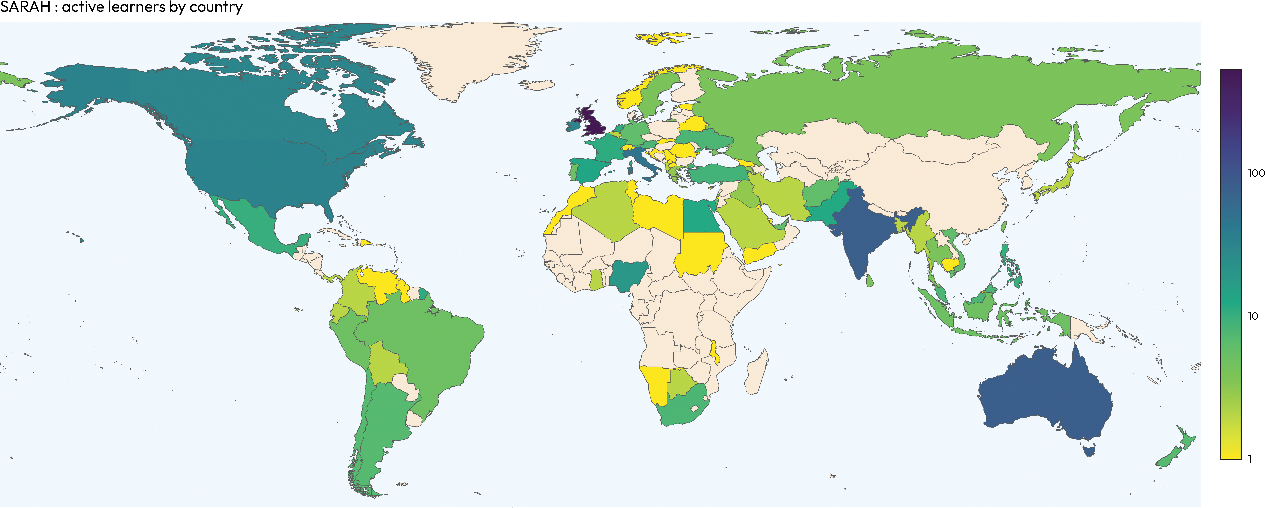
Results: Both resources were developed through an iterative process, user-centred design principles, and multiple rounds of testing and refinement [3, 4]. The resources were self-paced and delivered through text, exercise videos, feedback forms, and downloadable materials. Patient representatives demonstrated the SARAH exercises and taught how to set and progress the strength loads in the exercise videos. 3837 learners from 82 countries enrolled to the SARAH course when launched on the University of Oxford website in 2017. It was then moved to Future Learn between 2021 and 2023, during which 1905 learners enrolled (Figure 1). In 2023, the course was moved to the University of Exeter website (
Conclusion: The online SARAH course for health professionals and the online SARAH for patients are the world’s first evidence-based digital resources that continue to provide evidence in improving hand function in people with rheumatoid arthritis.
REFERENCES: [1] Lamb SE, Williamson EM, Heine PJ, Adams J, Dosanjh S, Dritsaki M, Glover MJ, Lord J, McConkey C, Nichols V, Rahman A, Underwood M, Williams MA; Strengthening and Stretching for Rheumatoid Arthritis of the Hand Trial (SARAH) Trial Team. Exercises to improve function of the rheumatoid hand (SARAH): a randomised controlled trial. Lancet. 2015 Jan 31;385(9966):421-9. doi: 10.1016/S0140-6736(14)60998-3. Epub 2014 Oct 9. PMID: 25308290.
[2] National Institute for Health and Care Excellence. 2018.
Rheumatoid Arthritis in Adults: Management
. NICE Guideline NG100.
[3] Srikesavan CS, Williamson E, Eldridge L, Heine P, Adams J, Cranston T, Lamb SE. A Web-Based Training Resource for Therapists to Deliver an Evidence-Based Exercise Program for Rheumatoid Arthritis of the Hand (iSARAH): Design, Development, and Usability Testing. J Med Internet Res. 2017 Dec 13;19(12): e411. doi: 10.2196/jmir.8424.
[4] Srikesavan C, Williamson E, Cranston T, Hunter J, Adams J, Lamb SE. An Online Hand Exercise Intervention for Adults With Rheumatoid Arthritis (mySARAH): Design, Development, and Usability Testing. J Med Internet Res. 2018 Jun 27;20(6): e10457. doi: 10.2196/10457.
[5] Williamson E, Srikesavan C, Thompson J, et al. Translating the Strengthening and Stretching for Rheumatoid Arthritis of the Hand Programme from clinical trial to clinical practice: An effectiveness–implementation study. Hand Therapy. 2020;25(3):87-97. doi:10.1177/1758998320948538.
[6] Srikesavan C, Williamson E, Thompson JY, Cranston T, Swales C, Lamb SE. The online version of an evidence-based hand exercise program for people with rheumatoid arthritis: A mixed-method, proof-of-concept study. J Hand Ther. 2022 Jul-Sep;35(3):468-476. doi: 10.1016/j.jht.2020.10.011.
[7] Srikesavan C, Williamson E, Lamb SE. The online version of an evidence-based hand exercise programme for people with rheumatoid arthritis: An effectiveness-implementation study. J Hand Ther. 2025 Jan 2: S0894-1130(24)00157-1. doi: 10.1016/j.jht.2024.11.001.
Acknowledgements: NIL.
Disclosure of Interests: None declared.
© The Authors 2025. This abstract is an open access article published in Annals of Rheumatic Diseases under the CC BY-NC-ND license (