fetching data ... 
Background: Sex-related differences may influence symptoms, physical function, exposure to specific treatments, and structural damage in axial spondyloarthritis (axSpA). However, long-term data on how sex influences clinical outcomes and spinal radiographic progression remain limited.
Objectives: To assess the longitudinal impact of sex on clinical outcomes, treatment exposure, and spinal radiographic progression over 10 years in a large axSpA cohort.
Methods: We analyzed patients with axSpA enrolled in the German Spondyloarthritis Inception Cohort (GESPIC) who were followed up prospectively for up to 10 years. We assessed Axial Spondyloarthritis Disease Activity Score (ASDAS), Bath Ankylosing Spondylitis Disease Activity Index (BASDAI), Bath Ankylosing Spondylitis Functional Index (BASFI), Bath Ankylosing Spondylitis Metrology Index (BASMI), patient global assessment (PGA), C-Reactive Protein (CRP), tender and/or swollen joint count, and enthesitis count longitudinally. We assessed spinal structural damage using the modified Stoke Ankylosing Spondylitis Spine Score (mSASSS) and evaluated radiographic progression over 2-year intervals (change in mSASSS, ≥2 points increase in mSASSS units, and new syndesmophyte formation). We used multivariable generalized estimating equations (GEE) to estimate the effect of male sex (vs female) on repeated clinical outcomes, treatment exposure, and radiographic progression, with covariate adjustment as specified in the table footnotes: including tumor necrosis factor Inhibitor (TNFi) and Nonsteroidal anti-inflammatory drugs (NSAID) exposure, symptom duration, Human Leukocyte Antigen (HLA)-B27, ASDAS, baseline spinal damage, Body Mass Index (BMI), smoking, and extra-musculoskeletal manifestations.
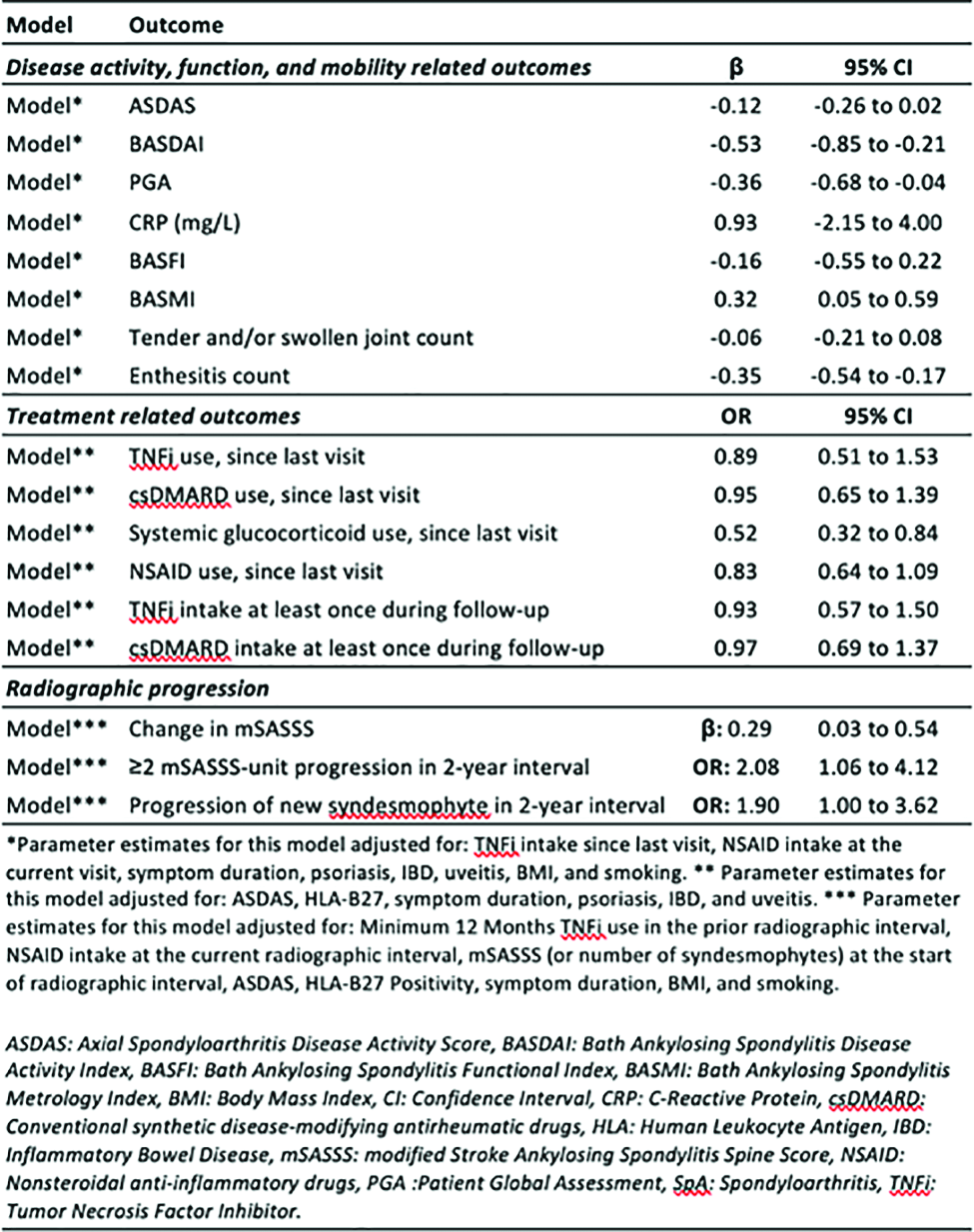
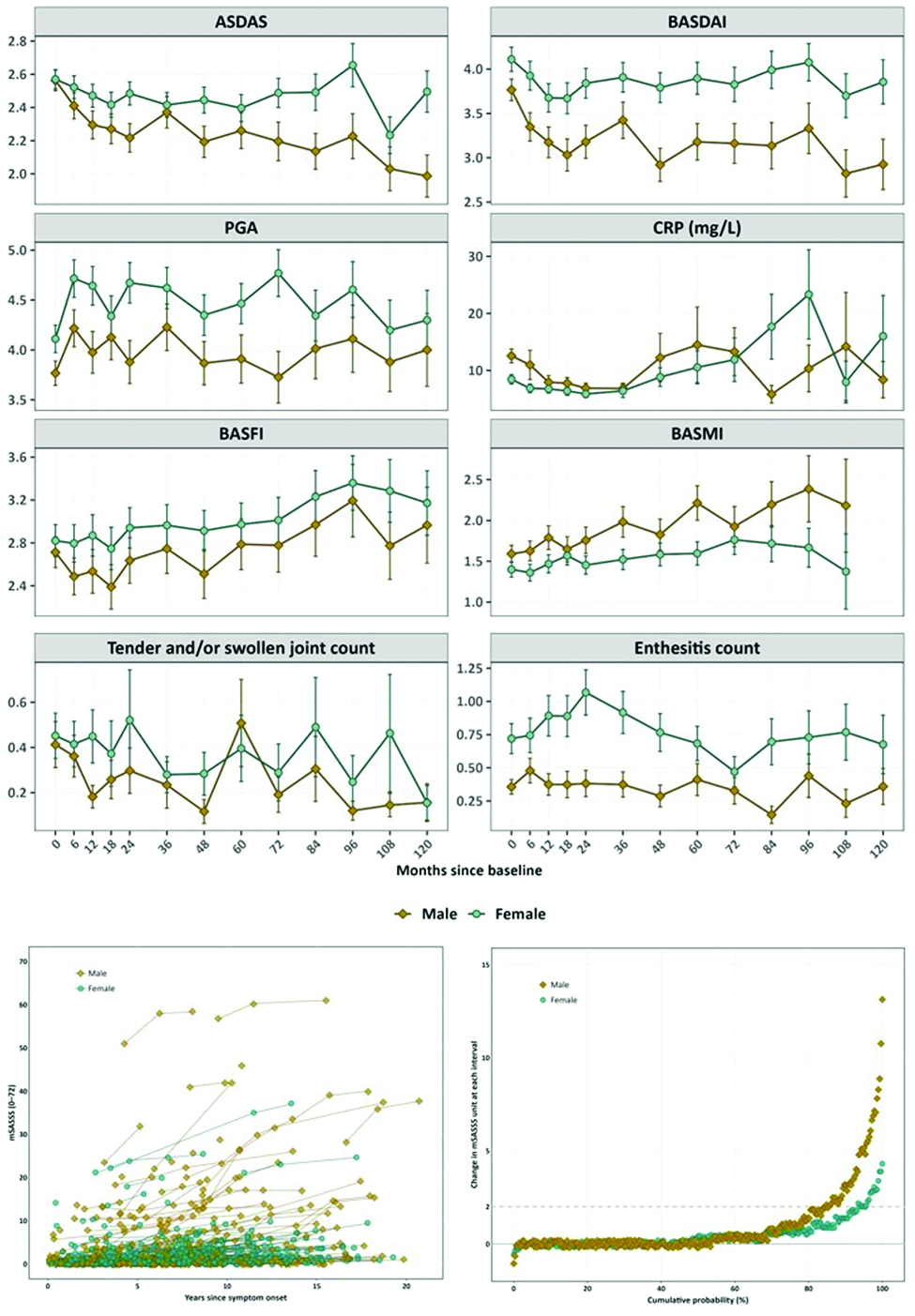
Results: Among 525 patients (286 males, 239 females), males were younger than females (34.2 ± 10.3 vs 37.3 ± 10.0 years), more often HLA-B27 positive (83.5% vs 71.3%), and more likely to have radiographic axSpA (58.4% vs 33.9%) at baseline. Descriptively, females showed higher ASDAS, BASDAI, and PGA across visits, and higher enthesitis and tender/swollen joint counts, while BASMI was higher in males (Figure 1). In adjusted models (Table 1), male sex was associated with lower ASDAS (β −0.12, 95% CI −0.26 to 0.02), BASDAI (β −0.53, 95% CI −0.85 to −0.21), lower PGA (β −0.36, 95% CI −0.68 to −0.04), and lower enthesitis count (β −0.35, 95% CI −0.54 to −0.17), but higher BASMI (β 0.32, 95% CI 0.05 to 0.59). Male sex showed a modest association with lower BASFI (β -0.16, 95% CI -0.55 to 0.22). However, no association was observed between male sex and CRP (β 0.93, 95% CI -2.15 to 4.00). Treatment exposure was similar by sex for TNFi, csDMARDs, and NSAIDs, but males had lower odds of systemic glucocorticoid use (OR 0.52, 95% CI 0.32 to 0.84). Radiographic progression exhibited notable differences by sex. In the spaghetti plot (Figure 1, lower left), individual trajectories of mSASSS over time demonstrated a clear clustering of males with marked upward slopes, indicative of continuous increase in mSASSS, whereas the majority of female subjects exhibited flat or minimally increasing curves, suggesting minimal or no progression. The cumulative probability plot (Figure 1, lower right) further illustrates this separation: while the majority of females were observed to be clustered below the 2-unit mSASSS threshold, the males displayed a right-hand tail representing a higher frequency of rapid progression intervals. Consistent with these visual trends, male sex was independently associated with greater mSASSS increase (β 0.29, 95% CI 0.03 to 0.54), higher odds of ≥2 mSASSS unit progression (OR 2.08, 95% CI 1.06 to 4.12), and new syndesmophyte formation (OR 1.90, 95% CI 1.00 to 3.62).
Conclusions: Over 10 years, males had lower disease activity, as assessed by ASDAS and BASDAI, and less enthesitis, but worse mobility parameters. Moreover, spinal radiographic progression was substantially greater among males. These results emphasize a dissociation between symptoms and structural progression in axSpA and support the need for sex-specific strategies in long-term disease monitoring and management.
Table 1. Impact of Male Sex (vs female) on Clinical, Treatment, and Spinal Radiographic Progression in participants with axSpA: Multivariable GEE Analyses over 10 years of Follow-up
Disease Activity Scores and Radiographic Progression over a 10-year Follow-up
REFERENCES: NIL.
Acknowledgments: NIL.
Disclosure of Interests: Didem Sahin: None declared, Valeria Rios Rodriguez UCB, AbbVie and Takeda, AbbVie, Lilly, Johnson & Johson, UCB and Pfizer, Fabian Proft AbbVie, Amgen, BMS, Celgene, Eli Lilly and Company, Galapagos, Hexal, Janssen, Medscape, MoonLake Pharma, MSD, Novartis, Pfizer, Roche and UCB., AbbVie, Amgen, BMS, Celgene, Eli Lilly and Company, Galapagos, Hexal, Janssen, Medscape, MoonLake Pharma, MSD, Novartis, Pfizer, Roche and UCB., Eli Lilly and Company, Novartis and UCB, Mikhail Protopopov Johnson & Johnson and AbbVie, Judith Rademacher Janssen and UCB., Hildrun Haibel Abbvie, Boehringer, Janssen, MSD, Sobi, Roche, Pfizer, UCB; Novartis, SOBI, Joachim Sieper: None declared, Martin Rudwaleit Abbvie, Astrazeneca, Boehringer Ingelheim, Lilly, Johnson&Johnson, Novartis, UCB, Denis Poddubnyy AbbVie, Canon, Celltrion, Eli Lilly, Globemed, Johnson and Johnson, Medscape, Novartis, Peervoice, Pfizer, and UCB., AbbVie, Eli Lilly, GlaxoSmithKline, Greywolf Therapeutics, Johnson and Johnson, Merk, Moonlake, Novartis, Pfizer, and UCB., AbbVie, Bristol Myers Squibb, Eli Lilly, Johnson and Johnson, Novartis, Pfizer, and UCB., Murat Torgutalp: None declared.