fetching data ... 
Background: The current treatment recommendations for peripheral spondyloarthritis (pSpA) follow a step-up approach, with nonsteroidal anti-inflammatory drugs (NSAIDs) for initial symptomatic relief. If an adequate response is not achieved, conventional synthetic disease-modifying antirheumatic drugs (csDMARDs)—particularly sulfasalazine or methotrexate—are introduced. Biological DMARDs (bDMARDs), such as tumor necrosis factor inhibitors (TNFi), have remained reserved for refractory disease. Unfortunately, this strategy often results in long-term or lifelong need for therapy, with a substantial proportion of patients experiencing incomplete clinical response. As shown in the CRESPA trial, we reasoned that first line initiation of bDMARDs in early new onset pSpA could induce substantially better treatment response and outcome, resulting in high remission rates and promoting sustained drug-free remission. However, these findings were limited to patients with an extremely short symptom duration (< 3 months) and explored in a placebo-controlled study design.
Objectives: The SPARTACUS trial was designed to address the limitations of the CRESPA trial primarily by including patients with symptom duration up to one year and by randomizing participants to either TNFi induction therapy or a standard csDMARD step-up strategy. The central focus of this clinical trial was to determine whether a therapeutic window exists and whether treatment herein would translate into long-term drug-free remission. Here we report the first 24 weeks results.
Methods: SPARTACUS is a prospective, randomized, active-comparator controlled, double-blind, double-dummy, phase III, multicentric clinical trial evaluating two treatment strategies in newly diagnosed patients with early active pSpA, fulfilling the ASAS classification criteria for pSpA (symptom duration ≤ 1 year). All subjects were required to have current arthritis or enthesitis or dactylitis at baseline plus at least 1 SpA feature and were randomized (1:1) to either first-line golimumab (50mg sc every 4 weeks) or to oral methotrexate (15mg/week, increased to 20mg at week 4 if tolarated). At Week 12, the Patient Acceptable Signs and Symptoms Improvement (PASSI) was evaluated to justify continuation of the current treatment regimen for an additional 12 weeks. Patients responding affirmatively maintained their treatment unchanged; in those patients responding negatively, oral sulfasalazine at 2 g/day was added. The primary endpoint is the proportion of patients achieving clinical remission defined as complete absence of arthritis, dactylitis or enthesitis at week 24, comparing both strategies. Secondary efficacy endpoints included the proportion of patients achieving sustained clinical remission at Week 24, the change from baseline to week 24 in individual clinical measures and composite indices (78-TJC and 76-SJC, dactylitis, SPARCC enthesitis count and ASDAS-CRP), inflammatory markers (CRP and ESR) and patient reported outcomes (global disease activity, pain, BASDAI, BASFI, ASAS Health Index). Safety was assessed through adverse event incidence from baseline to Week 24. Primary efficacy analysis at week 24 was performed using a one-sided z-test for proportions (superiority design with significance level α=0.025) on the intention to treat population. For secondary analyses, changes in continuous variables were modeled with Mixed Effect Models for Repeated Measures.
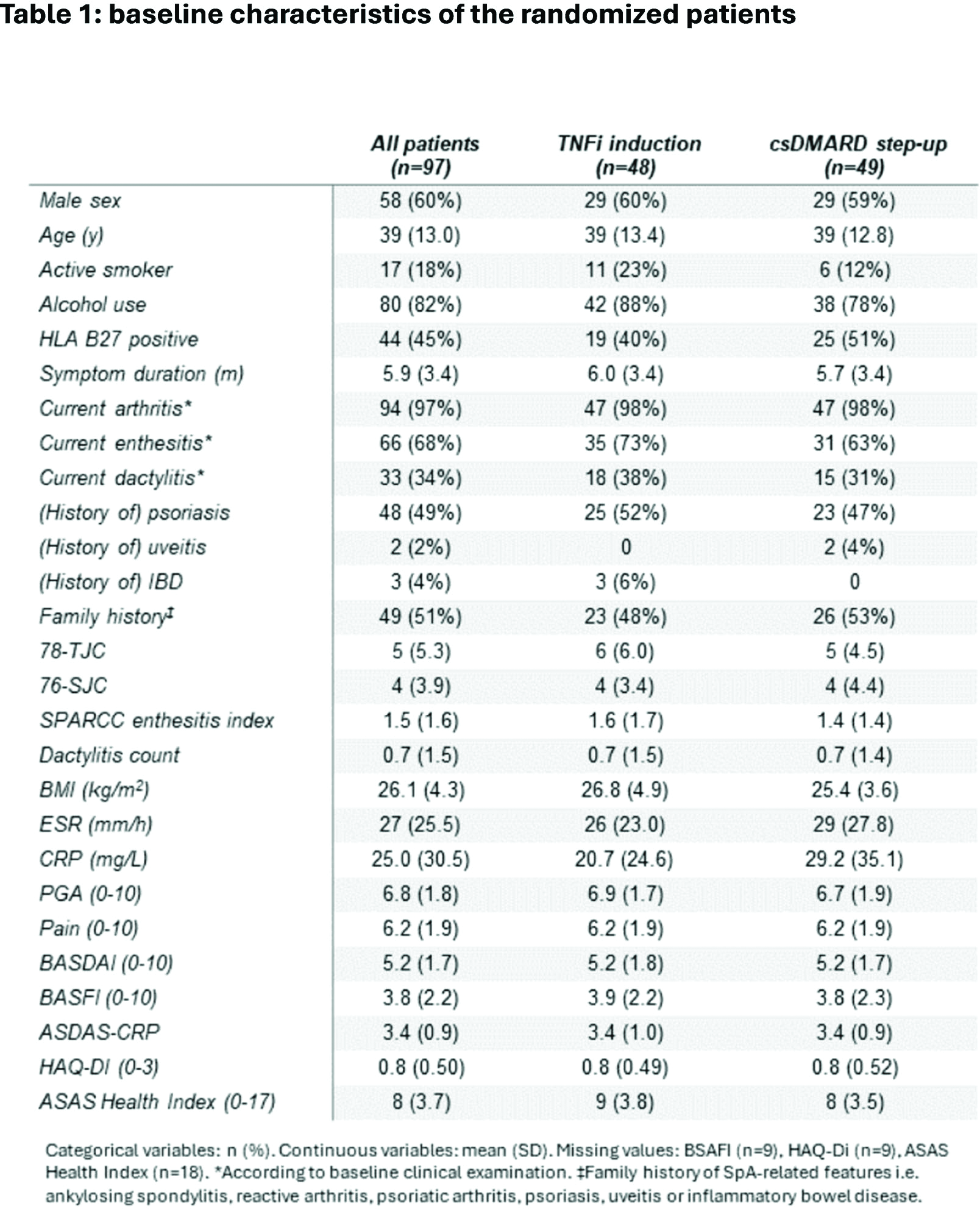
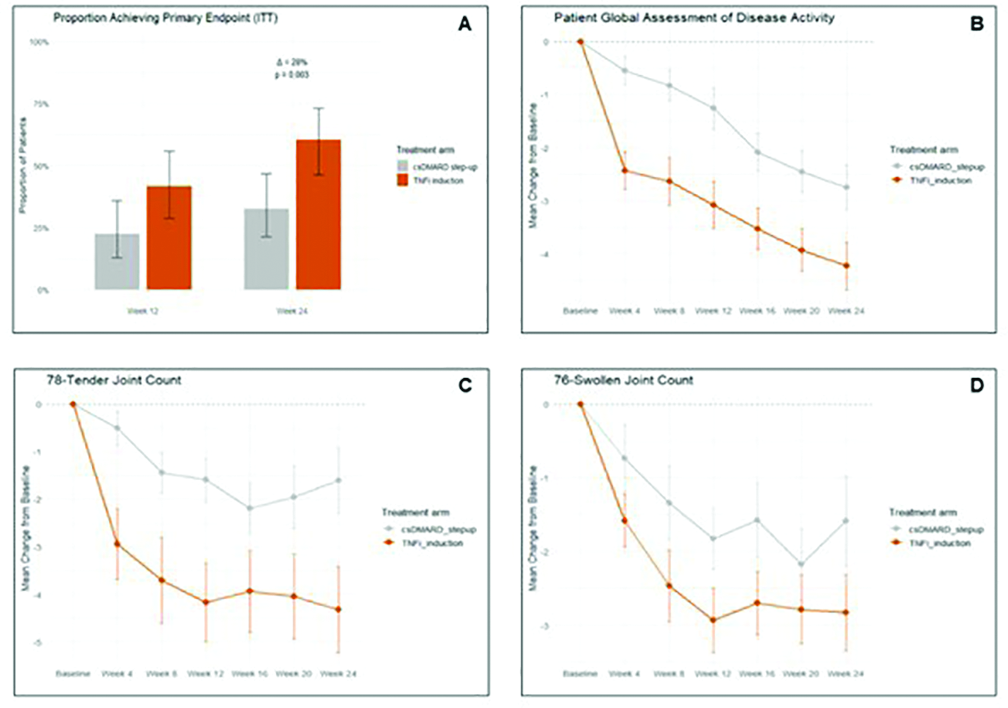
Results: A total of 97 patients with early active peripheral spondyloarthritis were included (TNFi induction arm: n=48; csDMARD step-up arm: n=49). The cohort was predominantly male (60%) with a mean age of 39 years (SD 13.0). Mean symptom duration was approximately 6 months. HLA-B27 positivity was observed in 45% of patients. Arthritis was present in nearly all patients (97%), while enthesitis and dactylitis were reported in 68% and 34%, respectively. Psoriasis was documented in 49%. Baseline disease metrics display active disease, with mean 78-TJC and 76-SJC of 5 and 4, respectively, SPARCC enthesitis index of 1.5, and dactylitis count of 0.7. Inflammatory markers were elevated (ESR: 27 mm/h; CRP: 25 mg/L). Groups were well balanced across demographic and clinical parameters (Table 1). At week 24, clinical remission was achieved in 60% (29/48) of patients receiving TNFi induction treatment versus 33% (16/49) in the csDMARD step-up group (Figure 1A). The TNFi induction strategy was significantly more effective in achieving the primary endpoint (p=0.003), with an absolute difference of 28% (95% CI: 8–46%), exceeding the prespecified superiority margin of 0% (Figure 1A). The odds ratio for clinical remission at week 24 was 3.1 (95% CI: 1.4–7.3; p=0.006) in favor of the TNFi induction strategy. The proportion of patients achieving sustained clinical remission at week 24 was significantly higher in the TNFi induction compared to the csDMARD step-up group (42% vs. 18%, Δ23%, p=0.006). Patients receiving the TNFi induction strategy also showed significantly lower scores on key secondary outcomes at week 24 compared to patients assigned to the csDMARD step-up strategy, such as 78-TJC (EMM 1.3 vs. 3.3 respectively, Δ2.0, p=0.004), 76-SJC (1.1 vs. 2.5, Δ1.4, p=0.006), patient global assessment of disease activity (2.6 vs. 4.0, Δ1.4, p=0.003) and patient pain (2.4 vs. 3.7, Δ1.3, p=0.002). Change from baseline PGA, 78-TJC and 76-SJC in each treatment group is shown in Fig 1B-D. One patient in the TNFi induction arm experienced a serious adverse event: flu-like symptoms requiring hospitalization.
Conclusions: In patients with early peripheral spondyloarthritis, initiation of first line bDMARD by immediate TNFi induction achieved significantly higher clinical remission rates at 24 weeks compared to a csDMARD step-up strategy, supporting the concept of a therapeutic window for disease interception. Our observations corroborate that early TNFi initiation optimizes clinical outcomes and may reduce the requirement for prolonged therapy in routine clinical practice.
REFERENCES: NIL.
Acknowledgments: NIL.
Disclosure of Interests: Phillippe Carron Speaker or consulting fees by AbbVie, UCB, Eli Lilly, Novartis, Janssen, Alfasigma., Research support: Pfizer., Gaëlle Varkas Speaker or consulting fees by AbbVie, Amgen, UCB, Pfizer, Eli Lilly, Novartis, Janssen, Galapagos, Celltrion., Educational grants: KBVR-SRBR, Celltrion, EG. Research support: Takeda, Celltrion, Galapagos, AbbVie, MSD., Ann-Sophie De Craemer speaker fees from UCB and Eli Lilly, Barbara Neerinckx: None declared, Kurt de Vlam Speaking Engagements/Honoraria: Amgen, Pfizer, Eli Lilly, Abbvie, UCB, Alpha Sigma, Novartis, Allegro, Droia, 4P Pharma. Consulting Fees: Pfizer, Abbvie, J&J, Eli Lilly,UCB, Alfa Sigma, Novartis, Amgen, Grants/Research Support: Celgene, MSD., Rik Lories Leuven Research and Development has received consulting or speakers fees from UCB, Abbvie, J&J, Eli-Lilly, Kabi-Fresenius on behalf of Rik Lories, Rik Joos: None declared, Liesbet Van Praet: None declared, Yves Piette Received speakers fees from Pfizer, Alfasigma. Received consultancy fees from Alfasigma, Fresenius, Celltrion, Janssen, AstraZeneca., Peggy Jacques: None declared, Ruth Wittoek: None declared, Alla Ishchenko: None declared, Casper Webers Speaker fee: Novartis, Research funding/grants: AbbVie, Dirk Elewaut: None declared, Filip Van den Bosch Speaker or consulting fees from Abbvie, Alfasigma, Eli Lilly, Greywolf Therapeutics, Janssen, Novartis, UCB and Xencor.