fetching data ... 
Background: Assessment of SpondyloArthritis international Society (ASAS) and Spondyloarthritis Research and Treatment Network (SPARTAN) established a combined initiative to test and, if needed, revise the 2009 ASAS classification criteria for axial spondyloarthritis (axSpA). In the Classification in Axial Spondyloarthritis Inception Cohort (CLASSIC) two new candidate criteria sets were developed for axSpA aimed at increasing the specificity of the criteria. In 2025, the now-called ASAS-SPARTAN revised classification criteria received the most votes from ASAS and SPARTAN members, and thus were selected, while the other proposed criteria set was rejected [1].
Objectives: In early axSpA, we tested the performance of the 2025 ASAS-SPARTAN revised classification criteria for axSpA and compared performance with that of the 2009 ASAS classification criteria and the rejected proposal.
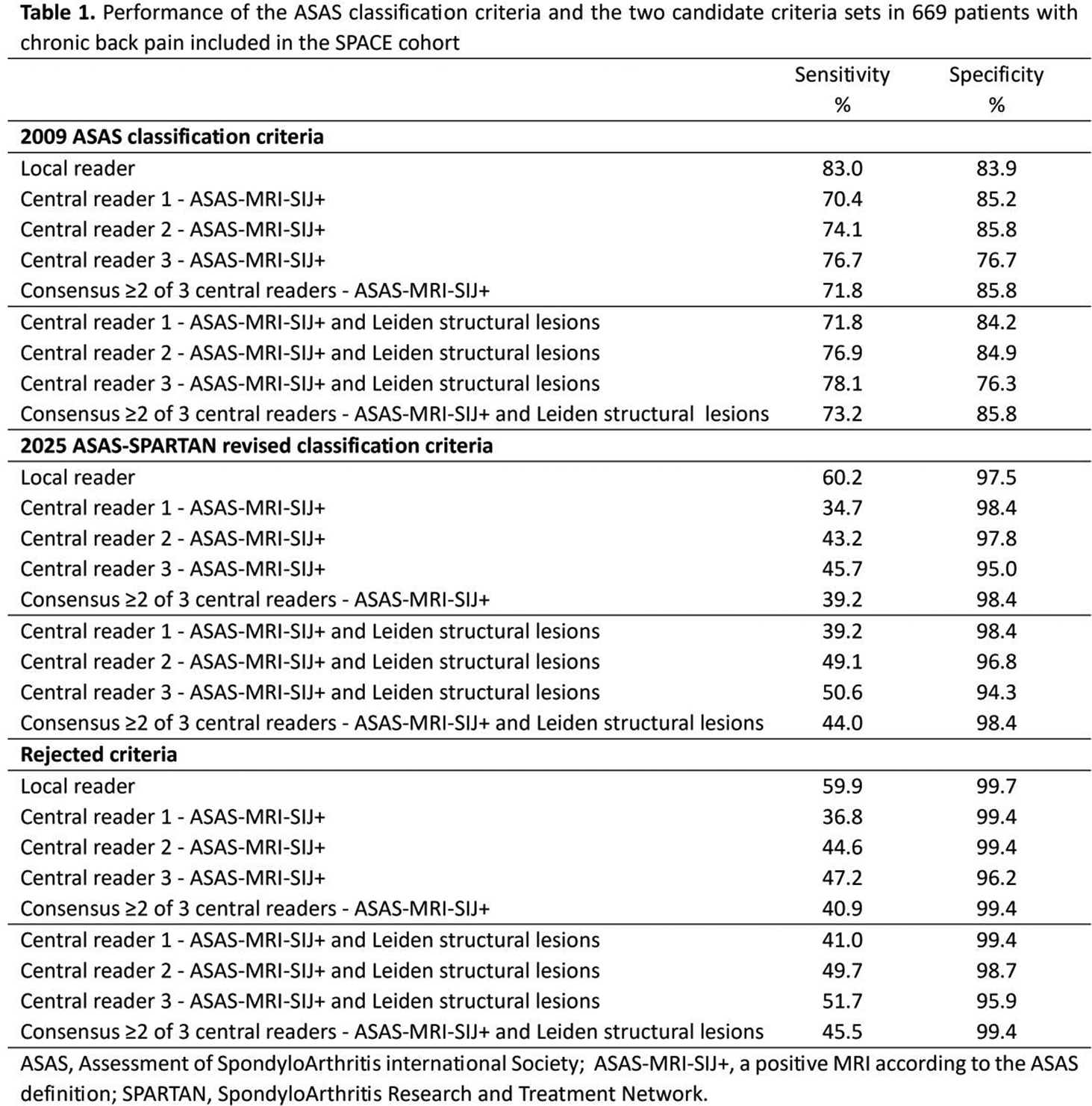
Methods: Patients with chronic back pain (≥3 months; ≤2 years; onset <45 years) from the Spondyloarthritis Caught Early (SPACE) cohort with a rheumatologist’s diagnosis of axSpA or non-axSpA at 2-year follow-up were included. Magnetic resonance imaging (MRI) and radiography of the sacroiliac joints (SIJ), acute phase reactants and clinical information were obtained at baseline, 3 months, 1 and 2 years. MRI and radiography were assessed by one local reader per center and three central readers. Both candidate sets and the 2009 ASAS criteria set could classify an imaging and/or clinical arm as categorized by the presence of positive imaging (MRI or radiography [modified New York criteria]) and/or a positive HLA-B27 status, depending on the combination and number of present SpA features/total score of the present, weighed SpA features. The 2009 ASAS classification criteria set considered an MRI when patients met the ASAS definition for a positive MRI (ASAS-MRI-SIJ+). The candidate sets require the MRI to be globally assessed for active and structural lesions. In our data, global assessment for both active and structural lesions was available for local readers, but not for central readers. Instead, the ASAS-MRI-SIJ+ and the structural lesions according to the Leiden definition were used for the calculations based on central reader scores [2]. While the 2009 ASAS classification criteria treat all SpA features equally (besides MRI/radiography and HLA-B27), both candidate sets attribute weighed points to each SpA feature and establish a threshold for the total of points based on the SpA features present. In each candidate set, the SpA features weighed differently; the ASAS-SPARTAN revised classification criteria assign weight to MRI than radiography, while the rejected proposal weighs the imaging modalities the same. Notably, the rejected proposal generally weighs objective clinical features more heavily compared to the ASAS-SPARTAN revised classification criteria, especially acute anterior uveitis, inflammatory bowel disease and peripheral arthritis. Based on baseline data, patients were classified according to the three classification criteria sets. The criteria sets and the imaging and clinical arms were assessed for their prevalence, and sensitivity and specificity were calculated for each set per local reader, central reader and the consensus of central readers. The assessment related to central readers was divided into two branches, one assessing the performance using ASAS-MRI-SIJ+ status, and another using the combination of the ASAS-MRI-SIJ+ and Leiden structural lesion definitions. The criteria sets were also assessed for their prevalence and overlap among patients with axSpA.
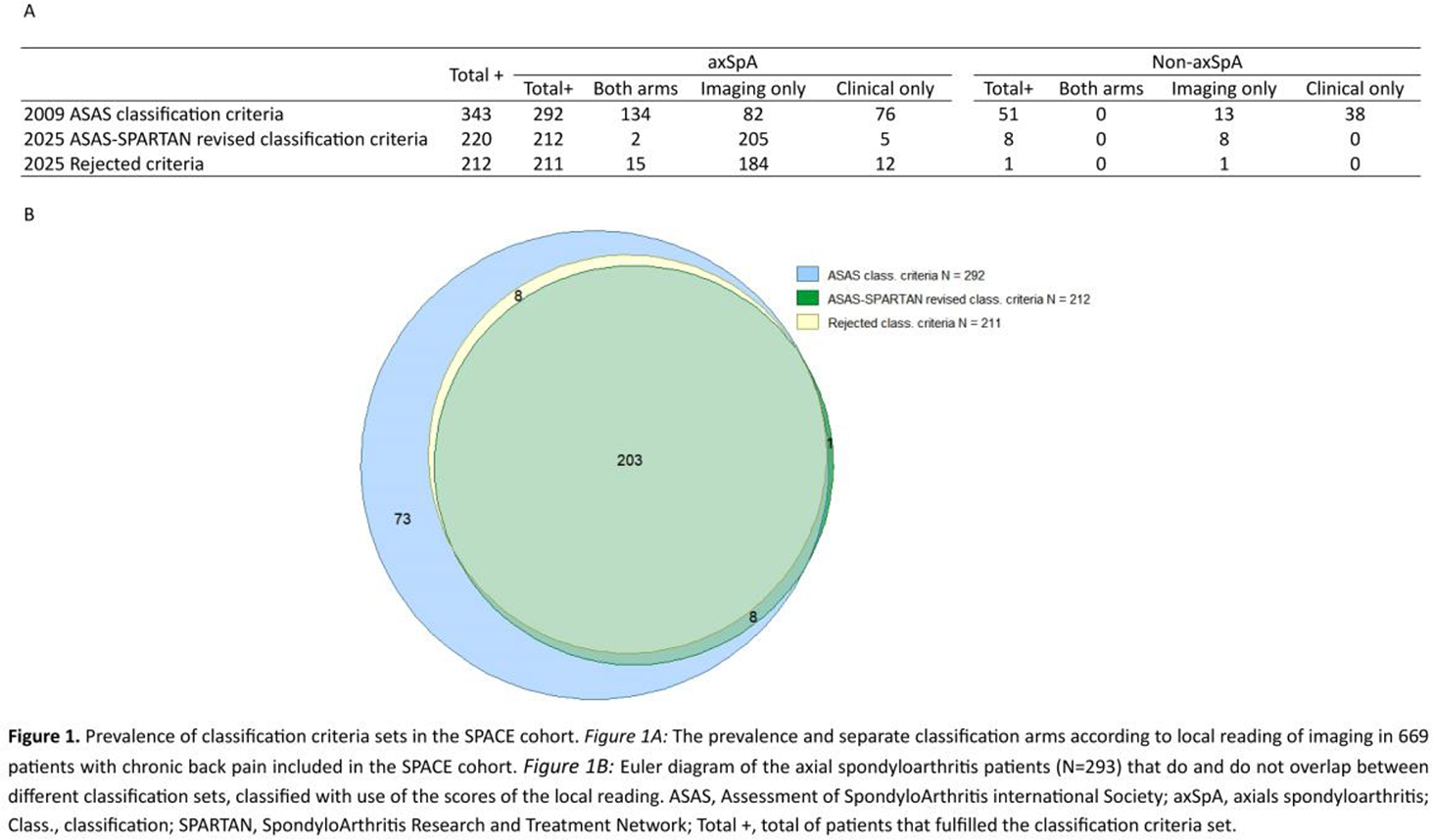
Results: We analyzed 669 patients with chronic back pain (mean age 30 (SD 8) years; 39% males; 53% axSpA). Fewer patients fulfilled the newly proposed criteria sets compared to the 2009 ASAS classification criteria (Figure 1A). The new criteria sets were highly specific (>94% regardless of local or central reading) (Table 1). However, compared to the 2009 ASAS criteria, sensitivity was lower when based on local readings (59.9-60.2% vs. 83.0%) and substantially lower when based on central readings or consensus across central readers (34.7-51.7% vs 70.4-78.1%). Structural lesions added little sensitivity (+1.4-5.9%) to the assessments’ performances, while specificity was similar to that of active lesions alone (Table 1). In the proposed criteria sets the proportion of patients classified in the clinical arm only was much lower compared to the 2009 ASAS classification criteria (84-93% reduction). Patients with axSpA classified in both candidate criteria sets overlapped almost entirely, while the 2009 ASAS classification criteria set included between 79 and 80 (27-28%) more axSpA patients (Figure 1B).
Conclusions: In early axSpA, the revised ASAS-SPARTAN axSpA criteria have a high specificity but moderate to low sensitivity, excluding about 27% of the axSpA patients that were included by the 2009 ASAS classification criteria. Compared to the 2009 ASAS classification criteria for axSpA, the reduced sensitivity of the revised criteria is mostly due to fewer patients being classified based on clinical features alone, highlighting the central role of imaging and reduced reliance on clinical features in the new classification criteria for axSpA. Notably, the addition of structural lesions to active MRI lesions slightly increased sensitivity without affecting specificity, and the high specificity of the new ASAS-SPARTAN axSpA criteria could already be achieved using local reading of imaging.
REFERENCES: [1] Maksymowych WP et al. The Assessments … Cohort Study . Abstract nr. 0854. Arthritis Rheumatol. 2025; 77 (suppl 9).
[2] De Bruin LJE, et al. POS0503 Predictive … Early cohort . Annals of the Rheumatic Diseases 2024;83:903-904.
Acknowledgments: NIL.
Disclosure of Interests: Liese de Bruin: None declared, Sofia Ramiro AbbVie, Alfasigma, Eli Lilly, Novartis, Pfizer, UCB, AbbVie, Alfasigma, Eli Lilly, Johnson&Johnson, MSD, Novartis, Pfizer, Takeda, UCB, AbbVie, Alfasigma, Eli Lilly, Novartis, Pfizer, UCB, Miranda van Lunteren: None declared, Mary Lucy Marques Novartis, Medac, Novartis, Ana Bento da Silva: None declared, Gizem Ayan: None declared, Manouk de Hooge UCB Pharma, UCB Pharma, Inger Jorid Berg: None declared, Sofia Exarchou Novartis and UCB Pharma, AbbVie, Amgen, Eli Lilly, Janssen, Novartis and UCB Pharma., Roberta Ramonda Abbvie, Novartis, Johnson& Johnson, Elly-Lilly, MSD, Pfizer, UCB, Amgen, Celltrion and Astra Zeneca, Robert Landewé AbbVie, UCB, Novartis, Galapagos, Janssen., AbbVie, UCB, Novartis, Galapagos, Janssen., Désirée van der Heijde AbbVie, Alfasigma, ArgenX, BMS, Elly-Lilly, Grey-Wolf Therapeutics, Janssen, Novartis, Pfizer, Takeda, UCB Pharma, Floris A. van Gaalen AbbVie, Novartis, UCB, Alfasigma, Johnson&Johnson, Lilly, Merck, Pfizer.