fetching data ... 
Background: Achieving sustained drug-free remission remains a major unmet goal in rheumatoid arthritis (RA), as current disease-modifying anti-rheumatic drugs (DMARDs) suppress inflammation but do not restore immune tolerance, leading to relapse after treatment withdrawal. Antigen-specific immunotherapy (ASI) offers a strategy to re-establish tolerance by directing disease-relevant CD4 + T-cell epitopes to antigen-presenting cells (APCs) in a non-inflammatory context. Liposomal ASI platforms co-encapsulating self-antigen and NF-κB inhibitors have shown potential to regulate autoimmune responses; however, stable in vivo delivery of multiple active components to lymph nodes without direct lymph node administration remains a significant translational challenge.
Objectives: To optimise a stable ASI liposomal formulation using semi-synthetic lipids, and to evaluate its in vivo biodistribution, APC targeting, and therapeutic efficacy in experimental arthritis.
Methods: ASI liposomes were formulated using semi-synthetic phospholipids 1-palmitoyl-2-oleoyl-glycero-3-phosphocholine (POPC) and 1-palmitoyl-2-oleoyl-sn-glycero-3-phosphoglycerol (POPG), encapsulating the citrullinated autoantigen peptide vimentin35–71Cit64 and the NF-κB inhibitor 1,25-dihydroxycholecalciferol (calcitriol). Liposomes were produced by microfluidic mixing and optimised for stability using a novel size exclusion chromatography (SEC) based assay to resolve intact liposomes from unencapsulated components and guide selection of stable formulations in vitro. Physicochemical characterisation included particle size, polydispersity index (PDI), zeta potential, encapsulation efficiency, and stability under multiple storage conditions. For biodistribution studies, peptide antigen was radiolabelled with zirconium-89 ( 89 Zr) and administered to mice by subcutaneous injection as free peptide or encapsulated within liposomes, followed by PET-CT imaging and ex vivo tissue analysis. Antigen uptake by draining lymph node APCs and associated immunoregulatory effects on CD4 + T-cell responses were assessed in vivo following administration of the optimised formulation. Therapeutic efficacy was evaluated in the proteoglycan-induced arthritis (PGIA) model following a short course of dexamethasone (DEX) to suppress disease severity.
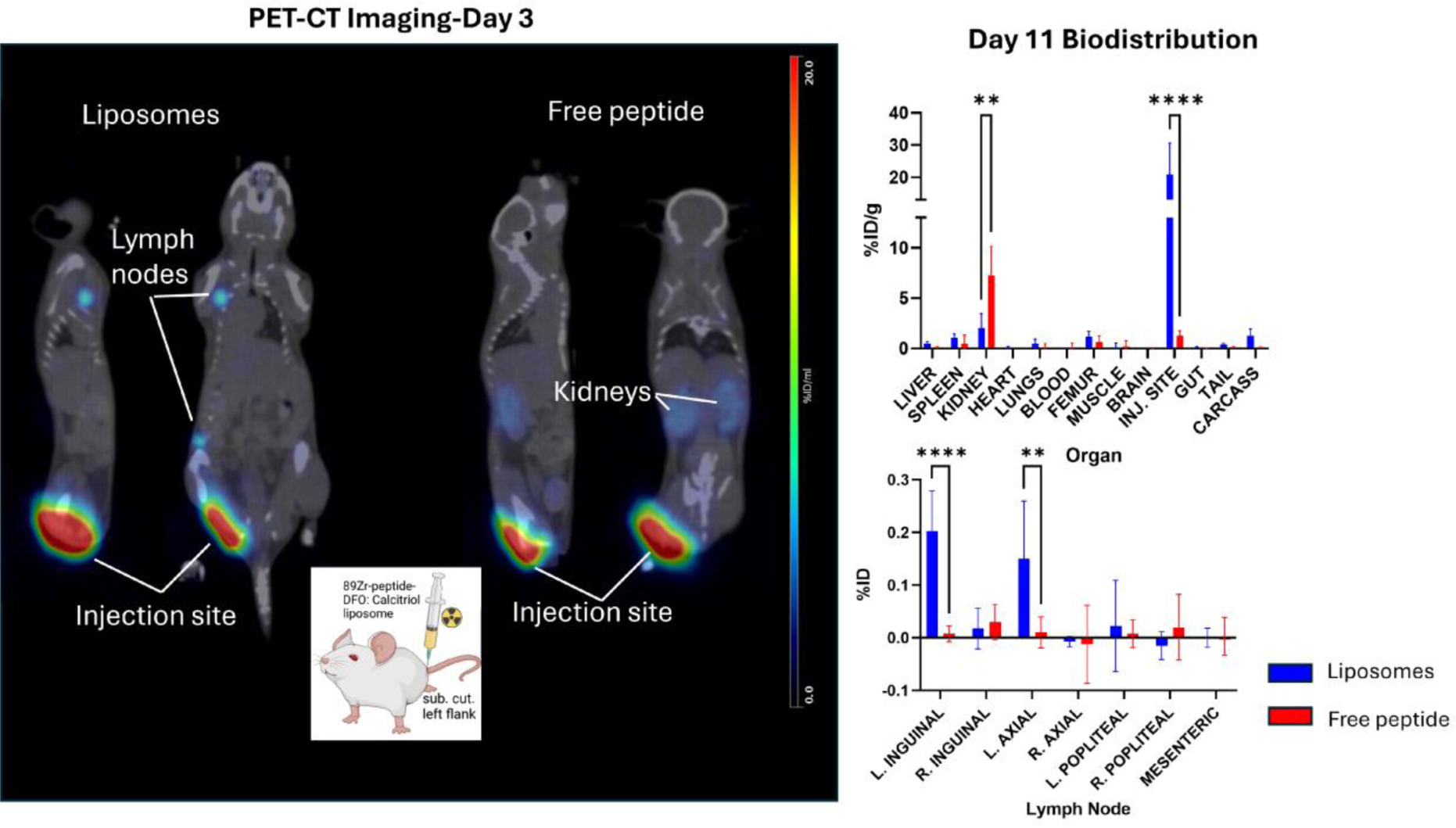
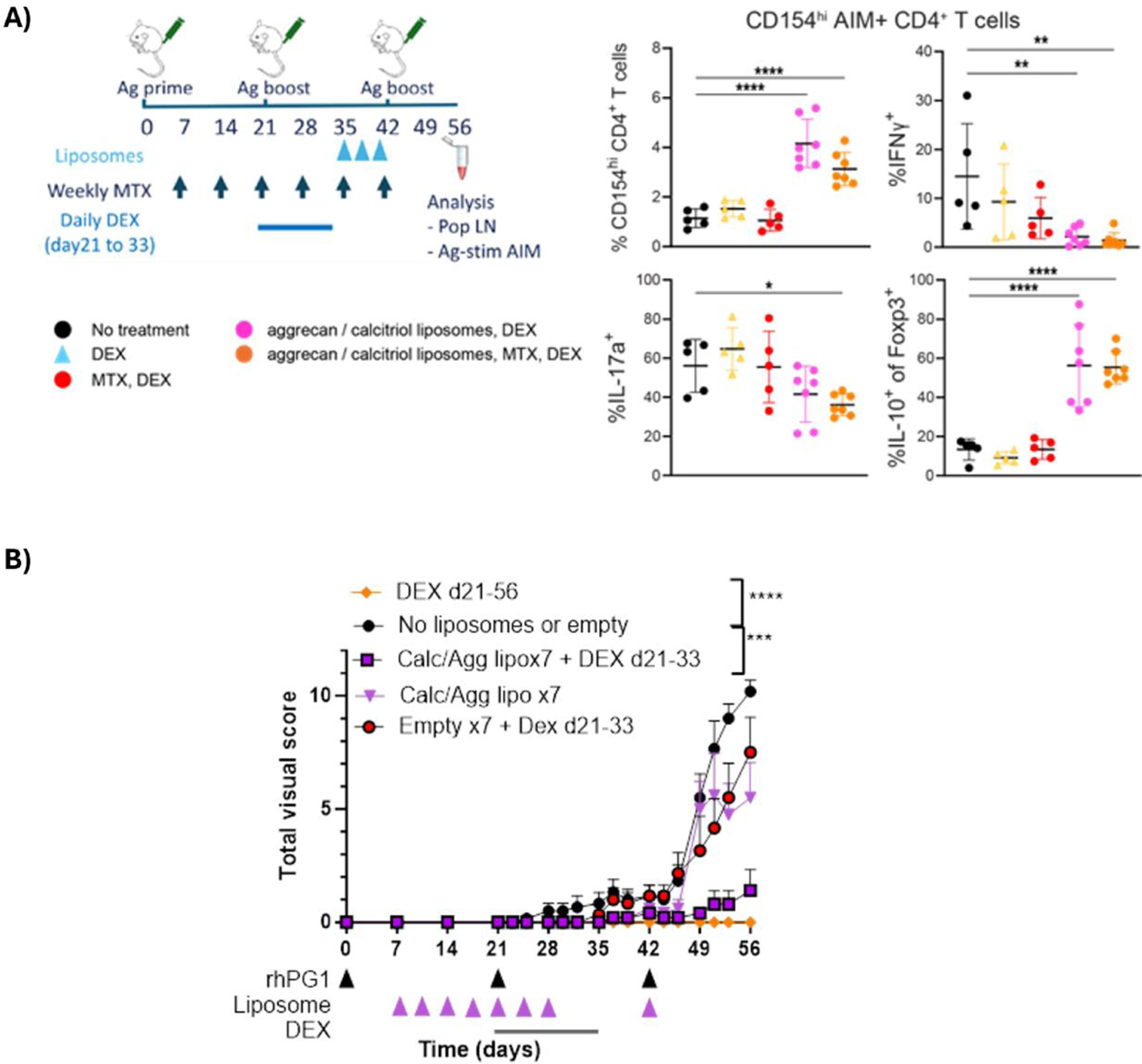
Results: Optimised ASI liposomes exhibited a mean hydrodynamic diameter of 119.18 nm, low PDI (0.132), a negative surface charge (−40.3 mV), and high peptide encapsulation efficiency (>80%), with <15% variation in physicochemical parameters over 28 days. PET-CT imaging demonstrated prolonged retention of liposome-associated antigen at the injection site and targeted trafficking to draining lymph nodes, whereas free peptide underwent rapid renal clearance ( Figure 1 ). The optimised liposomal composition identified through SEC-based stability profiling demonstrated sustained accumulation within draining lymph nodes and enhanced uptake by APC populations, accompanied by regulatory T cell induction and suppression of pro-inflammatory CD4 + T-cell responses ( Figure 2A ). In mice with PGIA model, treatment with a short course of DEX followed by ASI but not empty liposomes significantly improved arthritis scores and prevented the flare in disease activity associated with DEX withdrawal ( Figure 2B ).
Conclusions: Optimisation of ASI liposomes using semi-synthetic lipids overcomes key stability and delivery barriers to in vivo antigen presentation. By enabling targeted APC uptake and immune regulation within draining lymph nodes, this approach prolongs remission following short-course MTX and DEX through antigen-specific tolerance. These findings support the potential of ASI liposomal platforms to achieve durable, drug-free remission in RA.
Biodistribution of radiolabelled free peptide versus encapsulated peptide in liposomes after subcutaneous administration via PET-CT imaging.
Antigen-specific immunotherapy (ASITI) liposomes modulate immune responses and sustain disease control in PGIA model.
REFERENCES: NIL.
Acknowledgments: NIL.
Disclosure of Interests: None declared.