fetching data ... 
Background: The ANCHOR-RA study was an international cross-sectional study that will enable development of a multivariable model for prediction of rheumatoid arthritis-associated interstitial lung disease (RA-ILD).
Objectives: To evaluate risk factors for RA-ILD in patients with RA without known ILD.
Methods: Investigators at 27 sites in 6 countries prospectively enrolled consecutive patients with RA who had ≥2 of the following six risk factors for RA-ILD: 1) male; 2) current or previous smoker; 3) age ≥60 years at RA diagnosis; 4) high-positive rheumatoid factor (RF) and/or anti-cyclic citrullinated peptide (CCP) (titre >3 x upper limit of normal); 5) presence or history of at least one of these extra-articular manifestations of RA (vasculitis, Felty’s syndrome, secondary Sjögren’s diseases, cutaneous rheumatoid nodules, serositis, and/or scleritis/uveitis); 6) high RA disease activity in the prior 12 months. Patients who had been identified as having ILD, or had undergone a computed tomography scan in the prior 2 years, were not eligible. Participants underwent a chest high-resolution computed tomography (HRCT) scan, which was assessed centrally for presence of ILD (≥10%) by two expert radiologists and adjudicated by a third radiologist in case of disagreement. Participants could opt to have genotyping for the MUC5B promoter variant (T allele at rs35705950). Univariate logistic regression modelling was used to evaluate associations between participant characteristics and presence of ILD on HRCT.
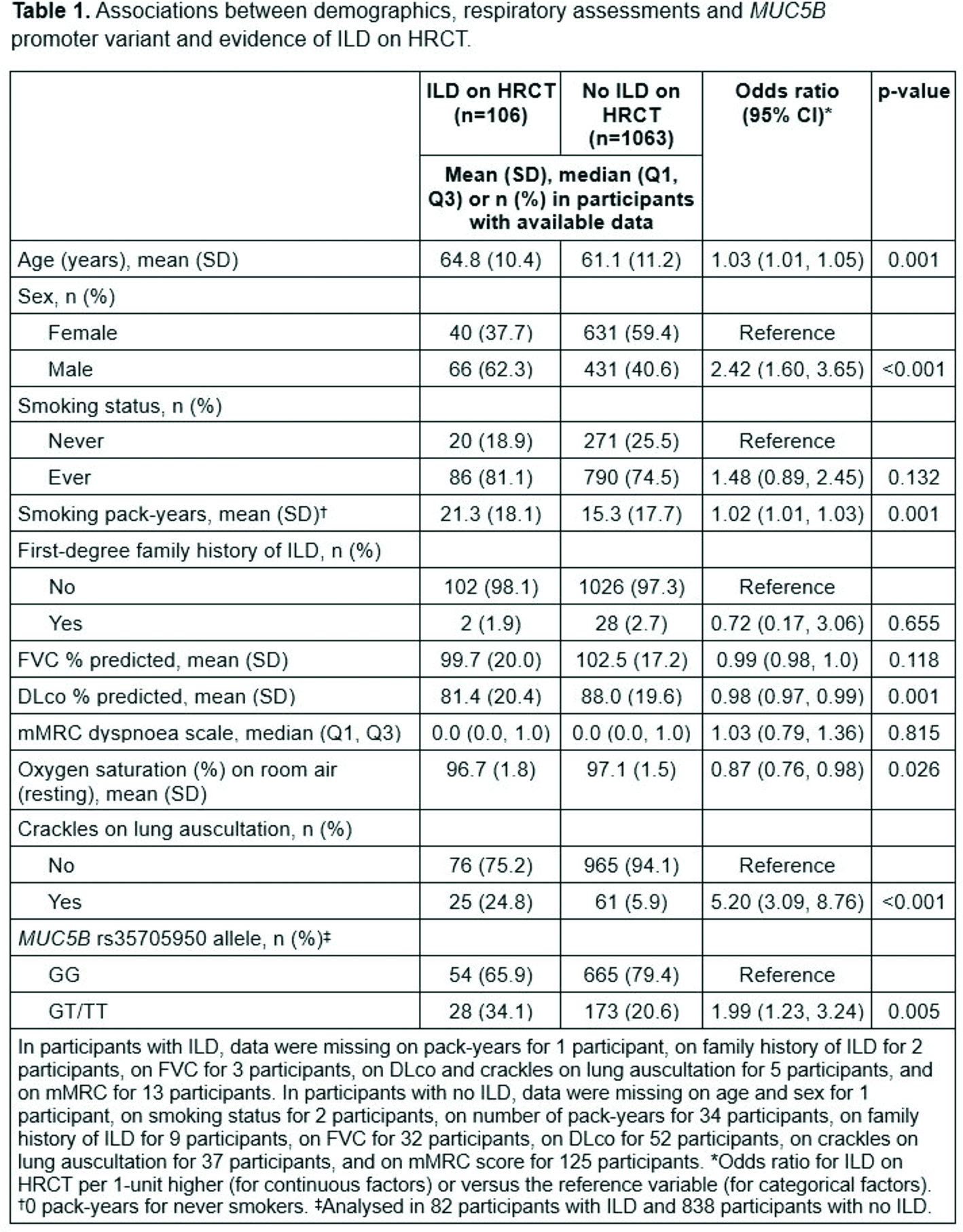
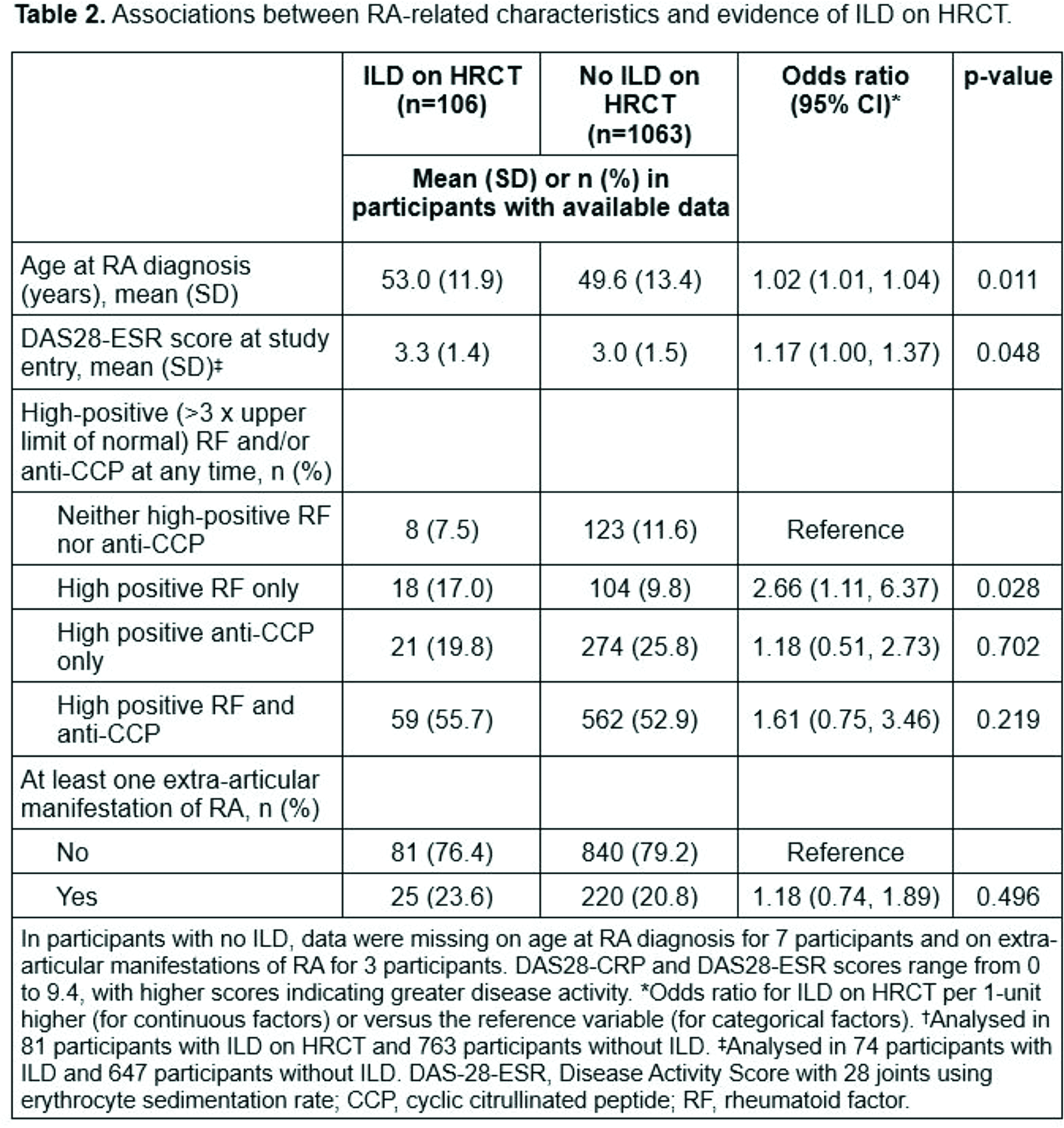
Results: Among 1169 participants who had an HRCT scan, 106 (9.1%) had ILD. Compared with participants without ILD, participants with ILD were significantly older at RA diagnosis and at study entry, more likely to be male, and had greater pack-years smoking exposure, but there were no significant differences in the proportion who were ever smokers or had a family history of ILD (Tables 1 and 2). Participants with ILD had lower mean DLco % predicted, but similar FVC % predicted, than those without ILD. Crackles on lung auscultation were more frequent in participants with than without ILD. Mean oxygen saturation was lower in participants with than without ILD. The GT/TT MUC5B rs35705950 T risk allele was more frequent in participants with than without ILD. Mean DAS-28-ESR score was higher in participants with than without ILD. The proportion of participants with high positive RF was higher in participants with than without ILD. The proportion of participants with at least one extra-articular manifestation of RA was similar in participants with and without ILD.
Conclusions: In this large international study in patients with RA with risk factors for ILD, but without known ILD, 9.1% had undiagnosed ILD. Based on exploratory univariate analyses, factors associated with RA-ILD were older age, male sex, greater tobacco exposure, lower DLco % predicted, lower oxygen saturation, higher DAS-28-ESR score, crackles on lung auscultation and the MUC5B promoter variant.
REFERENCES: NIL.
Acknowledgments: NIL.
Disclosure of Interests: Jeffrey A. Sparks has served as a consultant for AbbVie, Amgen, Boehringer Ingelheim, Bristol Myers Squibb, Gilead Sciences, Inova Diagnostics, Janssen, Optum, Pfizer, ReCor, and has received grants/research support from Bristol Myers Squibb, Gerd R. Burmester has served as a speaker for AbbVie, Bristol Myers Squibb, Boehringer Ingelheim, Chugai Pharma, Galapagos, Lilly, Pfizer, Sanofi, and has served as a consultant for AbbVie, Bristol Myers Squibb, Boehringer Ingelheim, Galapagos, Lilly, Pfizer, Sanofi, Philippe Dieudé has served as a speaker for Boehringer Ingelheim, Bristol Myers Squibb, Pfizer, has served as a consultant for Boehringer Ingelheim, Bristol Myers Squibb, Pfizer, has received grants/research support from AstraZeneca, Boehringer Ingelheim, Bristol Myers Squibb, and has participated on a Data Safety Monitoring Board or Advisory Board for Boehringer Ingelheim, Bristol Myers Squibb, Pfizer, Anna-Maria Hoffmann-Vold has served as a speaker for Boehringer Ingelheim, Janssen, Medscape, Merck Sharp & Dohme, Novartis, Roche, has served as a consultant for AbbVie, Argenx, AstraZeneca, Avalyn Pharma, Boehringer Ingelheim, Bristol Myers Squibb, Calluna Pharma, Genentech, Janssen, Merck Sharp & Dohme, Pliant Therapeutics, Roche, Werfen, has received grants/research support from Boehringer Ingelheim, Janssen, has received travel support from Boehringer Ingelheim, was the convenor of the European Respiratory Society/European Alliance of Associations for Rheumatology (ERS/EULAR) guideline for connective tissue disease-associated ILD, and is the EULAR study group leader on the lung in rheumatic and musculoskeletal diseases, Michael Kreuter has served as a consultant for Boehringer Ingelheim, AstraZeneca, Bristol Myers Squibb, Chiesi, GlaxoSmithKline, Helmut Prosch has served as a speaker for AstraZeneca, Boehringer Ingelheim, Bristol Myers Squibb, Janssen, Merck Sharp & Dohme, Roche, Sanofi, Takeda, has served as a consultant for AstraZeneca, Boehringer Ingelheim, Sanofi, has received grants/research support from AstraZeneca, Boehringer Ingelheim, Siemens, has received travel support from Boehringer Ingelheim, has participated on a Data Safety Monitoring Board or Advisory Board for Boehringer Ingelheim, and is President elect of the European Society of Thoracic Imaging, Stéphanie Wirbel is an employee of ICON Plc, which was contracted by Boehringer Ingelheim International GmbH as part of the research study, Gerrit Toenges is an employee of Boehringer Ingelheim International GmbH, Madhu Kanakapura is an employee of Boehringer Ingelheim International GmbH, Paul Emery has served as a consultant for Abbvie, Artiva Biotherapeutics, AnatptysBio, Autolus, Boehringer Ingelheim, Bristol Myers Squibb, Forward Therapeutics, Gedeon Richter, Immunovant Inc, Lilly, Merck Sharp & Dohme, Novartis, Quell Therapeutics, Spyre Therapeutics.