fetching data ... 
Background: Janus kinase inhibitors (JAKis) are approved for the treatment of rheumatoid arthritis (RA) and other chronic inflammatory diseases. Whilst highly effective, safety signals from clinical trials and from some observational studies including a previous study from us suggest a possible increase in the risk of venous thromboembolism (VTE) [1]. Continued monitoring of VTE risks with JAKi and biological disease modifying antirheumatic drugs (bDMARDs) as used in RA is thus critical.
Objectives: To assess and compare the incidence of VTE in patients with RA treated with JAKis, tumour necrosis factor inhibitors (TNFi) or other bDMARDs.
Methods: We performed an observational nationwide register-based cohort study in Sweden from January 01 2017 through December 31 2024. We used the Swedish Rheumatology Quality Register (SRQ) to identify treatment cohorts (exposure) of initiators of a JAKi, a TNFi, or non-TNFi bDMARDs. From SRQ, we collected age, sex, smoking history and RA disease activity measures as covariates, including RA disease duration, number of previous b/tsDMARD treatments, seropositivity, C-reactive protein (CRP), Disease Activity Score (DAS28)-CRP, Health Assessment Questionnaire (HAQ). For contextualisation, we used a linkage with Swedish national health registers to match five randomly selected individuals without RA from the general population by age, sex and residential area (at time of the RA diagnosis of the index RA patient). For all individuals, we collected history of comorbidities from the Swedish national health registers within 5 years before each b/tsDMARD initiation, and the incidence of VTE using previously validated algorithms [2,3]. We followed the cohorts from treatment initiation until any first VTE, end of the b/tsDMARD treatment under study plus a lag of 90 days, switch to different b/tsDMARD, death or end of study period (31/12/2024), whichever occurred first. Treatment initiations with a history of VTE within one year before start were excluded. We calculated crude and age/sex-standardised incidence rates (IR), and multivariable adjusted Hazard-Ratios (HR) using Cox regression. Analyses were performed in the entire study population, and separately for the period covered by our previous assessment (treatment starts 2017 through 2020 but this time with follow-up for VTE through 2024 as opposed to 2021 in our previous report) and b/tsDMARD starts 2021 through 2024.
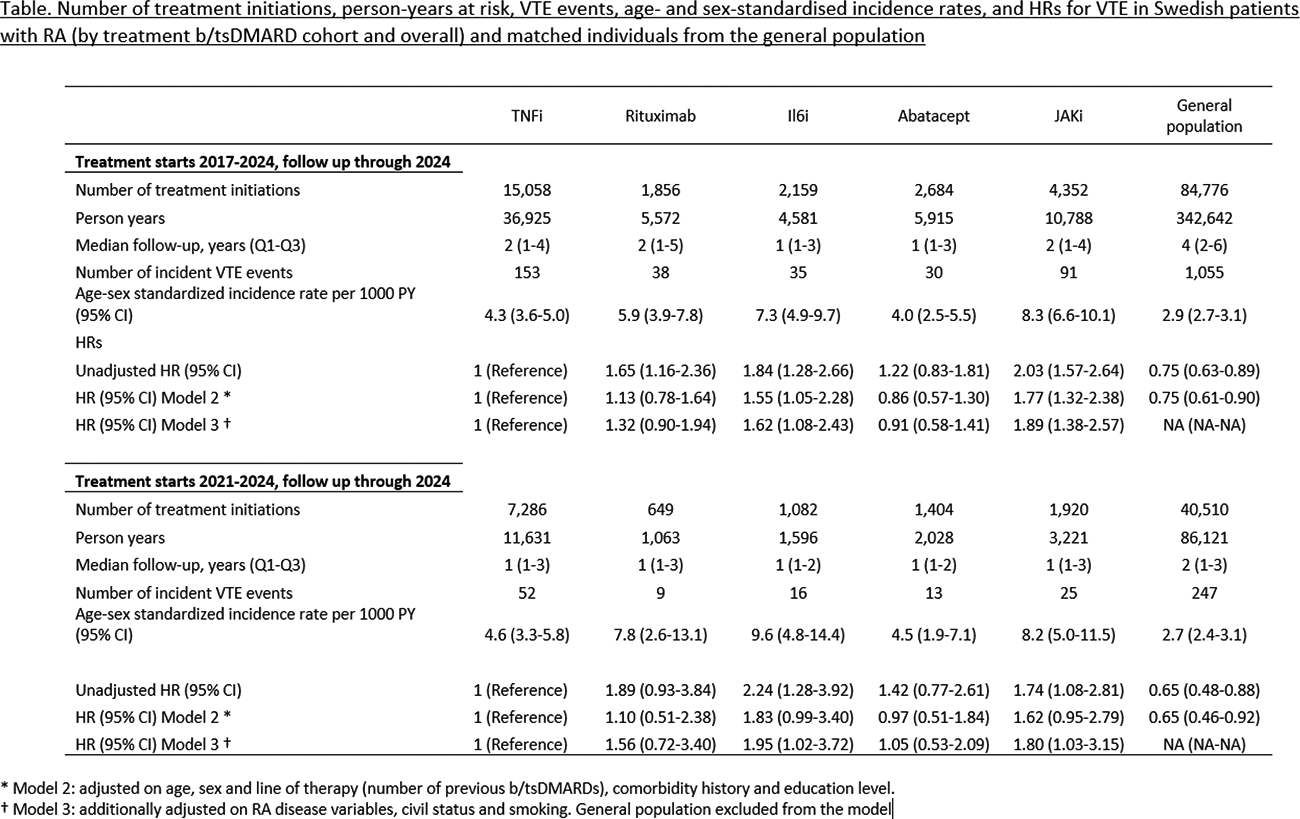
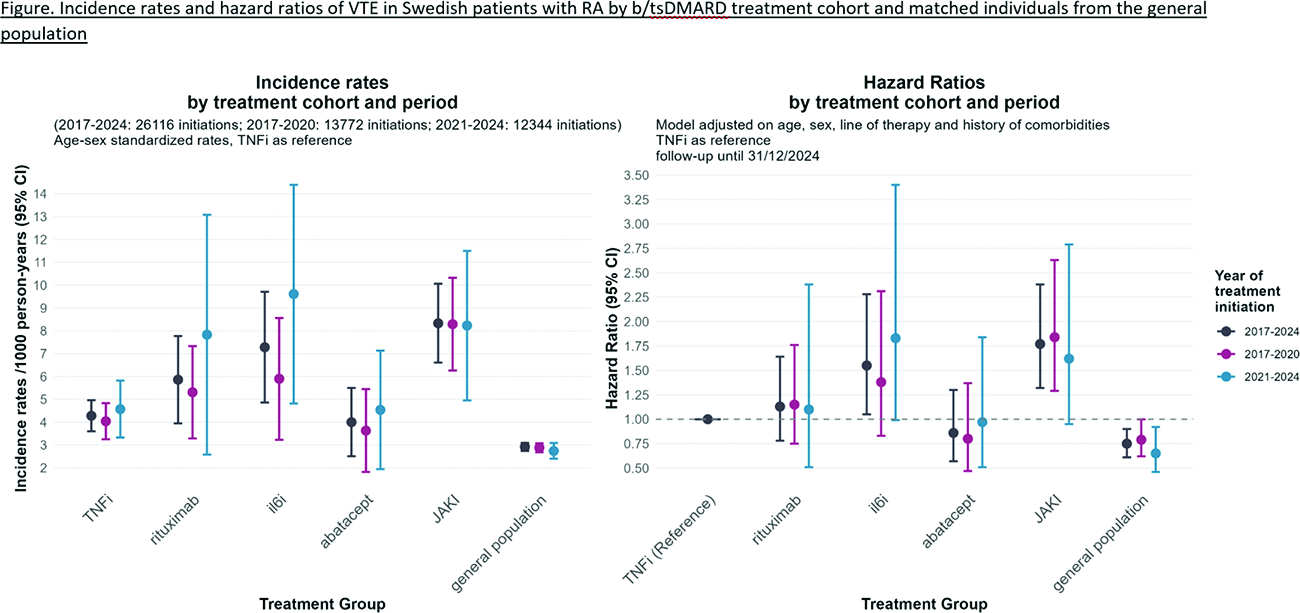
Results: We included 26 116 treatment initiations between 2017 and 2024 (median 61 years of age, 76% women). Based on 347 incident VTE events, the age and sex-standardised (to TNFi) IR (95% Confidence Interval (CI)) for VTE was 4.3 per 1000 person-years (3.6-5.0) for patients treated with TNFi, 8.3 (6.6-10.1) for patients treated with JAKi, 5.9 (3.9-7.8) for patients treated with rituximab, 7.3 (4.9-9.7) for patients treated with IL6i, 4.0 (2.5-5.5) for patients treated with abatacept and 2.9 (2.7-3.1) for the general population. The fully adjusted HR (95% CI) for VTE with JAKi versus TNFi was 1.89 (1.38-2.57). The estimates among the patients in the 2021–2024 subset were similar to the estimates of the 2017-2024 initiations (HR=1.80 (1.03-3.15). Additionally, the fully adjusted HR for VTE with IL6i versus TNFi was 1.62 (1.08-2.43) among the 2017-2024 treatment initiations.
Conclusions: Patients with RA selected for treatment with JAKi experience a higher risk of VTE during treatment than patients with RA selected for TNFi. This pattern persists also in treatment initiations 2021 or later. The signal of a higher risk of VTE with IL6i vs. TNFi observed among initiators 2021-2024 warrants further investigation.
REFERENCES: [1] Molander V, Bower H, Frisell T, Delcoigne B, Di Giuseppe D, Askling J, et al. Venous thromboembolism with JAK inhibitors and other immune-modulatory drugs: a Swedish comparative safety study among patients with rheumatoid arthritis. Ann Rheum Dis. 2023 Feb;82(2):189–97.
[2] Molander V, Bower H, Askling J. Validation and characterization of venous thromboembolism diagnoses in the Swedish National Patient Register among patients with rheumatoid arthritis. Scand J Rheumatol. 2023 Mar;52(2):111–7.
[3] Molander V, Bower H, Frisell T, Askling J. Risk of venous thromboembolism in rheumatoid arthritis, and its association with disease activity: a nationwide cohort study from Sweden. Ann Rheum Dis. 2021 Feb;80(2):169–75.
Acknowledgments: NIL.
Disclosure of Interests: Maxime Raffray: None declared, Viktor Molander: None declared, Daniela Di Giuseppe: None declared, Helena Idborg: None declared, Helga Westerlind: None declared, Christel Karlqvist: None declared, Per-Johan Jakobsson: None declared, Johan Askling PI for agreements between Karolinska Institutet and Abbvie, BMS, Eli Lilly, Pfizer, Roche, Samsung Bioepis, AlfaSigma and Sanofi for safety monitoring of anti-rheumatic therapies (ARTIS).