fetching data ... 
Background: The clinical significance to time-averaged proteinuria, defined as time-adjusted mean urinary protein-creatinine ratio (g/mmol) (TAM UPCR) over the observational period, has not been systematically evaluated in lupus nephritis (LN), particularly at the lower levels below the threshold used to define proteinuria in systemic lupus erythematosus disease activity index (SLEDAI) -2K (>0.5 g/24h; approximately >0.05 g/mmol with attribution to active SLE based on physicians’ clinical judgement).
Objectives: We aimed to elucidate the clinical significance of (TAM UPCR >0.05 g/mmol) in patients with LN, focusing on renal outcomes, flares, and damage accrual.
Methods: Data from the Asia Pacific Lupus Collaboration cohort, collected prospectively from 13 countries between 2013 and 2020 using standard templates were analysed. Patients with LN defined by meeting renal domain criteria at study entry in either the American College of Rheumatology (ACR) or the Systemic Lupus International Collaborating Clinics (SLICC) classification criteria, or ever positive renal domain in SLEDAI-2K during follow-up were studied. Proteinuria was defined based on TAM UPCR, with categorisation of ≤0.015, >0.015–0.05, >0.05–0.1, and >0.1 g/mmol. Associations with LLDAS-50 (LLDAS achievement for ≥50% of follow-up), renal function decline (≥30% or ≥40% estimated glomerular filtration rate [eGFR] decline, and creatinine doubling), severe flares, and SLICC/ACR Damage Index (SDI) increase were evaluated using multivariable logistic regression.
Results: 2,477 patients with LN (median follow-up 3.0 years [IQR 1.1–5.7]; 20,637 visits) were studied. 45.4% had TAM UPCR >0.05 g/mmol, and 42.8% achieved LLDAS-50. Discrepancy of the presence of proteinuria >0.05 g/mmol and judgement of inactive renal involvement based on the proteinuria of SLEDAI occurred in 6.8% of visits. 22.0% of those who achieved LLDAS-50 still had TAM UPCR >0.05 g/mmol. Patients with TAM UPCR >0.05 g/mmol had higher renal decline than those with TAM UPCR ≤0.05 g/mmol (30% eGFR decline, 17.3% vs 5.7%, p<0.01 and 40% eGFR decline, 10.8% vs 2.9%, p<0.01). TAM UPCR >0.1 g/mmol and not in LLDAS-50 (<LLDAS-50) independently associated with increased risk of creatinine doubling (OR 7.57 [95% CI: 1.72–22.3], p=0.007; OR 6.81 [1.57–20.60], p=0.010), severe flares (OR 3.13 [2.17–4.51], p<0.001, OR 2.93 [2.17–3.96], p<0.001), and SDI increase (OR 2.03 [1.37–2.99], p<0.001; OR 1.45 [1.05–2.00], p=0.023). TAM UPCR ≤0.015 g/mmol did not further improve renal outcomes versus >0.015–0.05 g/mmol but was associated with fewer flares and less damage accrual even in patients who achieved LLDAS-50.
Conclusions: High time-averaged proteinuria (TAM UPCR >0.05 g/mmol) is a significant prognostic indicator, associated with renal function decline, disease flares, and damage accrual. Notably, we show that low-grade elevation in TAM UPCR (between 0.015 to 0.05 g/mmol) were similarly associated with adverse renal and overall disease outcomes. In contrast, LLDAS-50 attainment was protective against both renal and overall outcomes, supporting combined targets of LLDAS achievement and minimal residual proteinuria in the management of LN.
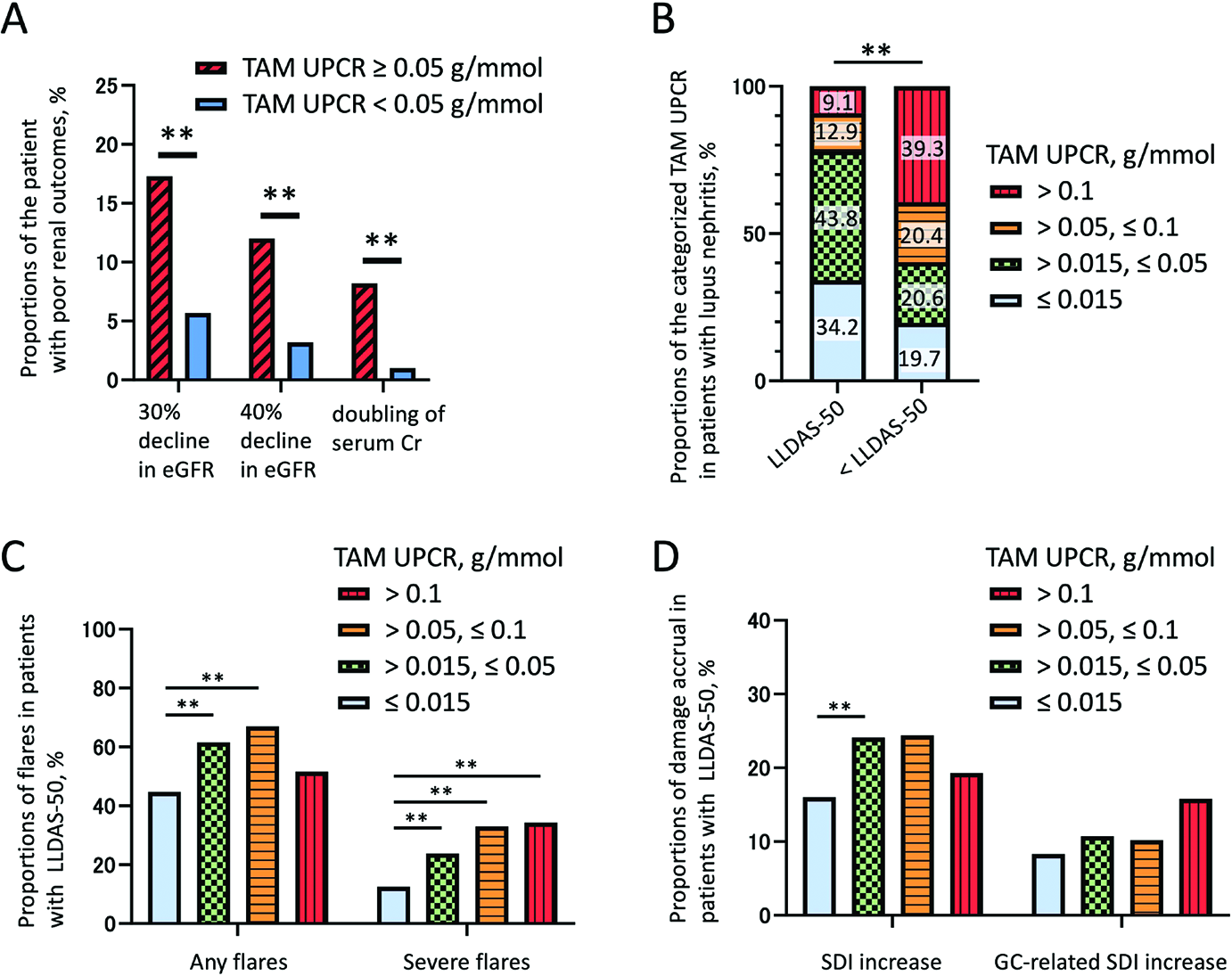
A. Comparison of the proportions of 30% decline in eGFR, 40% decline in eGFR and doubling of serum creatinine between lupus nephritis patients with TAM UPCR ≤ 0.05 g/mmol and those with TAM UPCR > 0.05 g/mmol. B. proportions of the categorised TAM UPCR in lupus nephritis patients with or without LLDAS-50 (LLDAS-50 indicates that the cumulative time spent in LLDAS during the follow-up period is equal or more than 50%.). C, D. Comparison of the proportions of any flares, severe flares and increase in SLICC/ACR damage index (SDI) and increase in glucocorticoid (GC)-related SDI between the four groups categorized into TAM UPCR ≤ 0.015 g/mmol, > 0.015–0.05 g/mmol, > 0.05–0.1 g/mmol, and > 0.1 g/mmol, stratified by the patients with LLDAS-50. **p < 0.001.
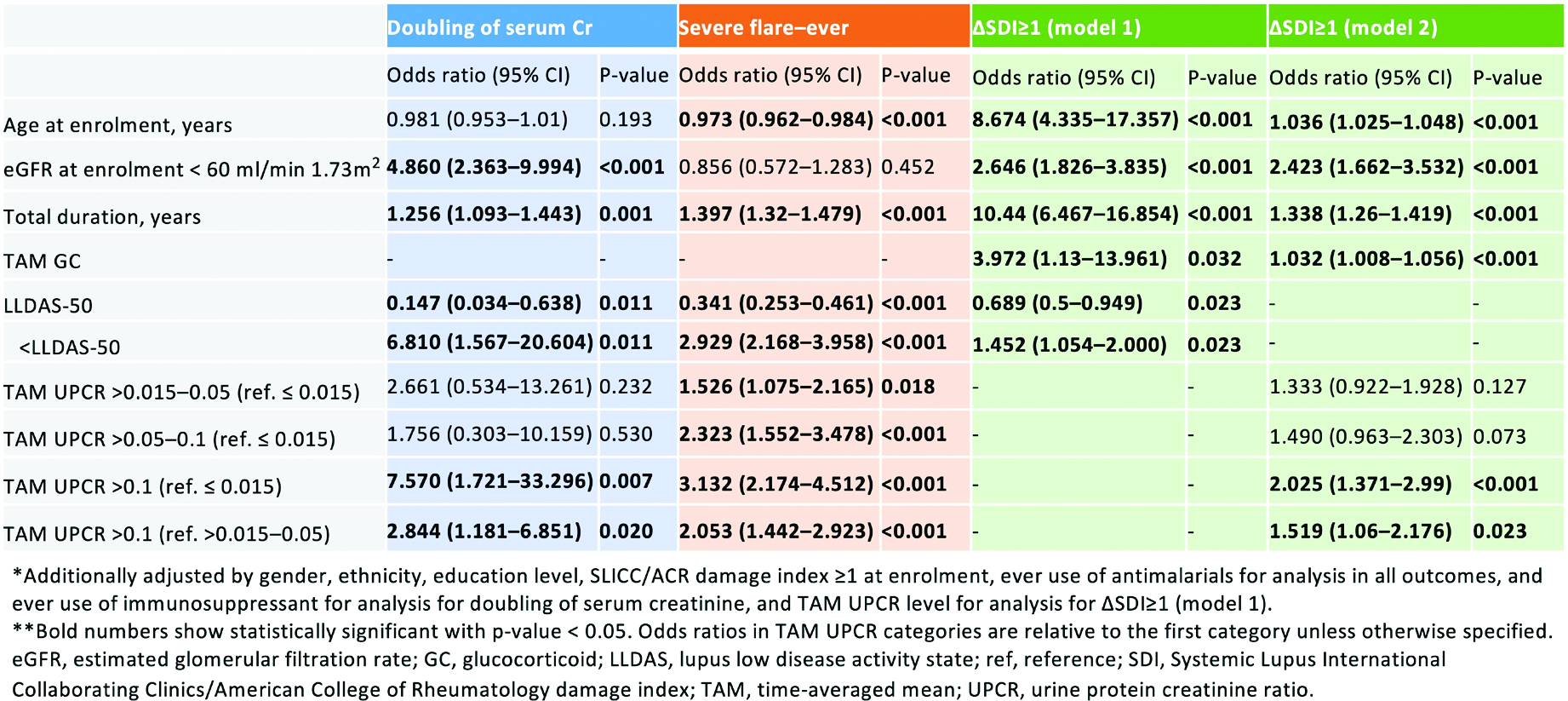
Factors associated with doubling of serum creatine, severe flares, and damage accrual in patients with lupus nephritis by multivariable analysis.
REFERENCES: NIL.
Acknowledgments: NIL.
Disclosure of Interests: Jun Kikuchi: None declared, Rangi Kandane-Rathnayake: None declared, Worawit Louthrenoo: None declared, Chak Sing Lau: None declared, Laniyati Hamijoyo: None declared, Jiacai Cho: None declared, Aisha Lateef: None declared, Shue Fen Luo: None declared, Yeong-Jian Jan Wu: None declared, Sandra Navarra: None declared, Zhanguo Li: None declared, Yi-Hsing Chen: None declared, Shereen Oon: None declared, Madelynn Chan: None declared, Sargunan Sockalingam: None declared, Yanjie Hao: None declared, Zhuoli Zhang: None declared, Sang-Cheol Bae: None declared, Yasuhiro Katsumata Asahi Kasei Pharma, AstraZeneca K.K., Chugai Pharmaceutical Co., Ltd., GlaxoSmithKline K.K., Otsuka Pharmaceutical Co., Ltd., Duminda Basnayake: None declared, Fiona Goldblatt: None declared, Sean O’Neill: None declared, Kristine Pek Ling Ng: None declared, Nicola Tugnet: None declared, Mark Sapsford: None declared, Tze Chin TAN: None declared, Shirley C.W. Chan: None declared, Cherica Tee: None declared, Michael Tee: None declared, Naoaki Ohkubo: None declared, Yoshiya Tanaka: None declared, Vera Golder: None declared, Mandana Nikpour: None declared, Alberta Hoi AstraZeneca, Novartis, Seqirius, Janssen, Roche, GSK, Recordati, UCB, AstraZeneca, Merck Serono, GSK, BMS, Eric Morand: None declared, Tsutomu Takeuchi: None declared, Yuko Kaneko: None declared.