fetching data ... 
Background: Antiphospholipid syndrome (APS) is a thrombo-inflammatory disease characterized by recurrent venous, arterial, and microvascular thrombosis and pregnancy morbidity, in the presence of persistent antiphospholipid antibodies (aPLs). Recurrent thrombosis despite treatment with anticoagulants and/or antiplatelets remains a challenge in patients with thrombotic APS in everyday clinical practice.
Objectives: To identify risk factors associated with first thrombotic recurrence and multiple thrombotic events in patients with thrombotic APS.
Methods: A retrospective study was conducted in a Greek cohort of patients with APS fulfilling the 2023 ACR/EULAR classification criteria. The primary outcome was recurrence, defined as a new confirmed thrombotic event occurring after the APS diagnosis. Multiple thrombotic events were defined as the occurrence of two or more thrombotic events post-diagnosis. Baseline demographics, clinical, laboratory, and treatment-related variables were collected, and associations between baseline characteristics and recurrence were initially assessed using metric and parametric tests. Variables associated with recurrence in univariable analysis (p < 0.20) were entered into multivariable binary logistic regression models to identify independent risk factors for recurrence and multiple thrombotic events. Results are reported as adjusted odds ratios (OR) with 95% confidence intervals (CI). Statistical significance was set at p < 0.05.
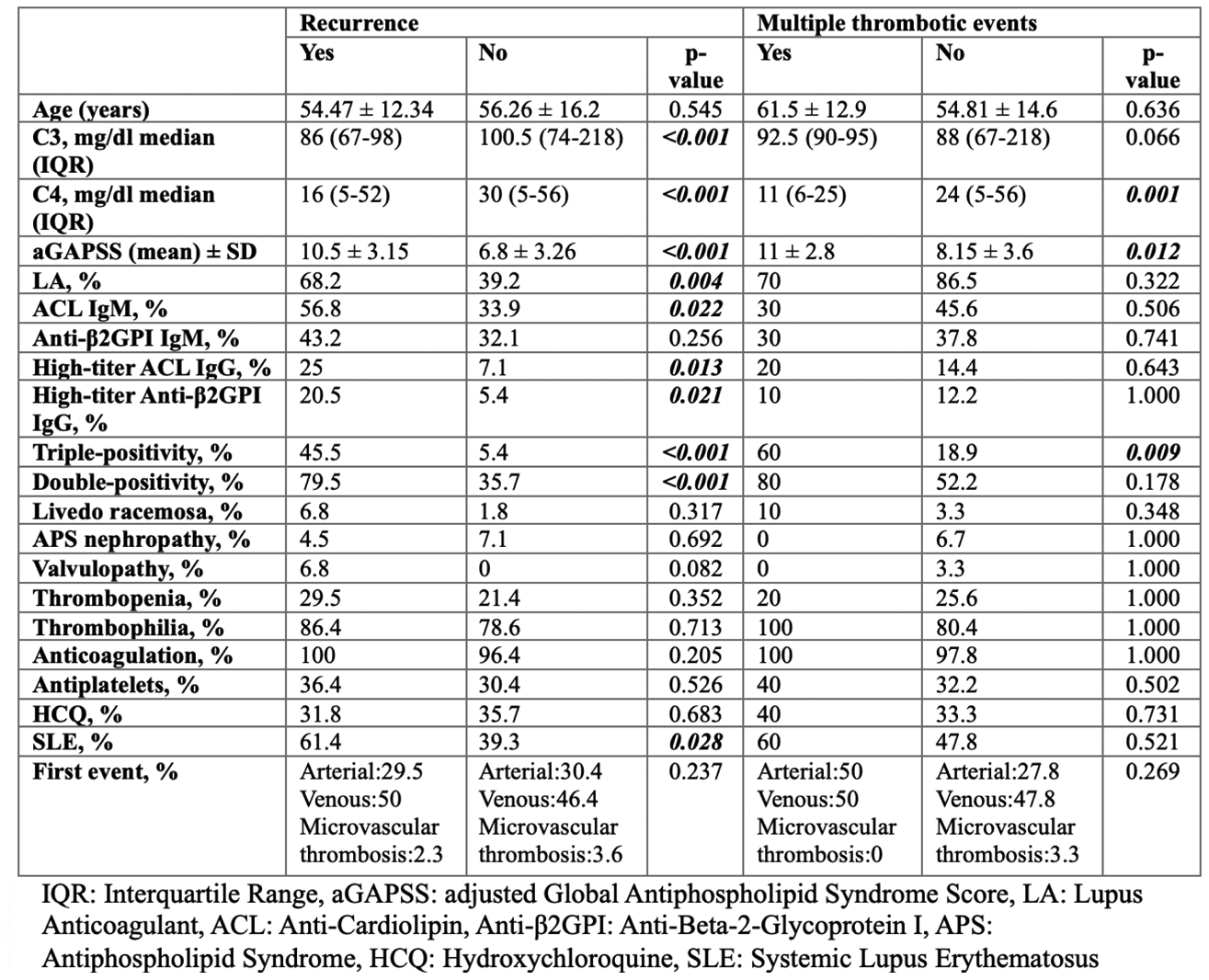
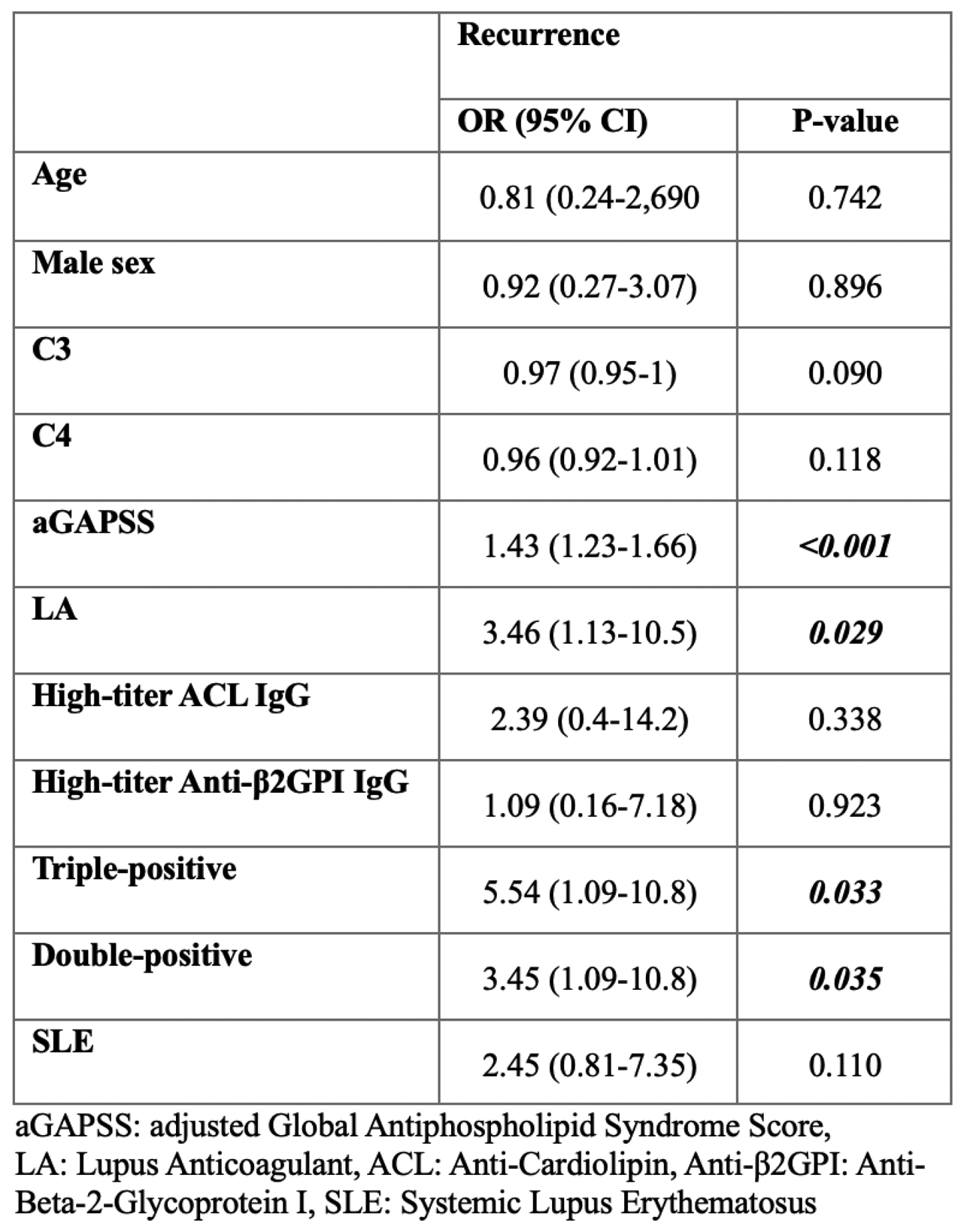
Results: Of 129 patients meeting the revised Sapporo criteria, 100 met the 2023 ACR/EULAR classification criteria and were included in the analysis. During follow-up, 44 patients (44%) experienced a new thrombotic event. There was no difference between patients with and without recurrence regarding baseline demographics [females: 75% vs 68.3%, p=0.451; mean age at diagnosis: 56.26 (51.92-60.6) vs 54.47 (50.72-58.23) years, p=0.545] or traditional cardiovascular risk factors. However, patients with recurrence had significantly lower complement levels (C3 and C4) and higher adjusted Global Antiphospholipid Syndrome Score (aGAPSS) and adjusted Global Antiphospholipid Syndrome Score for Cardiovascular Disease (aGAPSS-CVD) scores at diagnosis, than those without recurrence (Figure 1). Regarding the aPL profile, patients with recurrence were more frequently positive for lupus anticoagulant (LA) (68.2% vs 39.2%, p=0.004), high-titer anticardiolipin IgG (anti-CL IgG) (25% vs 7.1%, p=0.013), and high-titer anti-β2-glycoprotein I IgG (20.5% vs 5.4%, p=0.021). Triple and double positivity were detected more frequently in the recurrence group (45.5% vs 5.45%, p < 0.001; and 79.5% vs 35.7%, p < 0.001, respectively). There were no differences in clinical manifestations, use of anticoagulants, antiplatelets, or hydroxychloroquine (Figure 1). Concomitant systemic lupus erythematosus (SLE) was more frequent among patients with recurrence (61.4% vs 39.3%, p=0.028). In multivariable analysis, LA positivity was associated with an increased risk of recurrence (OR: 3.46, 95% CI 1.13-10.5; p=0.029). Moreover, triple and double positivity were identified as independent risk factors for recurrence (OR: 5.54, 95% CI 1.14-26.8; p = 0.033 and OR: 3.45, 95% CI 1.09-10.8; p = 0.035, respectively). The recurrence group had a higher aGAPSS at diagnosis (OR: 1.43, 95% CI 1.23-1.66; p<0.001). Baseline demographics, traditional cardiovascular risk factors, complement levels (C3, C4), age at diagnosis, and concomitant SLE were not independently associated with an increased risk of recurrence (Figure 2). Multiple thrombotic events occurred in 10% of patients. Patients with multiple thrombotic events did not differ in age, gender, traditional cardiovascular risk factors, or treatment. However, they were more frequently triple-positive (60% vs 18.9%, p=0.009) and anti-CL IgG-positive at medium titers (80% vs 33.3%, p=0.006). C4 levels at diagnosis were significantly lower in patients with multiple thrombotic events (median = 11 vs 24 mg/dL, p = 0.001) (Figure 1). In the multivariable analysis, triple positivity was identified as the sole independent predictor of multiple thrombotic events (OR 6.5, 95% CI 1.4-28.99, p=0.013).
Conclusions: Recurrence of thrombotic events despite recommended treatment is common in APS. Lupus anticoagulant positivity, double and triple aPL positivity, and a higher aGAPSS at diagnosis were identified as independent risk factors for recurrent thrombosis, while triple positivity identifies patients at particularly high risk for multiple thrombotic events.
Factors associated with first and multiple thrombotic recurrences in APS.
Multivariable logistic regression analysis of factors associated with first thrombotic recurrence in APS
REFERENCES: NIL.
Acknowledgments: NIL.
Disclosure of Interests: None declared.