fetching data ... 
Background: Psoriatic arthritis (PsA) is a heterogeneous inflammatory disease affecting multiple musculoskeletal and dermatologic domains [1]. Although composite indices and clinical assessments guide disease monitoring, reliable biological markers of disease activity remain limited [1]. Acute-phase reactants such as C-reactive protein (CRP) and erythrocyte sedimentation rate (ESR) are neither specific nor consistently elevated in PsA [1]. The neutrophil-to-lymphocyte ratio (NLR) is an inexpensive and readily available marker of systemic inflammation that reflects innate and adaptive immune balance [2]. While NLR has been associated with psoriasis severity and cardiovascular risk [2,3], its role as a marker of disease activity and severity in PsA is not well established.
Objectives: To evaluate the longitudinal association between NLR and measures of disease activity and severity across multiple PsA domains.
Methods: We analyzed data from a large prospective longitudinal PsA cohort. NLR was modeled (i) as a continuous variable and (ii) as elevated (>3.0). Outcomes included those for disease activity- composite disease activity indices (cDAPSA, DAPSA), swollen joint count (SJC), SPARCC enthesitis index, PASI, BASDAI, patient global assessment of disease activity, patient assessment of pain, CRP, and for damage- radiographic sacroiliitis grade (0–8), and modified Steinbrocker score (mSS). Associations were estimated using linear mixed-effects models with time as a repeated measure. Models were adjusted for age, sex, BMI, smoking, outcome-relevant comorbidities, and treatment exposure (NSAIDs, oral corticosteroids, csDMARDs, and b/tsDMARDs) using outcome-specific adjustment sets. Analyses were repeated stratified by CRP ≥5 versus <5 mg/L. Results are presented as forest plots for the overall cohort and CRP-stratified analyses, separately for continuous and elevated NLR.
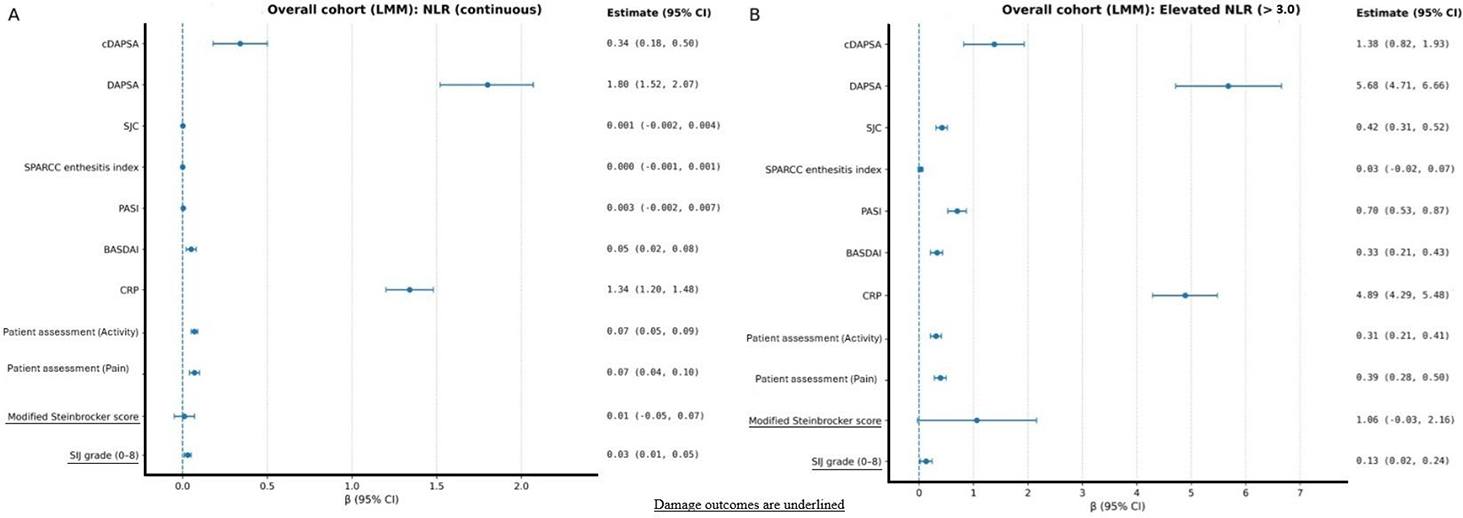
Results: The study included 1,685 patients (55.1% male) with a mean (SD) age at baseline (clinic entry) of 44.9 (13.2) years and a mean PsA duration of 6.2 (8.2) years. The median [IQR] duration of follow-up was 9.6 [2.9, 17.4] years, comprising 19,595.2 patient-years. At baseline, median DAPSA was 17.0 [9.0–29.0], median PASI was 1.2 [0.0–4.1], and mean (SD) NLR was 3.0 (3.7). At baseline, 560 patients (33.2%) had elevated NLR, while 606 (36.0%) had elevated CRP; 144 (8.5%) patients had normal CRP but elevated NLR. Over follow-up, 1,091 patients (64.7%) ever had elevated NLR, and 418 (24.8%) patients had at least one visit with elevated NLR despite normal CRP. In the overall cohort (Figure 1A ), higher continuous NLR was associated with higher disease activity measured by cDAPSA, DAPSA, BASDAI, patient global assessment of disease activity, and patient assessment of pain. Higher NLR was also associated with higher PASI, CRP levels, and radiographic sacroiliitis grade. Associations with swollen joint count were modest, and no consistent association was observed with enthesitis. When analyzed categorically (Figure 1B ), elevated NLR showed stronger and more consistent associations with disease activity than continuous NLR, particularly for cDAPSA, DAPSA, BASDAI, patient-reported outcomes, and CRP.
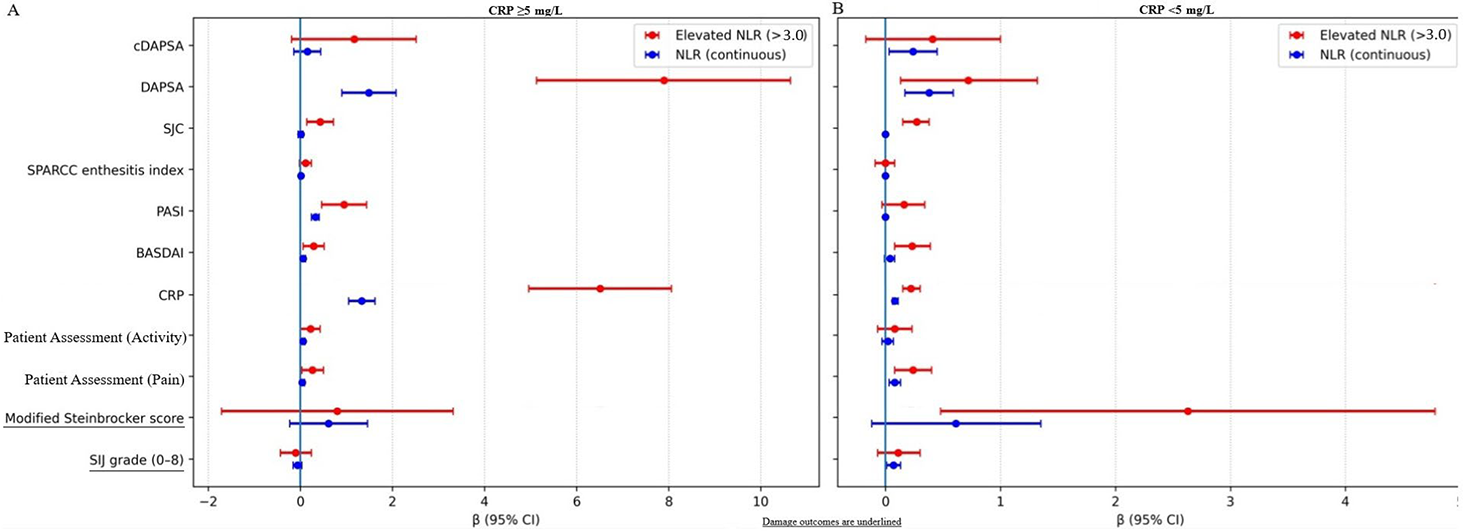
In CRP-stratified analyses (Figure 2 ), elevated NLR remained associated with higher disease activity in both strata. Among visits with CRP ≥5 mg/L, elevated NLR was associated with higher DAPSA, BASDAI, patient-reported outcomes, and CRP (Figure 2A ). Importantly, among visits with CRP <5 mg/L, elevated NLR also remained associated with higher DAPSA and patient-reported outcomes (Figure 2B ). Associations with damage outcomes were observed primarily in the CRP <5 mg/L subgroup: elevated NLR was associated with higher mSS, while higher continuous NLR was associated with greater radiographic sacroiliitis grade.
Conclusions: In this large longitudinal PsA cohort, NLR was independently associated with multiple measures of disease activity across musculoskeletal, skin, and patient-reported domains. Elevated NLR demonstrated particularly consistent associations with global disease activity and patient-perceived disease impact, including among patients with normal CRP, suggesting that NLR captures inflammatory burden not reflected by traditional acute-phase reactants. Associations with structural damage were observed primarily in patients with normal CRP, indicating that NLR may also reflect cumulative disease impact in selected subgroups. Given its low cost and widespread availability, NLR may serve as a practical adjunct biomarker for disease assessment and stratification in PsA.
Forest plots showing associations between continuous (A) and categorical (B) neutrophil-to-lymphocyte ratio (NLR) and disease activity and damage outcomes.
Forest plots showing CRP-stratified associations between NLR and disease activity and damage outcomes in visits with CRP ≥5 mg/L (A) and CRP <5 mg/L (B).
REFERENCES: [1] Kharouf F, Gladman DD. Advances in the management of psoriatic arthritis in adults. BMJ. 2024 Nov 21;387:e081860.
[2] Zahorec R. Neutrophil-to-lymphocyte ratio, past, present and future perspectives. BLL. 2021;122(07):474–88.
[3] Hong J, Lian N, Li M. Association between the neutrophil-to-lymphocyte ratio and psoriasis: a cross-sectional study of the National Health and Nutrition Examination Survey 2011-2014. BMJ Open. 2023 Dec 7;13(12):e077596.
Acknowledgments: NIL.
Disclosure of Interests: Fadi Kharouf: None declared, Pankti Mehta: None declared, Virginia Carrizo Abarza: None declared, Shangyi Gao: None declared, Daniel Periera: None declared, Dafna Gladman Abbvie, Amgen, AstraZeneca, Bristol-Myers Squibb, Eli Lilly, Fresenius Kabi, Johnson and Johnson, Novartis, Pfizer, UCB., Abbvie, Amgen, AstraZeneca, Bristol-Myers Squibb, Eli Lilly, Fresenius Kabi, Johnson and Johnson, Novartis, Pfizer, UCB., Vinod Chandran AbbVie, Bristol-Myers Squibb, Eli Lilly, Fresenius Kabi, Johnson and Johnson, Novartis, Takeda and UCB. His spouse is an employee of AstraZeneca., AbbVie, Eli Lilly and Johnson and Johnson., Denis Poddubnyy AbbVie, Biocad, Bristol-Myers Squibb, Eli Lilly, Janssen, Moonlake, Novartis, Pfizer, and UCB., AbbVie, Eli Lilly, Johnson and Johnson, Novartis, Pfizer, and UCB.