fetching data ... 
Background: Neuropsychological dysfunction is a common, functionally disabling manifestation of SLE and often persists despite immunomodulatory treatment. Memantine is an N-methyl-D-aspartate (NMDA) receptor antagonist mediating glutamate excitotoxicity, which may be amplified by autoantibodies and/or neuroinflammation in SLE. Pre-clinical studies suggest a dose response in the mechanism of action of memantine. One previous randomized, placebo-controlled trial of memantine for cognitive impairment in individuals with SLE failed to find significant improvement compared with placebo utilizing a maximum dose of 20 mg/d [1]. In that study, there was no requirement for objective neuropsychological deficit for inclusion and 12% of participants failed to score at least 1 standard deviation below normative data on any objective measure. The subset of participants with objective deficits at baseline showed the most marked improvement with memantine.
Objectives: Determine if memantine at a maximally tolerated dose up to 40 mg/d improves objective neuropsychological performance in individuals with systemic lupus erythematosus (SLE) with an acceptable adverse event profile.
Methods: ClearMEMory (NCT03527472) was a phase II, multi-site, randomized, double-blind, placebo-controlled trial. Potential participants meeting pre-screening criteria for subjective neuropsychological symptoms were screened for objective dysfunction using the Repeatable Battery for the Assessment of Neuropsychological Status (RBANS). Individuals scoring one age-adjusted standard deviation below population norms were eligible for the study and randomized to memantine or placebo stratified by anti-NMDAR antibodies and site. Participants underwent a weekly dose escalation to identify the maximum tolerated dose 10-40 mg/d. The primary outcome was change in RBANS Total Scale Index Score from baseline to endpoint (week 12). Other measures included RBANS subscales and measures of lupus disease activity, polysymptomatic distress, depression/anxiety, and participant global impression of change (PGIC).
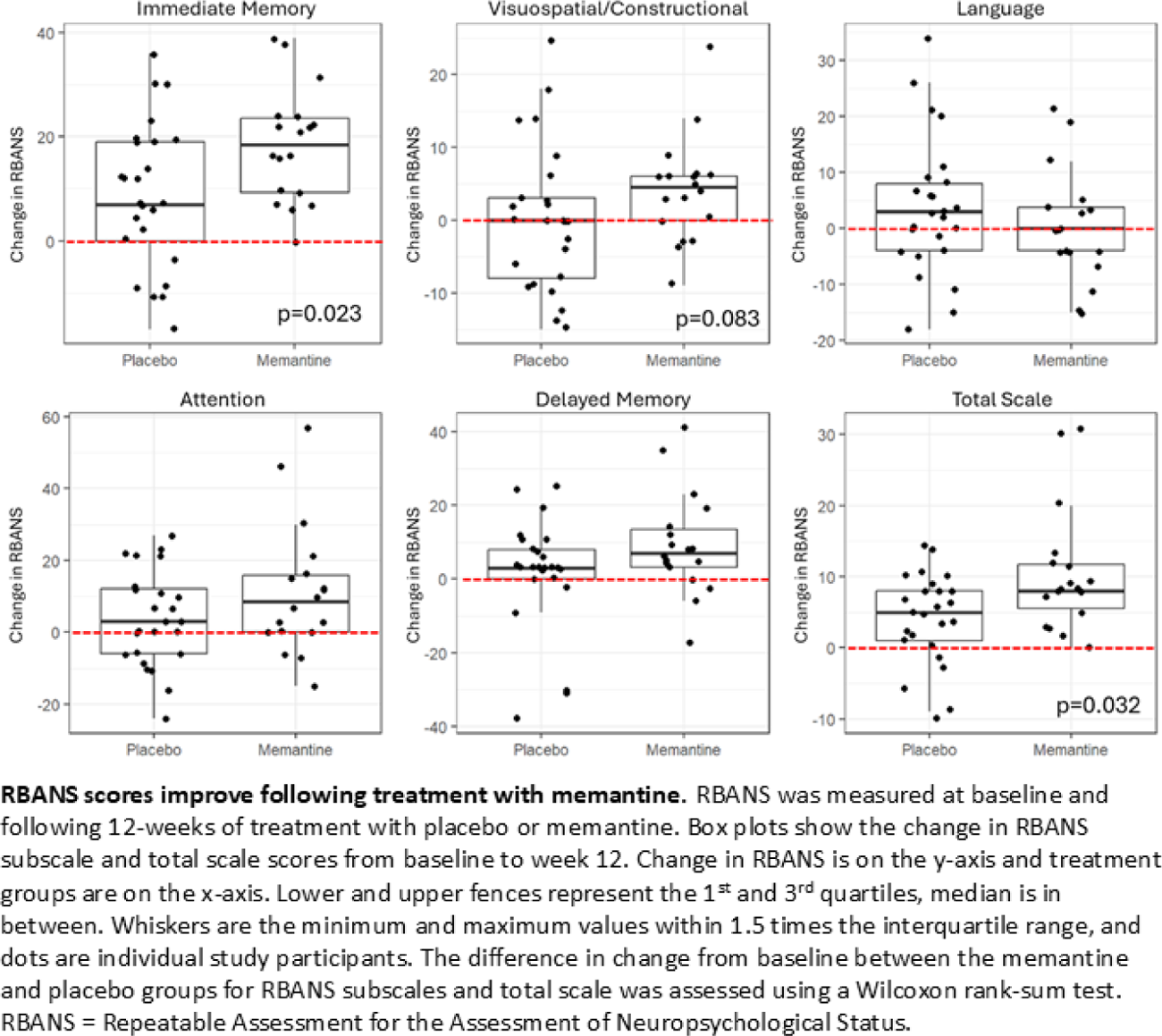
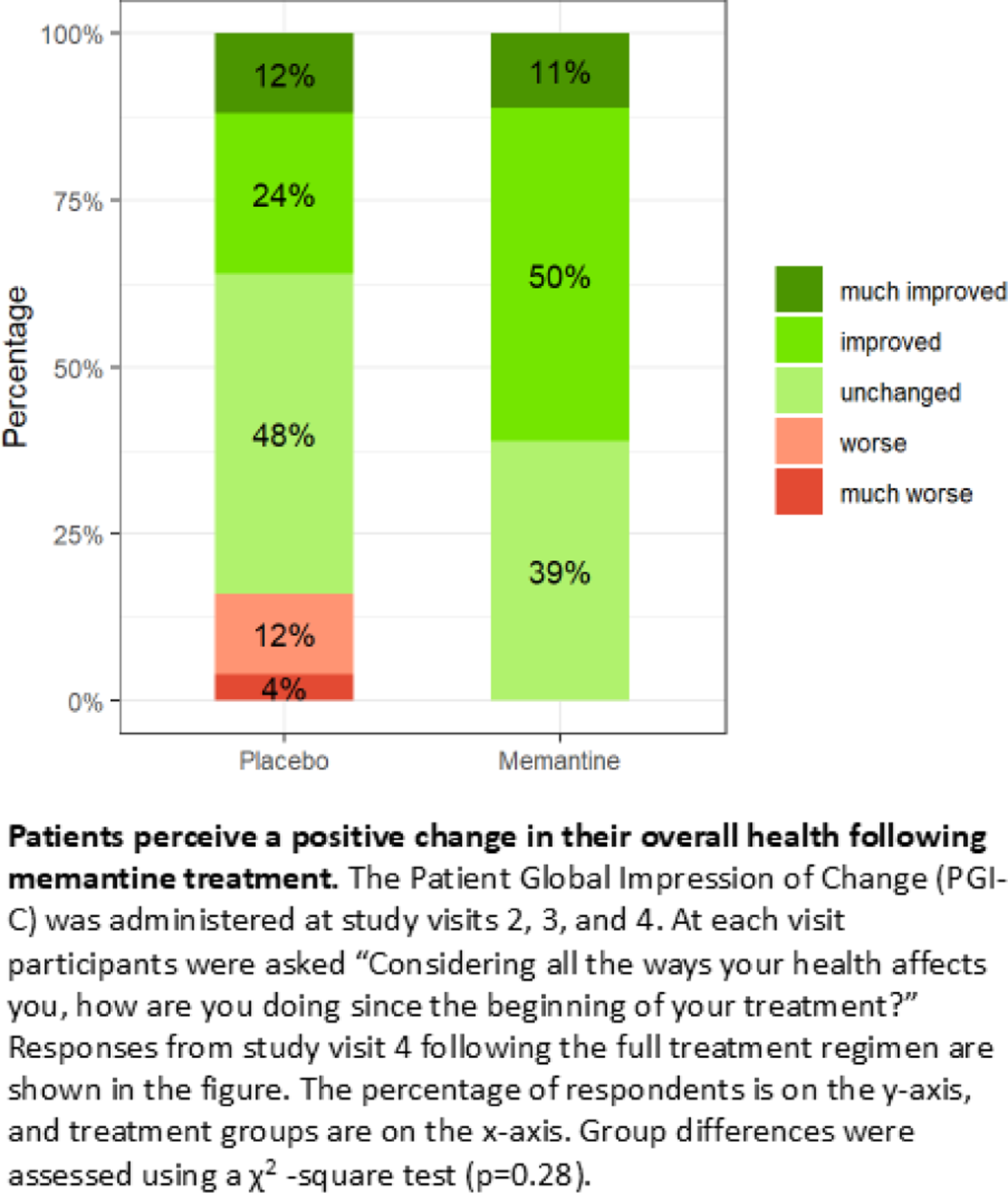
Results: Of the 258 pre-screened and 131 screened, 56 were randomized to either memantine (n=26) or placebo (n=30). Failure to meet the eligibility threshold on the RBANS accounted for 93% of screen failures. In the pre-specified per-protocol analysis, selected to assess biological efficacy following adequate therapeutic exposure, improvement in RBANS Total Scale Index Score was greater with memantine compared to placebo (p=0.032). Responders (MCID +7.5 or 0.5 SD) were higher in the memantine than placebo groups (+8: 67% vs 36%). The median change from baseline in the immediate memory index score was 18.5 (IQR 9, 24) in the memantine group, which represented a significantly greater improvement compared to the change in the placebo group (median 7, IQR 0-19, p=0.023). More participants taking memantine were improved or much improved as measured by PGIC. Eleven (61%) of the 18 participants in the memantine group reported feeling improved or much improved since beginning the study treatment, whereas the majority of participants in the placebo group (64%) reported feeling unchanged, worse, or much worse. There were no significant differences in other outcome measures. Adverse event-related discontinuations were similar (5 vs 5), though total discontinuations were higher in the memantine group (8 vs 5). The most common adverse effects were dizziness/light-headedness. The mean tolerated dose for the placebo group was 37.6mg, and the mean tolerated dose in the memantine group was 32.7mg. Eleven (42.3%) participants in the memantine group tolerated the maximum dose of 40mg/d, compared to 21 participants (70%) in the placebo group.
Conclusions: In SLE, treatment with memantine meaningfully improved objective neuropsychological performance without significant effects on other SLE domains. Fewer participants in the memantine group tolerated the maximum dose.
REFERENCES: [1] Petri M, Naqibuddin M, Sampedro M, Omdal R, Carson KA. Memantine in systemic lupus erythematosus: a randomized, double-blind placebo-controlled trial. Semin Arthritis Rheum . 2011;41(2):194-202. doi:10.1016/j.semarthrit.2011.02.005
Acknowledgments: NIL.
Disclosure of Interests: Leslie Crofford UCB
Otsuka DSMB
Kezar DSMB, Evergreen
Cabaletta Bio, Jillian Rhoads: None declared, Lillian Ahmad: None declared, Jana Shirey-Rice: None declared, Jon Williams: None declared, Narender Annapureddy AstraZeneca
GSK, Emily Littlejohn BMS, BMS, Synthekine, Meera Subash: None declared, Charles Chang Lee Evergreen Therapeutics Inc, James Jackson: None declared.