fetching data ... 
Background: The 2023 European Alliance of Associations for Rheumatology (EULAR) recommendations for the management of systemic lupus erythematosus (SLE) suggest considering gradual immunosuppressive treatment tapering in subjects with long-standing remission. Data regarding Belimumab (BEL) withdrawal in SLE patients with quiescent disease are limited.
Objectives: To evaluate the feasibility and safety of BEL dose spacing and withdrawal in patients with SLE who were in long-standing remission on BEL, primarily the occurrence of SLE flares.
Methods: A multicentre retrospective study was conducted within the Milan Lupus Consortium (SMiLE), involving 4 tertiary rheumatology centres in the Milan area (ASST Gaetano Pini CTO, IRCCS Ospedale San Raffaele, Policlinico di Milano, and Ospedale San Paolo). A shared BEL dose reduction strategy was defined within the Consortium and served as a reference framework for routine clinical practice. Subjects with SLE fulfilling the 2019 EULAR/American College of Rheumatology (ACR) classification criteria and receiving stable BEL treatment for ≥24 consecutive months were eligible. Among these, patients who underwent BEL dose spacing and/or discontinuation during follow-up were identified. The reference step-down strategy consisted of initial spacing to 200 mg subcutaneous (SC) every 10 days (or 10 mg/kg intravenous [IV] every 6 weeks) for 6–12 months. In the absence of disease flares, BEL dose could be progressively tapered every 6–12 months to 200 mg SC every 14 days (or 10 mg/kg IV every 8 weeks), 200 mg SC every 21 days (or 10 mg/kg IV every 12 weeks), 200 mg SC every 28 days (or 10 mg/kg IV every 16 weeks) and eventually discontinued. Deviations from the reference schedule were permitted based on clinical judgement. Demographic and clinical data, including SLE disease activity index 2000 (SLEDAI-2K) and flares, were collected through retrospective chart review. The primary endpoint was the occurrence of SLE flares during follow-up. SLE flares were defined as new or worsening clinical signs or symptoms of active SLE associated with increased disease activity (SLEDAI-2K >4 and the presence of ≥1 British Isles Lupus Assessment Group [BILAG] A or B item) requiring escalation of immunosuppressive therapy. All patients provided written informed consent.
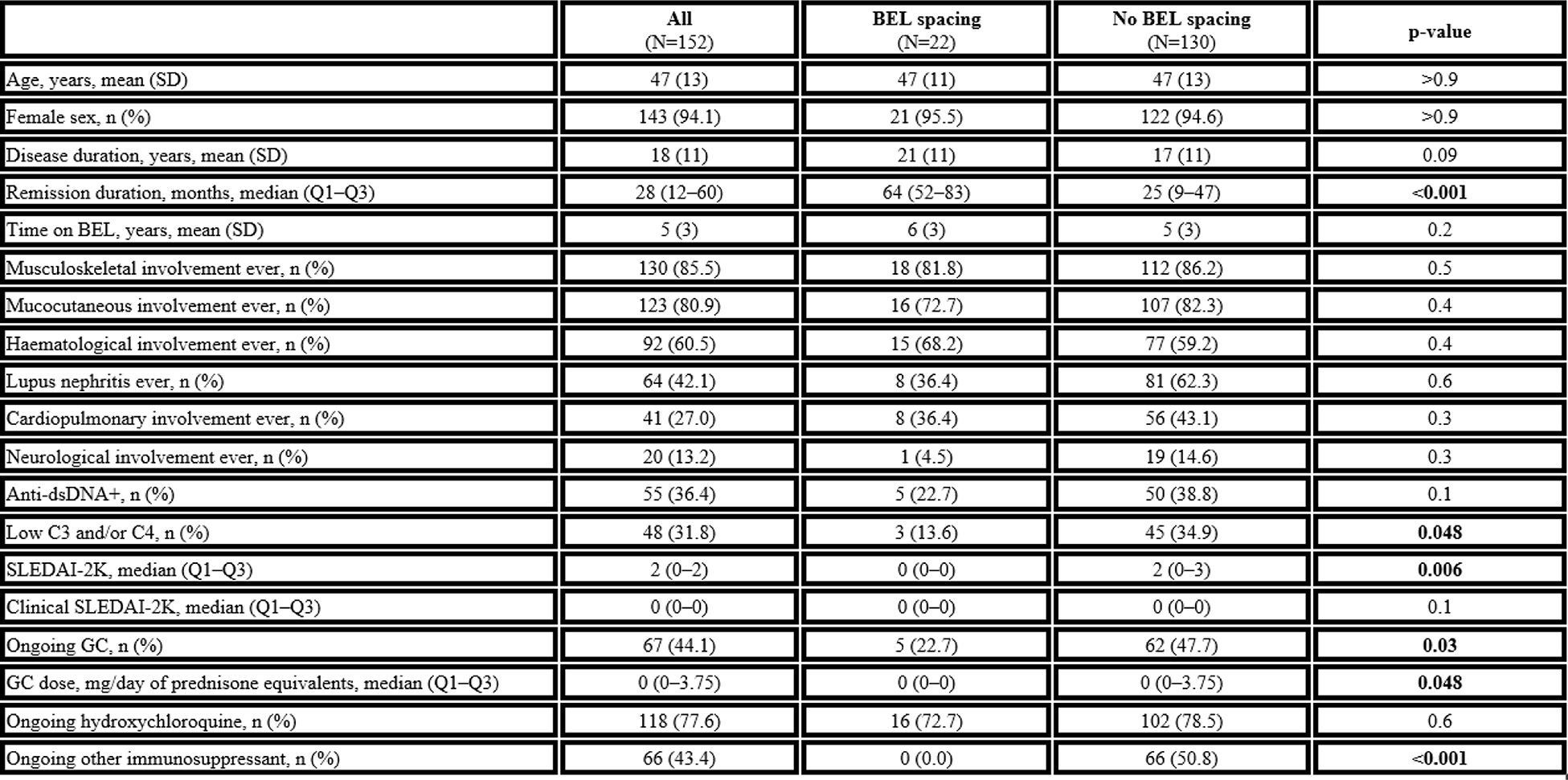
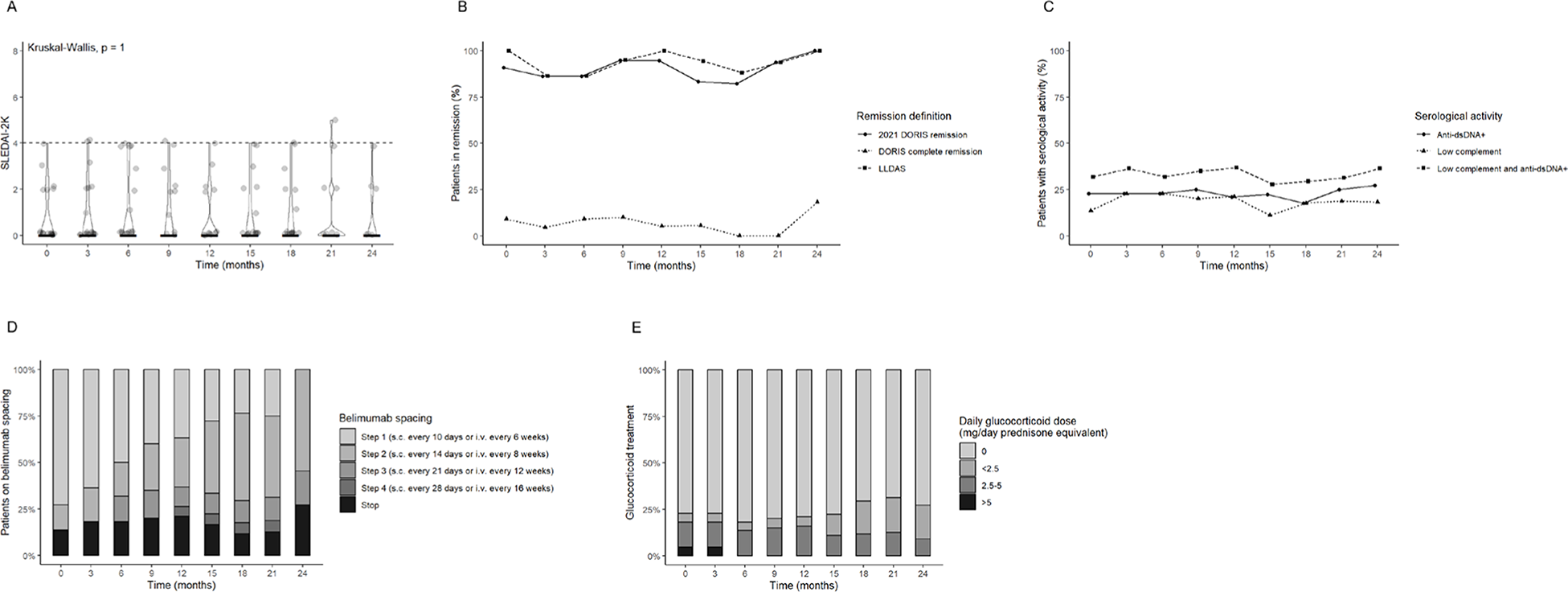
Results: Among 152 SLE patients treated with BEL across the 4 centres, 22 (14.5%) underwent BEL dose spacing. Twenty-one (95.5%) were on SC BEL and 1 (4.5%) on IV BEL. Demographic and clinical characteristics of the whole cohort are summarised in Table 1. Demographics, organ involvement and BEL duration were similar between the spacing and the standard-dose BEL group. Patients undergoing BEL spacing had a longer remission duration compared with those on standard-dose BEL (median [IQR] 64 [52–83] vs 25 [9–47] months, p<0.001), lower frequency of serological activity (low complement and/or positive anti-dsDNA 31.8% vs 54.6%, p=0.048), lower SLEDAI-2K scores (0 [0–0] vs 2 [0–3], p=0.006), and were less frequently treated with glucocorticoids (GC) (22.7% vs 47.7%, p=0.03). Hydroxychloroquine treatment was similar between the two groups (72.7% spacing vs 78.5% standard-dose BEL, p=0.6), whereas concomitant immunosuppressants were more frequent in the standard-dose BEL group (0% spacing vs 50.8% standard-dose BEL, p<0.001). Patients on BEL spacing were observed for 24 (21–24) months. No SLE flares occurred during the follow-up. Disease activity remained stable, with most patients attaining lupus low disease activity state (LLDAS) or 2021 definitions of remission in SLE (DORIS) (Figure 1A,B). Serological fluctuations were observed in a minority of patients without associated clinical flares. One patient who was anti-dsDNA negative at enrolment became anti-dsDNA positive and five patients with normal complement at baseline developed low complement at least once during the observation period (Figure 1C). None of the patients required GC dose escalation or return to a previous BEL dose (Figure 1D,E). Seven patients discontinued BEL due to sustained SLE remission. No severe SLE flares, deaths, or increases in Systemic Lupus Collaborating Clinics/ACR damage index were observed.
Conclusions: Progressive BEL dose spacing and withdrawal, coupled with close clinical monitoring, could be a feasible and safe strategy in selected SLE patients with long-standing remission.
Table 1. Patients’ characteristics at enrolment.
A. SLE disease activity during BEL spacing/discontinuation measured with SLEDAI-2K. B. Percentage of patients fulfilling DORIS complete remission criteria, 2021 DORIS remission, and LLDAS. C. Proportion of patients displaying serological activity. D. BEL dose spacing and discontinuation. E. Daily GC dose (mg/day of prednisone-equivalent).
REFERENCES: NIL.
Acknowledgments: NIL.
Disclosure of Interests: Alice Bartoletti: None declared, Lorenza Maria Argolini: None declared, Giuseppe Alvise Ramirez: None declared, Luca Moroni: None declared, Tommaso Schioppo: None declared, Chiara Bellocchi: None declared, Laura Giudice: None declared, Biancamaria Venerandi: None declared, Annalaura Fasiello: None declared, Lorenzo Beretta: None declared, Lorenzo Dagna: None declared, Roberto F. Caporali AbbVie, Alfasigma, Astra-Zeneca, BMS, GSK, Eli Lilly, Galapagos, Janssen, Novartis, Pfizer and UCB, AbbVie, Alfasigma, Astra-Zeneca, BMS, GSK, Eli Lilly, Galapagos, Janssen, Novartis, Pfizer and UCB, Maria Gerosa: None declared.