fetching data ... 
Background: Sjögren’s disease (SjD) is a systemic, heterogeneous, autoimmune disease with substantial disease burden, high unmet need and no approved systemic treatments. B-cell hyperactivity and dysregulated B cell–activating factor/receptor (BAFF/BAFF-R) signalling are a hallmark of SjD pathogenesis. Ianalumab is a fully human IgG1 mAb with a novel dual mechanism of action that depletes B cells through enhanced antibody-dependent cellular cytotoxicity (ADCC) and also inhibits their activation and survival via BAFF-R blockade.
Objectives: We present results from the two pivotal Phase 3 studies, NEPTUNUS-1 (NCT05350072) and NEPTUNUS-2 (NCT05349214), and the interim results from their extension study (NCT05985915), designed to assess the efficacy and safety of ianalumab in patients with active SjD.
Methods: NEPTUNUS-1 and NEPTUNUS-2 are 52-week, global, multicentre, randomised, double-blind, placebo-controlled studies that enrolled patients with SjD meeting ACR/EULAR 2016 classification criteria with a EULAR Sjögren’s Syndrome Disease Activity Index (ESSDAI) score of ≥5 and stimulated salivary flow rate of ≥0.05 mL/min. Background therapy (HCQ, AZA, MTX and glucocorticoids) was allowed in both studies. In NEPTUNUS-1, patients were randomised (1:1) to monthly (QM) subcutaneous (s.c.) ianalumab 300 mg or placebo (PBO); in NEPTUNUS-2, patients were randomised (1:1:1) to either ianalumab 300 mg QM, ianalumab every 3 months (Q3M) or PBO during the 52-week treatment period. In the extension study, patients who received active treatment in the core studies continued to receive their assigned treatment, while those from the PBO arm were randomised (1:1) to receive either ianalumab 300 mg QM or Q3M for 3 years. Patients received predniso(lo)ne (or equivalent) 50 mg as premedication 1-2 hours prior to the first dose of study treatment. The primary objective of both studies was to demonstrate superiority of ianalumab over placebo in terms of ESSDAI change from baseline at Week 48. ESSDAI domain analyses were conducted using the pooled ianalumab QM datasets. Patient-reported outcomes (PROs) including the Sjögren’s Syndrome Symptom Diary (SSSD) and EULAR Sjogren’s Syndrome Patient Reported Index (ESSPRI) were evaluated from the pooled analysis. The effect of ianalumab on SjD-related biomarkers was also assessed. A post hoc analysis of novel composite endpoints, Composite of Relevant Endpoints for Sjögren’s Syndrome (CRESS) and Sjögren’s Tool for Assessing Response (STAR), was performed by fitting logistic model to assess treatment effect of ianalumab over placebo. Safety was analysed with a cut-off date of May 14, 2025, with a maximum exposure of 137 weeks. Safety data are reported in terms of exposure-adjusted incidence rates (EAIR).
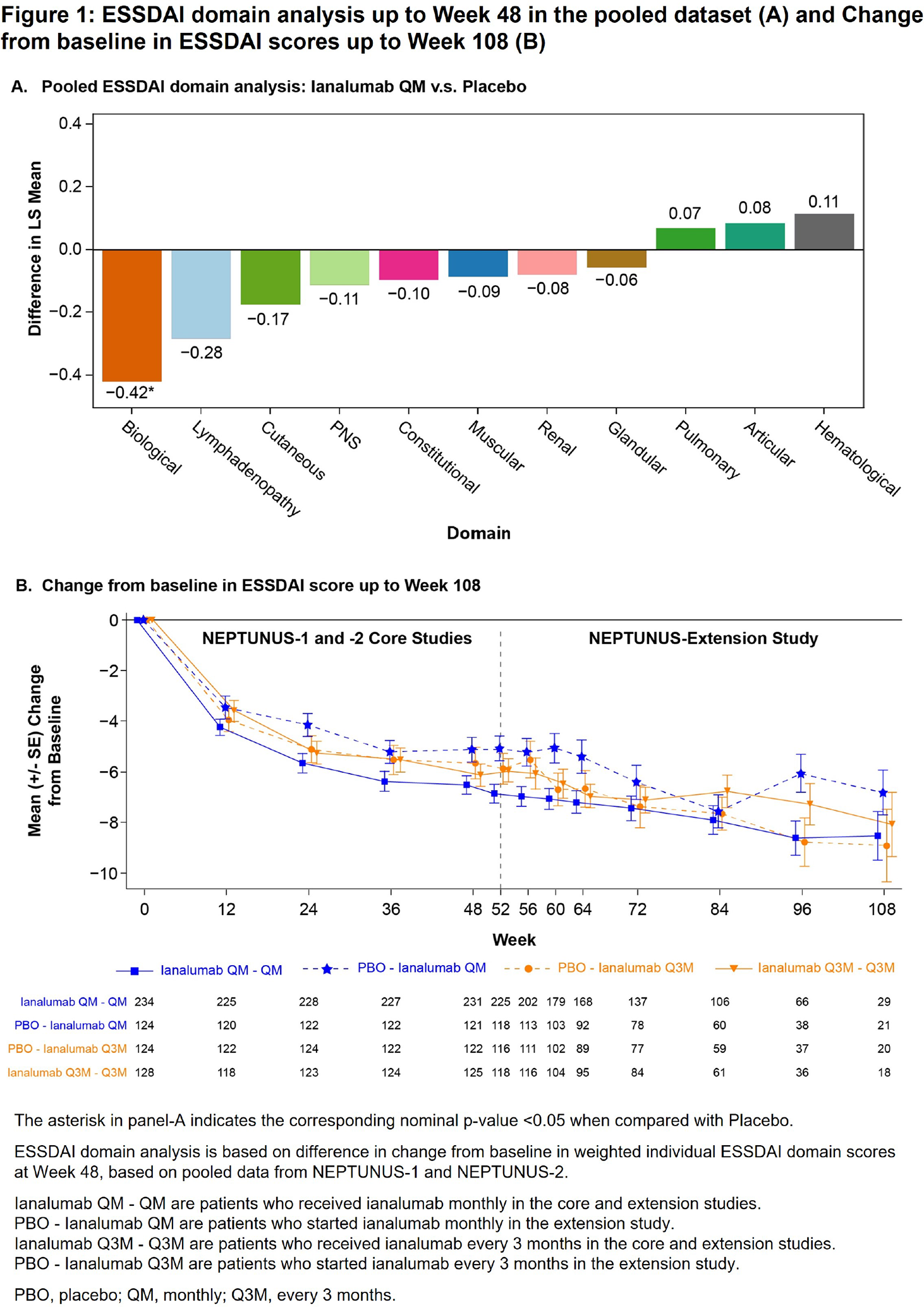
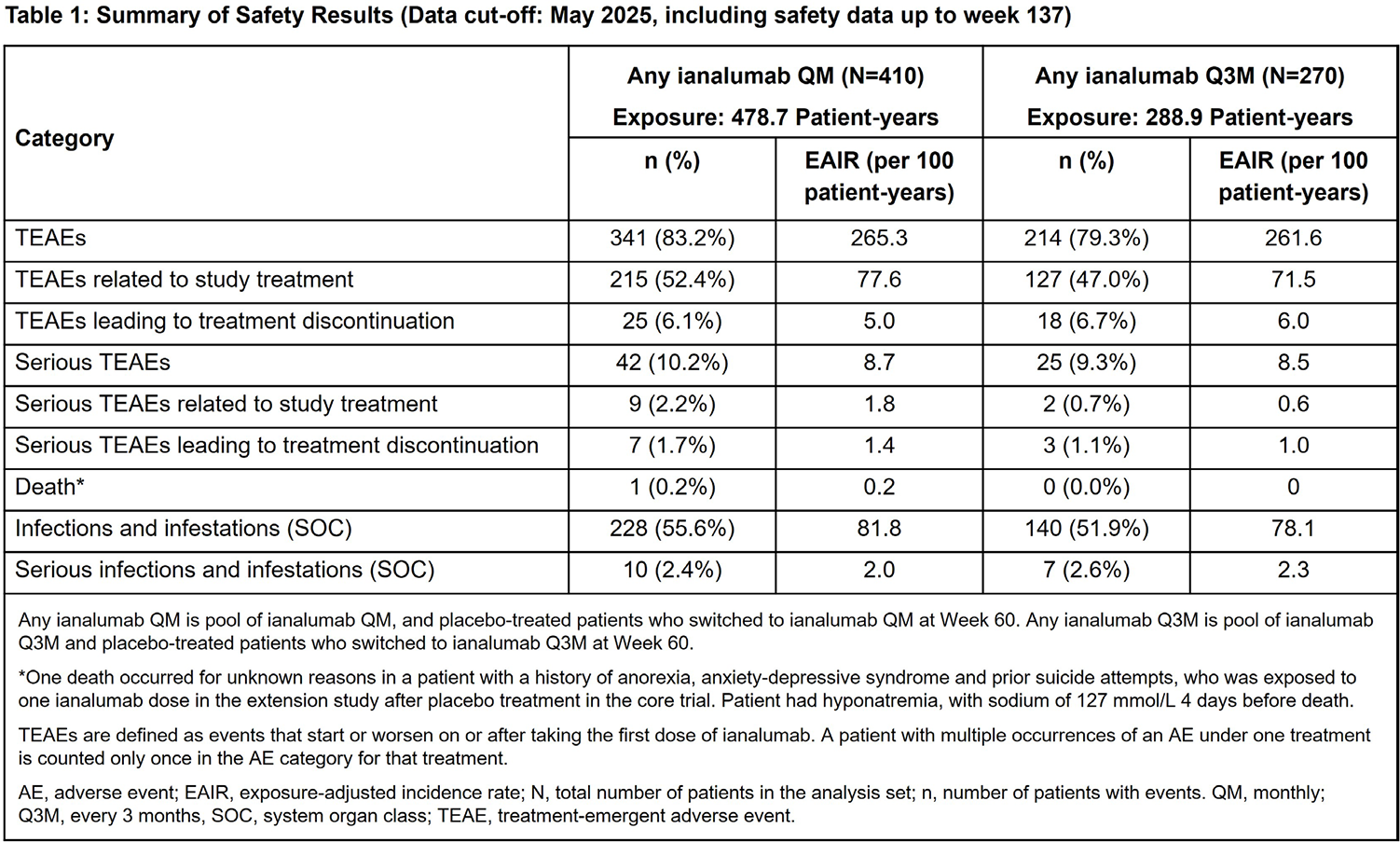
Results: In NEPTUNUS-1, 275 patients and in NEPTUNUS-2, 504 patients were randomised. Both studies met their primary objective. At Week 48, ianalumab QM demonstrated statistically significant improvement in ESSDAI change from baseline compared to PBO in both NEPTUNUS-1 (least squares [LS] mean change from baseline [SE]: −6.4 [0.47] vs −5.1 [0.46]; LS mean difference: −1.3; p=0.0496) and NEPTUNUS-2 (LS mean change from baseline [SE]: −6.5 [0.36] vs −5.5 [0.35]; LS mean difference: −1.0; p=0.0410). Pooled ESSDAI domain analysis showed improvements with ianalumab QM vs PBO across most of the ESSDAI domains ( Figure 1A ). Furthermore, ianalumab QM showed consistent trends towards improvement in the PROs over 48 weeks in the pooled analysis vs PBO. At Week 48, pooled ianalumab QM showed greater reduction in the SSSD score vs PBO (LS mean change from baseline [SE]: −1.5 [0.11] vs −1.3 [0.11]; LS mean difference: −0.23; 95% CI: −0.53 to 0.08]). Pooled ianalumab QM demonstrated similar reductions in ESSPRI vs PBO (LS mean change from baseline [SE]: −1.73 [0.12] vs −1.47 [0.11]; LS mean difference: −0.26; 95% CI: −0.58, 0.05]) at Week 48. In NEPTUNUS-1, ianalumab QM reduced IgG (LS mean difference: −15.99 g/L) and rheumatoid factor (RF; −21.4 IU/mL) vs PBO at Week 48. In NEPTUNUS-2, both ianalumab QM and Q3M showed similar trends for improvements in biomarkers demonstrating reduction in IgG (−16.96 g/L and −14.44 g/L) and RF (−19.6 IU/mL and −16.9 IU/mL) vs PBO at Week 48. The post hoc exploration of novel composite endpoints, including CRESS and STAR variants showed results broadly consistent with the prespecified analysis of NEPTUNUS-1 and 2 trials. Furthermore, in the NEPTUNUS-Extension study, ianalumab QM and Q3M showed further reductions in ESSDAI up to Week 108 (change from baseline, Ianalumab QM–QM: −8.5 and Ianalumab Q3M–Q3M: −8.1, respectively). PBO-treated patients who switched to ianalumab QM and Q3M showed further improvements at Week 108 compared to the end of the core study. Overall, the improvements in ESSDAI from baseline to Week 108 were −6.8 in the PBO–Ianalumab QM and −8.9 in the PBO–Ianalumab Q3M arm ( Figure 1B ). Safety findings including the core trials follow-up period and the extension trial with a cut-off date of May 14, 2025, are summarised in Table 1 and are consistent with data previously presented for the controlled trial period [1].
Conclusions: NEPTUNUS-1 and NEPTUNUS-2 are the first replicate global Phase 3 studies in SjD to meet their primary endpoint, with ianalumab 300 mg QM demonstrating significant and meaningful improvement in ESSDAI disease activity, with clinical domains together contributing more than the biological domain. Ianalumab showed consistent trends for improvements in PROs alongside substantial improvements in SjD-related biomarkers. Ianalumab also showed sustained clinical efficacy up to Week 108 and had a favourable safety profile.
REFERENCES: [1] Grader-Beck T, et al. Abstract Supplement ACR Convergence 2025. Arthritis & Rheumatology 2025;77(S9): Abstract number: LB24.
Acknowledgments: NIL.
Disclosure of Interests: Xavier Mariette Honorarium from BMS, Janssen, GSK, Novartis and Otsuka, Thomas Grader-Beck Consultant and study steering committee member for Novartis, Stephanie Finzel Invited Speaker for: AbbVie, AstraZeneca, Chugai, GSK, Janssen, Novartis, UCB, Advisor for AstraZeneca, GSK, Janssen, Novartis, Novo Nordisk, UCB, Elena Schiopu Clinical Trials Funding: Johnson & Johnson, EMD Serono, Horizon/Amgen, Novartis, Boehringer Ingelheim, Zurabio, Priovant, Zenas, Argenx, SetPoint, Biogene, Galapagos, Athena Papas Advisory Board/ Consultant Novartis, Otsuka, Biogen, Valerie Devauchelle-Pensec Honorarium from Novartis, AbbVie, Lilly, Fresenius Kabi, Thomas Dörner Honoraria and support for clinical studies (paid to the university) by Abelzeta, AbbVie, BMS, Novartis, Roche/Genentech, Monika Sopala Novartis, Novartis Pharma AG, Xiaofeng Zeng: None declared, Ghaith Noaiseh Consulting/Advisory Board: Novartis, Janssen, Amgen, Argenx., Clinical trials funding: Novartis, Janssen, Amgen, BMS, UCB, Pfizer, Tsutomu Takeuchi Received consulting fees from Novartis, Uma Kumar: None declared, Josef Hermann Honorarium as a speaker: Novartis, Hiroki Ozawa: None declared, Robert Fox: None declared, Susan Zong Novartis Pharmaceuticals Corporation, East Hanover, NJ, USA, Deepak Narayanswamy Novartis Healthcare Private Limited, Hyderabad, India, Xiaomei Li: None declared, Wen-Lin Luo Novartis Pharmaceuticals Corporation, East Hanover, NJ, USA, Janice Woznicki Novartis Pharmaceuticals Corporation, East Hanover, NJ, USA, Laurie Debonnett Novartis Pharmaceuticals Corporation, East Hanover, NJ, USA, Xuan Zhu Novartis Pharmaceuticals Corporation, East Hanover, NJ, USA, Linchen He Novartis Pharmaceuticals Corporation, East Hanover, NJ, USA, Franziska Matzkies Novartis, Novartis Pharma AG, Basel, Switzerland, Angelika Jahreis Novartis, Novartis Pharma AG, Basel, Switzerland, Brian Porter Novartis, Novartis Pharmaceuticals Corporation, East Hanover, NJ, USA, Sara S. McCoy Consultant for Novartis, Amgen, tear solutions, Artiva, Janssen, Veloxis, and Otsuka/Visterra, Simon Bowman In the past 3 years: consultancy fees regarding Sjogren’s Disease from: Abbvie, Aera, Amgen, Argenx, Aurinia, Bain, BMS, EcoR1, Forbion, Galapagos, Iqvia, J&J, Kiniksa, Novartis, Scitaris, Wolfgang Hueber Novartis, Novartis Pharma AG, Basel, Switzerland.